10 Best Accessibility Testing Tools to Meet WCAG 2.2
The web has an accessibility problem, and the numbers are hard to ignore. According to the 2024 WebAIM Million report, 95.9% of the top one million home pages have detectable WCAG failures — an average of 56.8 errors per page. The 2025 report showed a marginal improvement to 94.8%, but after six years of measurement the needle has barely moved.
At the same time, the regulatory environment is tightening fast. The ADA Title II deadline of April 24, 2026 requires all state and local government entities with populations of 50,000 or more to conform to WCAG 2.1 Level AA for their websites and mobile apps. Federal penalties can reach $150,000 per violation, and private lawsuits are rising. Even organizations outside government are accelerating their accessibility programs to avoid litigation and — more importantly — to stop excluding users who rely on assistive technology.
The good news: the right tools make WCAG compliance achievable. This article reviews the 10 best accessibility testing tools for meeting WCAG 2.2 in 2026, covering automated scanners, browser extensions, CI/CD integrations, design-phase checkers, and manual testing aids.
Why WCAG 2.2 — and Why Now?
WCAG 2.2, published in October 2023, builds on WCAG 2.1 with nine new success criteria, including:
- Focus Appearance (2.4.11 / 2.4.12) — visible keyboard focus indicators
- Dragging Movements (2.5.7) — alternatives to drag-and-drop
- Target Size (Minimum) (2.5.8) — touch targets at least 24×24 CSS pixels
- Accessible Authentication (3.3.8 / 3.3.9) — no cognitive tests required to log in
While the ADA Title II rule codifies WCAG 2.1, adopting WCAG 2.2 now is the smartest way to future-proof digital products. The tools below support the full spectrum of WCAG 2.0 through 2.2.
The 10 Best Accessibility Testing Tools for WCAG 2.2
1. axe DevTools (Deque Systems)
Best for: Developers who want maximum automated coverage
axe DevTools is the industry-standard accessibility testing engine. The underlying axe-core library has been downloaded more than 3 billion times and powers testing inside Google Lighthouse, Accessibility Insights, and dozens of other tools.
The free browser extension surfaces actionable, zero-false-positive results directly inside Chrome or Edge DevTools. The Pro tier adds Intelligent Guided Tests (IGTs) — AI-assisted workflows that walk non-experts through manual checks, covering issues that pure automation cannot catch. On average, axe-core finds around 57% of WCAG issues automatically, and IGTs push that coverage significantly higher.
Axe-core 4.5 introduced the first WCAG 2.2 rules, including minimum touch target size checks and focus appearance tests. The axe DevTools CLI lets teams scan pages from the command line or integrate into CI/CD pipelines without rewriting end-to-end tests.
Key features: Zero false positives, WCAG 2.0/2.1/2.2 rules, IGTs, CLI, VS Code linter (axe Linter), W3C ACT rule conformance.
Pricing: Free extension; Pro and enterprise plans available.
2. WAVE (WebAIM)
Best for: Visual learners and content editors doing page-level checks
WAVE is a web accessibility evaluation tool developed by WebAIM — the same organization that publishes the annual WebAIM Million report. Its defining feature is in-page visual feedback: WAVE injects icons directly onto the page being tested so you can see exactly where errors, alerts, and structural elements appear in context.
The free browser extension for Chrome, Firefox, and Edge runs entirely in the browser, meaning no data is sent to external servers — making it safe for testing password-protected and staging environments. The panel organizes findings into errors, contrast errors, alerts, features, structural elements, and ARIA usage.
The built-in color contrast checker lets testers pick foreground and background colors to verify 4.5:1 ratios for normal text and 3:1 for large text. A subscription API is available for automated, site-wide scanning.
Key features: Visual overlay feedback, contrast checker, structure visualization, WCAG 2.2 and Section 508 checks, standalone Node.js API.
Pricing: Free browser extension; paid API plans for site-wide scanning.
3. Pa11y
Best for: Engineering teams integrating accessibility into CI/CD
Pa11y (pronounced "pally") is a free, open-source Node.js tool designed for automated accessibility testing in continuous integration environments. Where browser extensions require a human sitting in front of a screen, Pa11y runs headlessly against a list of URLs or a sitemap — making it ideal for catching regressions before they reach production.
The Pa11y ecosystem includes:
- pa11y — the core CLI tool for single-page checks
- pa11y-ci — a CI runner that tests against URL lists and sitemaps
- pa11y-dashboard — a web UI for monitoring accessibility over time
- pa11y-webservice — a JSON API wrapper
Pa11y supports WCAG 2.0, WCAG 2.1, and Section 508 rule sets and outputs reports in JSON, CSV, or HTML. GitLab's CI/CD templates include built-in Pa11y support, and GitHub Actions workflows are straightforward to configure.
Key features: Headless CLI, CI/CD pipeline integration, configurable error thresholds, multiple output formats, open source.
Pricing: Free and open source.
4. Google Lighthouse
Best for: Developers wanting a quick, all-in-one page audit
Google Lighthouse is built directly into Chrome DevTools and requires no installation. It audits five categories in a single run: Performance, Accessibility, Best Practices, SEO, and Progressive Web App criteria.
The accessibility audit is powered by the axe-core engine and produces a weighted score from 0–100. Each failing audit shows the offending HTML elements, explains why the issue matters, and links to remediation guidance. Hovering over a flagged element highlights it on the rendered page — useful for quickly communicating issues to developers.
Lighthouse also generates a "Manual Checks" section listing criteria that automated tools cannot verify, such as logical reading order and video captions. The CLI version enables programmatic auditing and can be embedded in build pipelines.
Key features: No install required, performance + accessibility in one report, element-level highlighting, CLI for automation, mobile and desktop modes.
Pricing: Free (built into Chrome).
5. ANDI (Social Security Administration)
Best for: Government teams and Section 508 compliance testing
ANDI (Accessible Name & Description Inspector) is a free, open-source browser bookmarklet developed by the Social Security Administration. The SSA uses it as its primary manual accessibility testing tool, and it has become a standard for federal agencies and DHS Trusted Tester certification preparation.
ANDI requires no installation — it is a "favelet" activated by a single bookmark click. It self-updates automatically. The tool analyzes the page's HTML and reveals what a screen reader would announce for each interactive element, image, and table.
ANDI's eight specialized modules cover: focusable elements and tab order, graphics and images, data tables, page structure and headings, color contrast, links and buttons, hidden content, and ARIA attributes. The Output display shows the exact accessible name computation a screen reader would use — bridging the gap between code and user experience.
Key features: No install, screen reader output preview, eight testing modules, Section 508 and WCAG 2.1 coverage, government-vetted.
Pricing: Free and open source.
6. Accessibility Insights (Microsoft)
Best for: Teams who want structured, step-by-step WCAG assessments
Accessibility Insights is a free, open-source browser extension from Microsoft for Chrome and Edge. It offers two core workflows: FastPass and Assessment.
FastPass is designed to identify the most common, high-impact issues in under five minutes. It consists of three steps: (1) automated checks powered by axe-core, (2) a Tab Stops test that maps keyboard navigation order across interactive elements, and (3) a needs-review queue for issues requiring human judgment. Microsoft recommends running FastPass before every UI code check-in.
Assessment is a comprehensive, guided walkthrough that covers 100% of WCAG 2.1 AA success criteria through a combination of automated and manual steps. The results export to HTML or JSON and integrate with Azure DevOps and GitHub issue filing.
Key features: FastPass five-minute triage, guided full WCAG assessment, tab stops visualization, Azure DevOps/GitHub integration, export to HTML/JSON.
Pricing: Free and open source.
7. Stark
Best for: Designers catching accessibility issues before development
Stark is an accessibility plugin that runs inside Figma, Sketch, and Adobe XD, shifting accessibility testing left to the design phase. Catching contrast failures in a mockup costs seconds; fixing them after launch costs hours.
Stark's contrast checker analyzes selected elements against WCAG AA (4.5:1 for normal text, 3:1 for large text) and AAA thresholds in real time, drawing from local and remote library colors. The Vision Simulator renders designs through the lens of eight forms of color vision deficiency, blurred vision, and contrast loss — helping designers empathize with impaired users.
Other features include a focus order tool for defining keyboard navigation sequence, alt text guidance, typography legibility feedback, and accessibility annotations for developer handoff that reference ARIA roles, VoiceOver, TalkBack, and other assistive technology labels.
Browser extensions for Chrome, Firefox, and Edge allow Stark to check live web pages as well.
Key features: Design-phase contrast checking, vision simulation, focus order, a11y annotations, WCAG AA/AAA, Figma/Sketch/XD plugins.
Pricing: Free tier (up to 5 projects); Pro at $15/month; Business plans for teams.
8. Tenon.io
Best for: Enterprise teams needing API-first accessibility at scale
Tenon.io takes an API-first approach to accessibility testing, making it a natural fit for large organizations that need to embed accessibility checks into existing development, CMS, and reporting systems. The API accepts a URL or raw HTML and returns a detailed JSON report of accessibility issues against WCAG 2.0, 2.1, and Section 508.
The Reports API exposes 37 different report types, allowing compliance data to flow into dashboards, ticketing systems, and business intelligence tools. Tenon integrates with Jira, GitHub, Drupal, and WordPress out of the box.
Browser plugins for Chrome, Opera, and Firefox are available for on-demand page testing. An enterprise private cloud option supports organizations with strict data residency requirements. Non-profits and educational institutions are eligible for discounts.
Key features: REST API, 37 report types, WCAG 2.0/2.1/Section 508, Jira/GitHub/Drupal integrations, browser plugins, enterprise private cloud.
Pricing: Free tier; Pay-along at $5/month + $0.02/call; plans from $90/month for 3,000 API calls.
9. SortSite (PowerMapper)
Best for: Consultants and auditors running site-wide WCAG sweeps
SortSite by PowerMapper is a desktop and cloud-based website crawler that tests entire sites — not just individual pages — for accessibility, usability, SEO, and broken links in a single crawl. It is used by over 30% of the Fortune 100, including NASA, Disney, and UNICEF, and has led the field in W3C ACT Rules implementation reports since 2019.
SortSite performs over 700 tests covering WCAG 2.0, 2.1, and 2.2, Section 508, and ADA compliance using more than 320 evidence-based rules. Every issue is mapped to the specific page and line of code where it occurs, making reports actionable for large-scale remediation projects.
It can run offline in air-gapped environments — a critical feature for government and regulated-industry clients who cannot send page content to cloud servers. Custom test suites allow auditors to focus on specific standards or organizational requirements.
Key features: Full-site crawling, 700+ tests, WCAG 2.2 support, offline operation, SEO + usability + a11y in one report, Fortune 100 trusted.
Pricing: Free online trial; desktop and cloud subscriptions available.
10. Crosscheck
Best for: QA teams documenting and reporting a11y bugs found during manual testing
Automated tools are powerful, but they catch at most 30–57% of WCAG failures. The rest require human judgment: verifying focus order makes logical sense, confirming that a modal traps keyboard focus correctly, checking that a carousel is operable without a mouse. That manual testing work generates a lot of bugs — and without the right tooling, those bugs get reported inconsistently, lack evidence, and slip through the cracks.
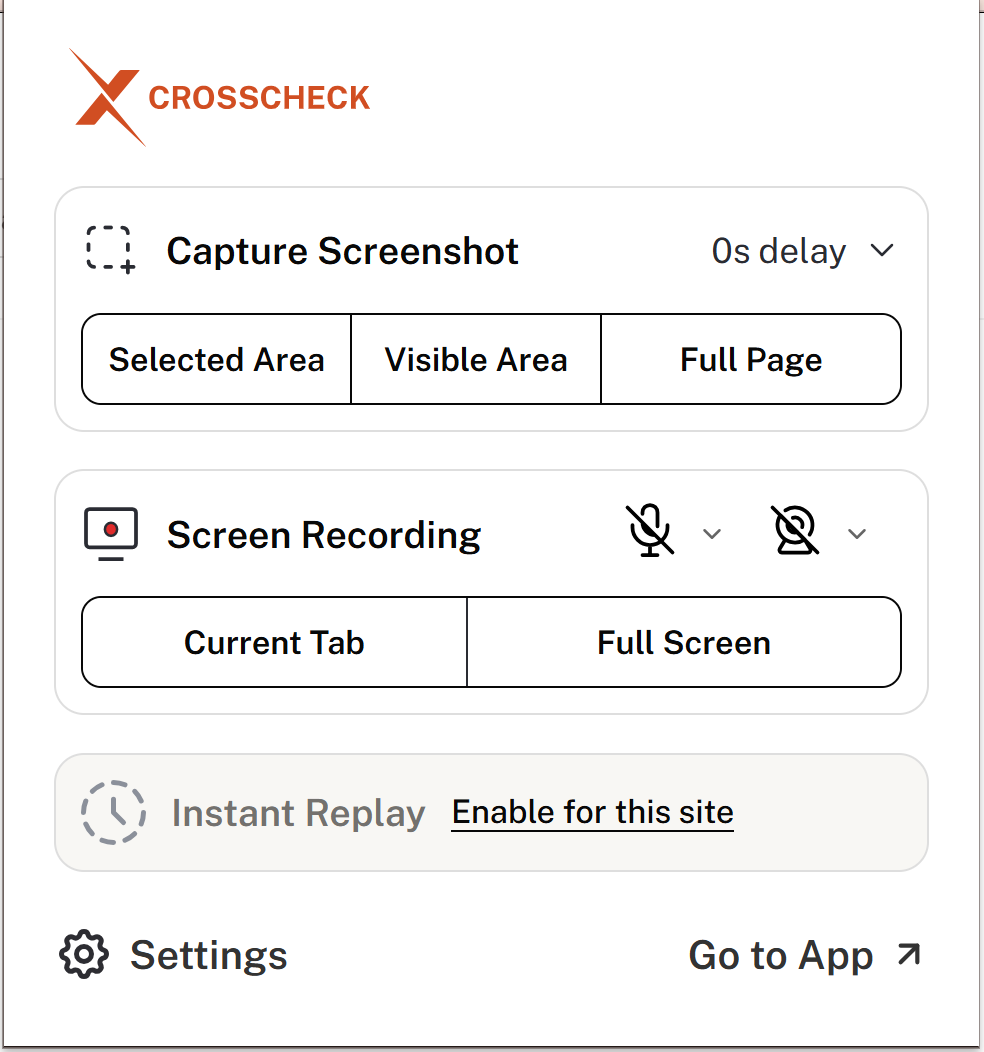
Crosscheck is a Chrome extension built for exactly this moment. When a QA engineer or accessibility auditor identifies an issue during manual testing, Crosscheck captures the full technical context automatically:
- Console logs — catch JavaScript errors that break screen reader announcements
- Network requests — surface failed API calls that silently break accessible names
- User action replay — record the exact steps needed to reproduce a focus trap or skip-nav failure
- Performance metrics — document slow interactions that exceed acceptable response time thresholds for cognitive accessibility
Every bug report is enriched with this evidence and pushed directly to Jira or ClickUp — no manual copy-pasting, no missing reproduction steps. For teams running formal WCAG audits or preparing for ADA Title II compliance, Crosscheck turns manual a11y findings into airtight, developer-ready tickets.
The result: accessibility bugs get fixed faster because developers have everything they need to reproduce and understand the issue without a back-and-forth thread asking for screenshots and steps.
Key features: Auto-capture of console logs, network requests, user actions, and performance metrics; one-click Jira and ClickUp integration; reproducible bug reports for complex a11y issues.
Pricing: Free to try at crosscheck.cloud.
How to Build a Complete Accessibility Testing Workflow
No single tool covers everything. The most effective accessibility programs layer tools across the development lifecycle:
| Phase | Recommended Tools |
|---|---|
| Design | Stark |
| Development (IDE) | axe Linter, Accessibility Insights FastPass |
| Pre-commit / CI/CD | Pa11y CI, Lighthouse CLI, axe DevTools CLI |
| Staging / QA | WAVE, ANDI, axe DevTools, Accessibility Insights Assessment |
| Site-wide audits | SortSite, Tenon.io API |
| Manual bug reporting | Crosscheck |
Best practice is to run automated checks first (they find the easy wins quickly), then supplement with structured manual testing using ANDI or Accessibility Insights Assessment, and finally use real assistive technologies — screen readers like NVDA, JAWS, and VoiceOver — to verify the actual user experience.
The ADA Title II Deadline Is Approaching Fast
If your organization serves state or local government constituents, the April 24, 2026 deadline for WCAG 2.1 AA compliance is weeks away. Non-compliance risks federal penalties up to $150,000 per violation, ongoing litigation exposure, and — most importantly — real harm to constituents who depend on accessible public services.
Even for private sector organizations, accessibility lawsuits under the ADA have been increasing year over year. Proactive testing is far cheaper than reactive remediation after a legal notice.
Start with automated tools to baseline your current state, prioritize the highest-traffic pages and user journeys, and build manual testing into your QA cycle. Then make sure every issue your team finds gets reported completely and fixed efficiently.
Stop Letting Accessibility Bugs Fall Through the Cracks
You've done the audit. Your testers have found real issues. Now comes the hardest part: making sure those issues actually get fixed.
Try Crosscheck for free — the Chrome extension that auto-captures console logs, network requests, user actions, and performance data the moment you find an a11y bug, then files a complete, reproducible ticket directly to Jira or ClickUp. Less chasing developers for context. More time testing.
Accessibility compliance starts with finding issues. It succeeds when those issues get resolved. Crosscheck closes the loop.
 Add to Chrome