10 Best AI-Powered Testing Tools Changing QA in 2026
Software quality assurance has never moved this fast. In 2026, AI is not just a feature you toggle on inside your test suite — it is the foundation the entire QA workflow is built on. Self-healing tests, agentic test generation, autonomous failure triage, and deep IDE integration have all gone from buzzwords to table stakes.
But with a new AI testing tool launching every other week, knowing which platforms actually deliver is harder than ever. This article cuts through the noise. Below are the 10 best AI-powered testing tools in 2026, ranked by their real-world impact on QA teams — what they do well, who they are built for, and why they belong on this list.
The 10 best AI testing tools in 2026 at a glance
- Playwright — Open-source, code-first automation with AI agents via Playwright MCP.
- Testim (Tricentis) — Agentic test automation for enterprise web, mobile, and Salesforce apps.
- Mabl — AI-native, CI/CD-first low-code automation with autonomous failure analysis.
- Applitools — Best-in-class visual regression testing powered by Visual AI.
- Katalon — All-in-one quality platform with dual (rule- and LLM-based) self-healing.
- QA Wolf — Fully managed AI QA service with a zero-flake guarantee.
- Functionize — Enterprise AI agents with near-perfect element recognition.
- Testsigma — Agentic, codeless platform with deep device and browser coverage.
- Sauce Labs — Enterprise-scale cross-browser and real-device mobile cloud.
- Crosscheck — AI-native bug reporting that plugs into Claude, Cursor, and Windsurf via MCP.
Prefer to jump straight to the details? Each tool is broken down below — what it does, who it is for, and its standout 2026 features.
1. Playwright
Best for: Engineering teams that want open-source, code-first test automation with AI assistance
If there is a default for modern end-to-end testing in 2026, it is Playwright. Maintained by Microsoft and fully open source, it drives Chromium, Firefox, and WebKit from a single API — with fast parallel execution, auto-waiting, and a trace viewer that technical teams rely on for debugging.
What earns Playwright the top spot this year is the wave of AI agents built around it. Microsoft's Playwright MCP server lets assistants like Claude, Cursor, and Copilot drive a real browser, generate tests from natural-language goals, and self-correct selectors — turning "describe the flow" into runnable Playwright code. Codegen, healing locators, and agentic authoring now sit on top of the same open spec your team already owns.
Because tests are plain code with zero licensing cost and no vendor lock-in, Playwright scales from a solo developer to enterprise CI without per-seat pricing. For technical teams, it is often the foundation the other tools on this list build on.
Key features: Open source, cross-browser (Chromium/Firefox/WebKit), Playwright MCP for AI agents, codegen and auto-healing locators, trace viewer, parallel execution, CI/CD-native, no vendor lock-in
2. Testim (Tricentis)
Best for: Enterprise teams testing web, mobile, and Salesforce apps
Acquired by Tricentis and now fully integrated into its enterprise testing suite, Testim remains one of the most battle-tested AI testing platforms available. Its ML-based smart locators continuously learn the structure of your application, automatically adapting to UI changes and cutting flaky tests by up to 70%.
In 2026, the standout addition is Agentic Test Automation: describe what you need to test in plain English and Testim's agent workers build the test automatically — no recording, no manual scripting. The Testim Copilot generates custom JavaScript from text descriptions, explains existing code, and flags issues before they ship.
For Salesforce-heavy teams in particular, Testim's agentic capabilities have slashed test authoring time by 50% compared to legacy scripting approaches. Teams using Testim consistently report bug rates falling around 30% after rollout.
Key features: Agentic test creation, ML smart locators, self-healing, Testim Copilot, cross-browser, Salesforce testing, CI/CD integrations
3. Mabl
Best for: DevOps-native teams that want AI-native, low-code test automation
Built by former Google engineers and designed from day one to live inside CI/CD pipelines, Mabl is the clearest example of a truly AI-native testing platform. Its Adaptive Auto-Healing uses multiple AI models — both ML and GenAI — to understand UI changes and autonomously update locators and test steps, reducing test maintenance by 85%.
The platform covers web, mobile, API, and AI app testing from a single interface. In early 2026, Mabl shipped Auto TFA (Autonomous Test Failure Analysis), which triages every test failure and pushes actionable root-cause insights directly into Jira tickets or your IDE. Their Enhanced mabl MCP Server now connects to Jira, X-Ray, and third-party agents, enabling richer agentic workflows without leaving your editor.
With claims of tests generated 10x faster and executed 9x faster, Mabl is trusted by enterprises like Workday, JetBlue, and Vivid Seats.
Key features: Adaptive auto-healing, Auto TFA, MCP server, agentic test creation, unlimited parallel execution, web/mobile/API coverage
4. Applitools
Best for: Teams that need bulletproof visual regression testing at scale
No tool in this list owns a single testing discipline quite like Applitools owns visual testing. Its Visual AI engine — trained on over 4 billion app screens across a decade — replicates the human eye to catch visual regressions that functional tests miss entirely. Dynamic content like ads, date stamps, and personalized dashboards is handled intelligently, dramatically reducing false positives.
Applitools Autonomous, its next-generation offering, extends the platform beyond visuals into full functional and API test automation, with NLP-based test authoring and smart test generation. The Ultrafast Grid captures DOM snapshots and validates them across hundreds of browser-device combinations in parallel — saving hours of cross-browser regression time.
Applitools was named a Strong Performer in the Forrester Wave: Autonomous Testing Platforms, Q4 2025. It carries a 4.6/5 on Capterra and integrates cleanly with Selenium, Cypress, Appium, and all major CI/CD platforms.
Key features: Visual AI, Applitools Autonomous, Ultrafast Grid, self-healing, accessibility testing, NLP test authoring, CI/CD integrations
5. Katalon
Best for: Mixed technical teams wanting an all-in-one quality management platform
Katalon has evolved from a test automation tool into a full AI-augmented quality management platform covering web, mobile, API, and desktop testing. What sets it apart in 2026 is its dual self-healing engine: rule-based healing handles simple locator shifts, and an LLM-backed AI self-healing engine kicks in for complex page structure changes — using accessibility tree context to recover the element without human intervention.
The February 2026 product release added TestCloud integration directly into the Platform MCP, so users connected via StudioAssist can access cloud test execution features without switching context. The Rerun Failed Tests Only feature means teams validate bug fixes without rerunning entire regression suites, and Live Video Streaming for TestCloud executions lets engineers debug issues in real time.
With users in 160+ countries and recognition from Gartner and Capterra, Katalon is especially strong for teams that need AI assistance without sacrificing flexibility.
Key features: Dual self-healing, NLP test generation, AI visual testing, LLM-backed locators, TestCloud MCP integration, live video streaming, flaky test detection
6. QA Wolf
Best for: Engineering teams that want zero involvement in test creation or maintenance
QA Wolf is not a tool you configure — it is a managed AI QA service that handles everything. Their agentic platform generates production-grade Playwright and Appium code from natural language prompts, with specialized agents covering workflow mapping, test code generation, and ongoing maintenance. You describe what needs testing; QA Wolf ships the tests.
The Zero-Flake Guarantee is the headline: AI and human QA engineers review every failure before it reaches your engineers, eliminating false positives entirely. Tests are written in open-source Playwright and Appium code that your team owns outright — no vendor lock-in. Parallel infrastructure means 100% of your test suite runs simultaneously, with no additional cost per run.
QA Wolf customers report 92% faster releases, 90% fewer post-release hotfixes, and 85% revenue impact improvement. The tradeoff is cost — at a median annual contract of $90,000 — and a slight dependency on QA Wolf's team capacity for new test requests.
Key features: Managed QA service, AI + human hybrid model, Playwright/Appium code output, zero-flake guarantee, parallel execution, no vendor lock-in
7. Functionize
Best for: Enterprise QA teams prioritizing maximum AI accuracy and minimal maintenance
Functionize calls itself the first AI-native testing platform powered by specialized agents, and its accuracy numbers back that claim up. Eight years of enterprise training across 30,000+ data points per page gives its AI 99.97% element recognition accuracy, cutting flaky tests and maintenance overhead by 80%.
Its EAI (Enterprise AI) Agents learn from real user behavior via a JavaScript Tag, autonomously updating workflows when systems change and notifying teams of what shifted. NLP test creation means non-technical users can write tests in plain English and deploy them up to 90% faster than traditional scripting. The Root Cause Analysis engine identifies the most probable failure cause even when it surfaces many steps after the actual issue.
Real-world results include GE Healthcare reducing 40 hours of testing to 4 hours — a 90% labor saving — and global payment teams validating 40 countries and 30+ payment methods daily. Functionize skews enterprise, and its pricing reflects that.
Key features: 99.97% element recognition, EAI Agents, self-healing, NLP test creation, visual testing with computer vision, root cause analysis, parallel execution
8. Testsigma
Best for: Teams wanting an agentic, codeless platform with deep device coverage
Testsigma's architecture in 2026 is built around five specialized AI agents — Generator, Runner, Optimizer, Analyzer, and Healer — each owning a specific stage of the test lifecycle. The Generator creates test cases from Jira tickets, Figma designs, live app URLs, or plain English. The Optimizer identifies redundant tests, flags coverage gaps, and prioritizes by risk and change frequency. The Healer auto-fixes broken locators when UI changes, with users reporting 90% less maintenance after switching.
Testsigma Copilot (called Atto) acts as an AI coworker that accepts multiple inputs and lets you refine tests through natural conversation — similar to a coding assistant but purpose-built for QA. The platform covers web (800+ browser/OS combos), mobile (2,000+ real devices), desktop, Salesforce, APIs, and databases, all from a single unified interface.
Enterprise customers include Nestlé, KFC, DHL, Samsung, and Cisco. The 30+ native integrations include a two-way Jira connection: failed tests auto-create Jira bugs with screenshots attached, and resolved bugs can trigger test reruns.
Key features: Five AI agents (Generator, Runner, Optimizer, Analyzer, Healer), Testsigma Copilot/Atto, 2,000+ real devices, two-way Jira integration, NLP test creation, accessibility testing
9. Sauce Labs
Best for: Enterprises running large-scale cross-browser and mobile testing
With 8 billion+ test executions under its belt and customers including Walmart, Bank of America, and Indeed, Sauce Labs is the infrastructure backbone for enterprise testing. In 2026, AI has moved from a feature to a first-class citizen across the platform.
Sauce AI Agents auto-generate, execute, debug, and autonomously update tests, delivering reported gains of 38% more developer productivity, 75% fewer critical issues, and 46% higher ship frequency. The headline 2026 launch is the Real Device Access API — the industry's first programmable mobile device cloud. Engineers allocate devices in seconds via HTTP requests, stream live video for Computer Vision workloads, issue ADB and xcrun-style commands, and maintain sessions up to 24 hours. Early adopters reclaimed up to 40% of device time previously lost to setup-teardown cycles.
The MCP-Ready architecture of the Real Device Access API is explicitly designed for AI-driven testing agents that interact with devices as native tools — making Sauce Labs a key piece of agentic mobile testing pipelines.
Key features: Sauce AI Agents, Real Device Access API, MCP-ready infrastructure, AI-powered failure analysis, cross-browser cloud, live video streaming, enterprise-scale parallel execution
10. Crosscheck
Best for: QA engineers and developers who want AI-native bug reporting inside Claude, Cursor, or Windsurf
Every tool above solves part of the QA puzzle. Crosscheck solves the part nobody talks about: getting rich, actionable bug data out of the browser and into the AI tools where developers actually work.
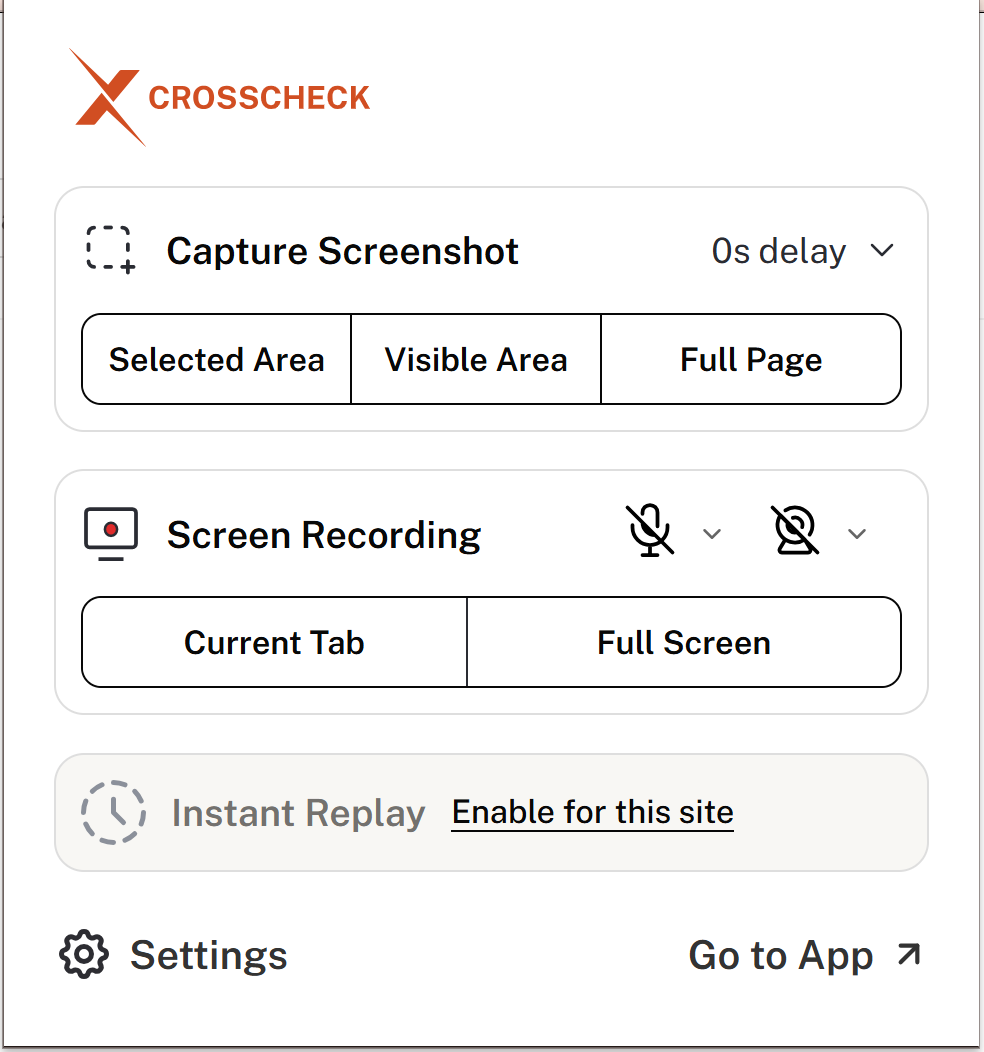
Crosscheck is a Chrome extension built for QA and bug reporting that automatically captures console logs, network requests, user action replays, and performance metrics the moment you encounter an issue. No manual copying. No missing context. No reproduction steps written from memory.
What makes Crosscheck unique in 2026 is its AI-powered MCP (Model Context Protocol) integration. When a bug is found, Crosscheck packages the full diagnostic payload — console errors, failed network calls, performance traces, and the exact sequence of user actions — and exposes it directly to AI coding assistants like Claude, Cursor, and Windsurf via MCP. Developers get a complete picture of what went wrong without leaving their editor. The AI can reason over real browser data, suggest fixes, and even generate reproduction test cases — all grounded in what actually happened in the browser.
For teams using Jira or ClickUp, Crosscheck auto-populates bug tickets with the captured data, eliminating the back-and-forth between QA and engineering over missing context. Reproduction steps, logs, and network traces arrive with the ticket — not three Slack messages later.
In a QA landscape where every tool promises to eliminate manual work, Crosscheck eliminates the most painful manual step of all: explaining a bug to a developer. With MCP, you hand the AI everything it needs to understand and fix the issue on its own.
Key features: Auto-capture of console logs, network requests, user actions, and performance metrics; AI-powered MCP integration for Claude, Cursor, and Windsurf; Jira and ClickUp integrations; one-click bug reporting with full diagnostic context
How to Choose the Right AI Testing Tool for Your Team
No single tool wins across every team and workflow. Here is a quick decision framework:
- You need visual regression coverage at scale → Applitools
- You want a fully managed QA service with zero internal effort → QA Wolf
- You want open-source, code-first automation with AI assistance → Playwright
- You are testing mobile apps at enterprise scale → Sauce Labs
- You want a codeless platform with deep device and browser coverage → Testsigma
- You need agentic testing with strong Salesforce support → Testim
- You want AI-native CI/CD-ready automation → Mabl
- You need an all-in-one platform for mixed technical teams → Katalon
- You want maximum AI accuracy with enterprise-grade agents → Functionize
- You want AI-powered bug reporting that plugs into Claude, Cursor, or Windsurf → Crosscheck
The Bottom Line
AI has not replaced QA engineers — it has freed them from the grind of writing locators, maintaining brittle tests, and manually writing reproduction steps for every bug. The best AI testing tools in 2026 handle the repetitive work so your team can focus on what actually matters: finding the issues that would have slipped through.
The tools above represent the strongest options across every layer of the QA stack, from visual regression to code review to infrastructure. Start with the layer that hurts most.
FAQ
What is the best AI testing tool in 2026?
There is no single winner — it depends on your stack. For open-source, code-first automation with AI agents, Playwright leads; for visual regression, Applitools; for a fully managed service, QA Wolf; for enterprise mobile testing, Sauce Labs; and for AI-native bug reporting that plugs into Claude, Cursor, and Windsurf, Crosscheck.
Can AI replace QA engineers?
No. AI removes the repetitive work — writing locators, maintaining brittle tests, and drafting reproduction steps — but humans still decide what to test and which risks matter. The strongest 2026 workflows keep a human in the loop.
What is MCP in AI testing?
MCP (Model Context Protocol) lets a tool expose real data — console logs, network requests, and user actions — directly to AI assistants like Claude, Cursor, and Windsurf, so the AI can reason over what actually happened in the browser. Crosscheck uses MCP to hand developers a complete, fixable bug report.
Which AI testing tool is best for visual regression?
Applitools. Its Visual AI engine, trained on billions of app screens, catches visual bugs that functional tests miss while intelligently ignoring dynamic content to keep false positives low.
Are AI testing tools worth it?
For most teams, yes. Self-healing locators and autonomous failure triage cut test-maintenance overhead dramatically — vendors report 70–85% reductions — freeing QA to focus on real risks instead of brittle scripts.
Try Crosscheck Free
If your team is still manually copying console errors into Jira tickets or writing reproduction steps from memory, Crosscheck eliminates that workflow entirely.
Install the Crosscheck Chrome extension and start capturing console logs, network requests, user actions, and performance data automatically — then send it straight to Jira, ClickUp, or your AI coding assistant via MCP. Your developers get everything they need to understand and fix a bug without a single follow-up message.
Try Crosscheck free at crosscheck.cloud — and see how much faster QA moves when your bug reports arrive with full context built in.
 Add to Chrome