QA Tools for Remote Teams: The 2026 Async-First Stack
The best QA tools for remote teams in 2026 share one trait — they all produce something a teammate in another time zone can act on without a meeting. A bug report that carries the console log. A video that replaces the standup. A Linear issue that links to the failed build. A Maze test that ran while everyone slept. Async-friendly is no longer a nice-to-have — it is the qualifier. Tools that demand live coordination drop off the list, no matter how powerful they look in a demo.
This guide is a working remote QA stack — ten tools chosen because they keep producing useful artifacts when the team is offline. Pricing, integrations, and the gotcha that matters are all called out where relevant.
TL;DR — the async QA stack at a glance
- Async bug capture: Crosscheck (free Chrome extension, auto-captures logs and a network trace into Jira/Linear/ClickUp/GitHub)
- Video walkthroughs: Loom (the de facto async-video tool; integrates with most issue trackers)
- Issue tracking + docs: Linear or Jira for engineering, Notion as the cross-functional context layer
- Pair programming when it is truly needed: Tuple (purpose-built for developers, end-to-end encrypted)
- Lightweight sync moments: Slack huddles (drop in, drop out, never on a calendar)
- Unmoderated user research: Maze for design-led teams, UserTesting for enterprise panels
- API testing: Postman, runnable in CI via Newman
- Cross-browser coverage: BrowserStack with shareable session recordings
A team running this stack tends to compress the bug-to-fix loop dramatically because no step requires both parties to be online.
Why "async-friendly" became the only QA criterion that matters
Remote work is no longer a phase — roughly 52% of the global workforce now engages in some form of remote work per the 2026 State of Remote Work index, and engineering remains the largest single category of fully remote roles. For QA specifically, the bottleneck has shifted. Test execution speed has roughly 5x'd since 2020 thanks to parallel cloud runners and AI-assisted test generation, but bug-to-fix cycle time has barely moved — most of that cycle is spent waiting for a developer to come online, ask for clarification, and wait for the tester to come back online.
The picks below are filtered on exactly one question: does the artifact this tool produces stand on its own when the recipient opens it eight hours later?
1. Crosscheck — async bug capture with full technical context
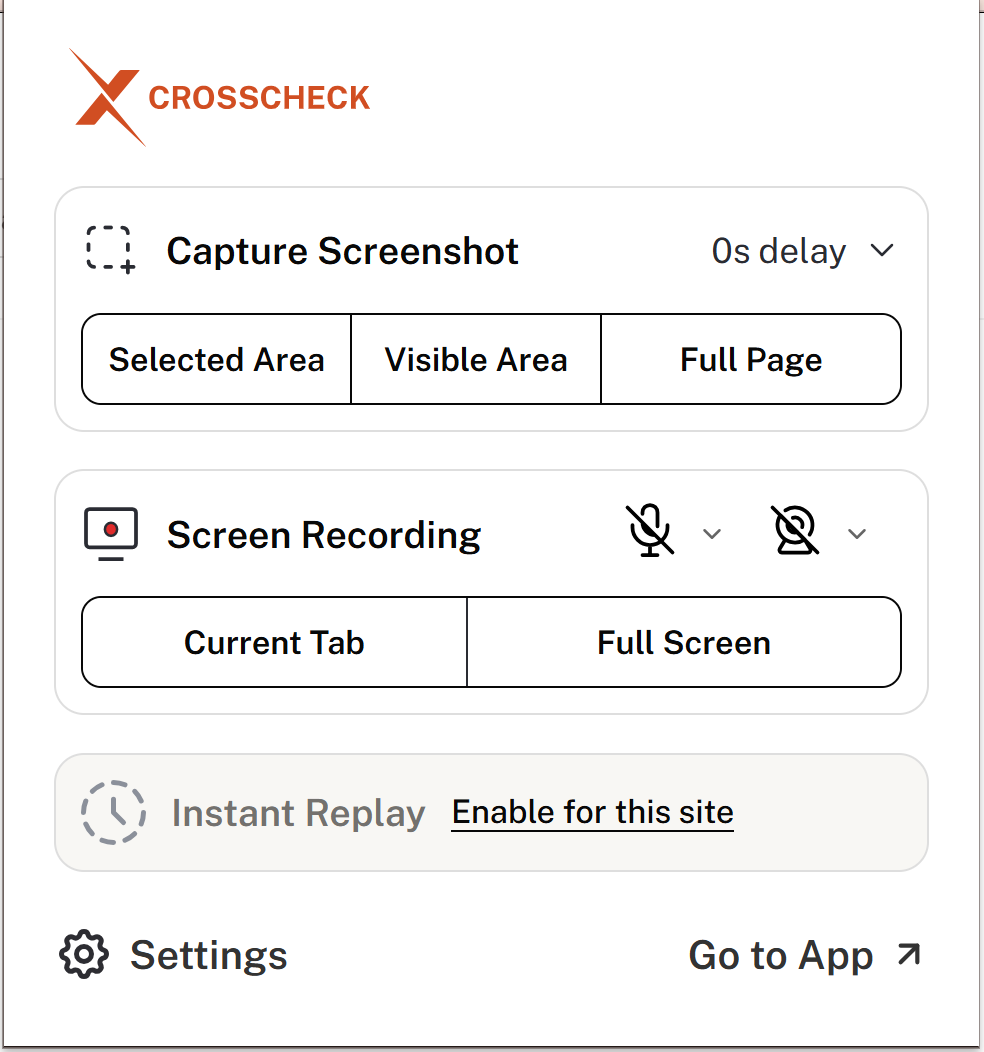
Crosscheck is a free Chrome extension built specifically to remove the back-and-forth that follows most remote bug reports. When a tester finds something broken, Crosscheck auto-attaches the console log, network trace, the user's recent actions, browser and OS metadata, viewport size, and a screenshot or screen recording — then pushes the whole report into Jira, Linear, ClickUp, GitHub, or Slack with one click.
The asymmetry it fixes is real. A manual bug report — screenshot plus a paragraph — costs the tester two minutes and costs the developer another fifteen to thirty minutes trying to reproduce it. Crosscheck inverts that ratio. The tester captures once. The developer opens the issue and already has everything they would have asked for.
Two features in particular earn it the top spot for distributed teams. The first is always-on background capture — a rolling buffer so a tester can hit record after a weird flash error happens and still attach the previous moments. Intermittent bugs stop being unreportable. The second is the Actions Panel — a chronological log of every click, scroll, input, and navigation leading up to the report. A developer in Lisbon can open a bug filed at midnight in Manila and reproduce it without sending a single follow-up message.
Crosscheck is the only entry on this list that is genuinely free with no usage limits or paid tier.
Best for: Anyone — QA, dev, PM, designer, support — filing bugs across time zones. Pricing: Free.
2. Loom — the async video layer for everything sync used to handle
Loom replaced "can we hop on a call?" for most remote engineering teams, and in 2026 it is effectively the default async-video tool. For QA, it covers the ground between a written bug report and a full pair-debug session — a quick walkthrough of a confusing reproduction step, a demo of a fix, an async sprint retro that latecomers watch on their own time.
The 2026 Loom AI features are the part that genuinely changed how teams use it. Auto-generated chapters, summaries, and action items mean a 12-minute walkthrough comes with a 30-second summary at the top. Filler-word removal and 50+ language transcription handle the multilingual case that bites larger distributed teams.
It is not a bug-reporting tool in the Crosscheck sense — no console log, no network trace, no Actions Panel. But for explaining context that a static bug report cannot carry — design intent, the why behind a deprecation, a verbal walkthrough of a regression suite — Loom remains unmatched. Since the Atlassian acquisition, reliability has slipped in places, and several teams now keep ClickUp Clips or ScreenPal as a fallback.
Best for: Async sprint reviews, design handoffs, complex bug walkthroughs, recorded retros. Pricing: Free tier capped at 5-minute recordings; Business at $12.50/user/mo; Business + AI from roughly $20/user/mo.
3. Linear — async-native issue tracking for engineering
Linear is what happens when an issue tracker is designed for the way distributed engineers actually work in 2026. Keyboard-first, sub-second loads, and a sync engine that means every teammate sees the same state without anyone hitting refresh. For async QA flows, the features that matter are Cycles (which auto-roll incomplete issues and surface scope creep without a meeting), Linear Asks (request info from a teammate without creating formal tickets), and the GraphQL API that integrates cleanly with CI and Crosscheck's push.
Linear is opinionated — a strength for engineering-only orgs, a weakness for cross-functional ones. Non-technical stakeholders frequently find it intimidating, so distributed teams often pair Linear (for engineering) with Notion (for everyone else).
The trade-off against Jira is scale and compliance. Issue creation drops from roughly four minutes in Jira to about one minute in Linear in documented 2026 migration case studies, but Jira still wins for >500-seat regulated environments. In one 2026 survey of distributed engineers, 52% named Linear as their preferred issue tracker.
Best for: Engineering-led distributed teams shipping fast cycles. Pricing: Free for up to 10 users and 250 issues; Standard at $8/user/mo; Business at $14/user/mo.
4. Jira — the central hub when the org is big enough to need one
Jira remains the central project hub for most mid-to-large distributed teams, and the reason is not nostalgia. It is the integration breadth — Crosscheck, Loom, BrowserStack, Postman, TestRail, Xray, every major CI tool, and most observability platforms push into Jira out of the box. For a large remote team where QA, engineering, support, and compliance all need to see the same ticket, Jira is the lowest-friction common denominator.
Where Jira earns its place on an async stack is the depth of its issue history. Every comment, status change, attachment, and linked PR is preserved with timestamps — exactly the audit trail a distributed team needs when nobody can tap a teammate on the shoulder. Jira Automation handles the routine handoffs so work moves without manual nudging.
Best for: Large, regulated, or cross-functional distributed teams that need extensive integrations and audit trails. Pricing: Free up to 10 users; Standard at roughly $7.16/user/mo; Premium at roughly $12.48/user/mo.
5. Notion — the cross-functional context layer
Notion is not a test-management tool, but in 2026 it sits on every working remote QA stack as the context layer — where the test strategy lives, where the release playbook lives, where the running list of known flaky tests lives. The point is not that Notion is the best wiki ever built. The point is that one searchable surface holds the institutional knowledge a distributed team would otherwise scatter across DMs.
The patterns that matter for async QA: a per-release test-plan database the QA lead populates and engineers review on their own time; an embedded Loom walkthrough on every feature page; and a "QA known issues" database that links each entry to the live Jira or Linear ticket. Notion's 2026 AI features — auto-summarising long bug threads, drafting test cases from a PRD — have matured enough to be genuinely useful here.
Best for: Distributed teams that need one searchable home for test strategy and cross-functional context. Pricing: Free for personal use; Plus at $10/user/mo; Business at $18/user/mo.
6. Tuple — pair programming when sync is genuinely the right call
Tuple is on this list precisely because async has limits. There are debugging sessions where two engineers and one screen save a day of back-and-forth, and when that moment comes generic screen-sharing tools fall apart. Tuple was built for it — up to 5K shared resolution, low-latency remote control, end-to-end encryption, and one-click driver swap.
The honest framing is that a good async stack reduces the number of moments where Tuple is needed, not zero them. Pair programming is still the right tool for a gnarly race condition, a complex refactor, or onboarding into a hairy module. CodeTogether, Drovio, and VS Code Live Share serve adjacent cases; Tuple remains the cleanest experience for a pure macOS/Windows dev-to-dev session.
Best for: Engineering pairs solving hard bugs together when a Loom would not be enough. Pricing: From $25/user/mo on annual billing.
7. Slack huddles — drop-in voice without the calendar overhead
Slack earns its place for two reasons. First, it is the communication backbone — CI failures get posted, Crosscheck reports get cross-shared, Jira notifications land. Second, huddles have quietly replaced the bulk of scheduled standups on async-mature teams. A huddle is a calendar-free voice room inside a channel — teammates join because they are online, leave when done, the next person joins later. The half-hour scheduled call for a five-minute question disappears.
The QA channel becomes a real-time digest of product quality state — Crosscheck reports, CI results, on-call pages — scrollable for anyone who comes online later.
Best for: Real-time-but-not-scheduled QA communication and pipeline alerts. Pricing: Free for limited history; Pro at $7.25/user/mo; Business+ at $12.50/user/mo.
8. Maze — unmoderated user research while the team sleeps
Maze earns its place because usability bugs are still bugs. Where Crosscheck catches the broken state and Playwright catches the failed assertion, Maze catches the moment a user cannot find the button. Researchers build a test in Figma or against a live URL, recruit through the Maze Panel or a shareable link, and quantitative results (task success rate, time-on-task, misclick rate) come back in hours.
For distributed teams the async fit is exact — the test runs while the product team sleeps, the morning brings real participant data. Maze Clips capture short audio, video, and screen recordings during unmoderated tests, bridging the qualitative gap that used to require a moderator. AI summaries kick in once a study has at least 10 open-response answers.
Pricing is transparent — roughly $99/month for Teams and $399/month for Organizations — which is unusual in this space and meaningful for smaller remote teams.
Best for: Design-led product teams validating prototypes from Figma with fast quantitative data.
9. UserTesting — the enterprise panel when scale matters
UserTesting is the enterprise counterpart to Maze — panel-first and account-managed. The 1M+ vetted participant panel, including hard-to-reach segments like "enterprise IT managers at Fortune 500 companies," is the real moat, and in 2026 UserTesting acquired User Interviews to deepen recruitment further. Video recordings with webcam, verbal think-alouds, and sentiment analysis produce qualitative signal a small Maze study cannot.
The trade-off is well documented — custom pricing typically lands in the $25K–$50K/year range. Smaller teams who try both consistently pick Maze on speed and price; larger orgs pick UserTesting on panel depth.
Best for: Mid-to-large remote organisations with a dedicated UX research budget.
10. BrowserStack — cross-browser sessions that capture themselves
BrowserStack solves a problem distributed teams cannot solve any other way at sensible cost — real-device, real-browser coverage without a physical device lab anyone has to travel to. The 2026 platform exposes 30,000+ real mobile devices and several thousand browser-OS combinations through the cloud.
The async-relevant feature is that every session captures itself — screen recording, console log, network log — and produces a shareable link. A QA engineer in Toronto runs a Safari-on-iPhone session, finds a layout bug, and hands the link to a developer in Berlin. The developer opens it later, watches the recording, has the logs they need. No re-running, no re-describing. For distributed teams running a Playwright or Cypress suite, BrowserStack Automate provides the parallel cloud grid, and Test Management pulls results into Jira or Azure DevOps.
Best for: Any remote team that needs real-device cross-browser coverage and shareable session evidence.
The async QA stack at a glance
| Need | Tool | Async artifact it produces |
|---|---|---|
| Bug capture with full context | Crosscheck | Auto-attached console + network log + recording |
| Async video walkthroughs | Loom | Shareable video with AI summary and transcript |
| Engineering issue tracking | Linear | Linkable issue with status, owner, cycle |
| Central hub for large orgs | Jira | Audit-trailed ticket with full history |
| Cross-functional context | Notion | Searchable wiki with embedded artifacts |
| Pair programming (when needed) | Tuple | Encrypted live session, low overhead |
| Drop-in voice without scheduling | Slack huddles | Channel-based ad-hoc voice room |
| Unmoderated user research | Maze | Quant + qual study results overnight |
| Enterprise UX research | UserTesting | Recorded sessions with vetted panel |
| Cross-browser coverage | BrowserStack | Self-recording session links with logs |
The pattern across the column on the right is the point — every cell describes an artifact that a teammate can open and act on without anyone scheduling anything.
How a 12-person distributed QA team actually wires this up
A composite example helps. A Series B fintech with engineering in Berlin, QA in Manila, product in New York, and design in São Paulo runs the stack roughly like this.
Bug flow. A QA engineer in Manila finds a regression at 22:00 local. She hits the Crosscheck shortcut, records a 30-second screen capture, and pushes the report into Linear with the auto-attached console log and network trace. Crosscheck also posts a link into the #qa-alerts Slack channel. By 08:00 in Berlin, the issue is in the developer's queue with everything he needs.
Release flow. The QA lead maintains the release test plan in Notion, linked to the Linear cycle. Engineers tick off coverage as they merge. The Manila QA team runs the manual exploratory pass on BrowserStack, pasting session links into Linear. A Loom walkthrough of the release lands in #releases for anyone who missed the cycle review.
Research flow. Design ships a new flow to a Maze study at end of day. Overnight, 30 participants run through it. The morning Loom from the design lead summarises the result with the Maze report linked underneath.
Sync flow. A race condition surfaces in payment processing. Berlin pings the QA lead, they huddle for ten minutes, then drop into Tuple for a 40-minute pair session. The fix lands by lunch.
Notice the meetings that did not happen — no standup, no triage call, no release readiness review. The artifacts did the work. For deeper coverage on how this maps to broader QA workflows, the 10 SQA methodologies and real-world case studies walkthrough goes further on the methodology side, and the best bug reporting tools breakdown covers the bug-capture market specifically.
FAQ
What is the most important async QA tool to adopt first?
Async bug capture. Every other piece of the stack assumes that when a bug surfaces, the report carries enough technical context that a developer can act without a follow-up message. If that assumption breaks, nothing else in the workflow survives the time-zone gap. Crosscheck installs in under a minute and is the lowest-friction way to get that base in place.
Do remote QA teams need both Maze and UserTesting?
Almost never. If your prototypes live in Figma and you want quantitative metrics fast and cheap, Maze is the answer. If you need a vetted enterprise panel and budget is not the constraint, UserTesting is the answer. Teams that try to run both usually consolidate within a year.
Is Linear ready to replace Jira on a remote team?
For engineering-only distributed teams under roughly 500 people — yes, in most cases. The speed and async-native cycle model outperform Jira for that profile. For cross-functional or regulated orgs, Jira still wins on integrations, audit trails, and compliance certifications.
How does Crosscheck fit alongside Loom?
They overlap on screen recording but solve different problems. Crosscheck files the bug — auto-captured logs, network trace, Actions Panel, push to the tracker. Loom explains the context — design intent, walkthroughs, async sprint reviews. A remote team uses both. See the perfect bug report template for the full breakdown.
Start filing bugs the way distributed teams actually need
The async stack above is only as strong as its first artifact. If the bug report does not survive the time-zone handoff, the whole pipeline stalls — every other tool inherits the gap. Crosscheck closes that gap by capturing the console log, network trace, Actions Panel, screenshot, and screen recording the moment a tester finds something broken, then pushing the complete report into Jira, Linear, ClickUp, GitHub, or Slack with one click.
It is free, it installs in under a minute, and it is the lowest-effort change a distributed QA team can make to compress its bug-to-fix cycle.
 Add to Chrome