The Best Bug Reporting Tools in 2026, Compared Honestly
A bug reporting tool is software that lets a tester, support agent or end user capture a defect with the technical context a developer needs to reproduce it — screenshot or video, console logs, network requests, browser and OS metadata, and the user actions that led up to the failure. In 2026 the category has split into two camps: visual feedback tools built around client review on a live website (Marker.io, BugHerd, Pastel, Userback) and developer-context capture extensions built around shipping a complete debug trace to engineering (Crosscheck, Jam, BetterBugs, Disbug). Picking the wrong camp is the single most common mistake teams make when they choose one.
This guide compares the nine tools teams actually evaluate against each other today, with verified pricing, the capture features that matter, and the workflow each one is built for.
Key takeaways
- For internal QA and developer-filed bugs, free Chrome extensions with auto-captured console and network logs — Crosscheck, Jam, BetterBugs — get a developer fixing within minutes instead of asking for repro steps.
- For client UAT on a staging site, point-and-pin tools like Marker.io and BugHerd are still the most natural fit because the client never installs anything.
- For product-side feedback that mixes bug reports with surveys and feature requests, Userback is the closest thing to an all-in-one workspace, though session replay and console logs sit behind its Business tier.
- Loom and Pastel are not bug reporting tools — Loom is a screen recorder and Pastel is a design review canvas. Both get pressed into bug-report duty and both fall down once a developer needs network or console data.
- The honest tradeoff in 2026 is price versus context depth. The Chrome-extension category gives away more debug data for free than the visual-pin tools charge for at $39 a month.
What separates a good bug reporting tool from a noisy one
The job of a bug report is to remove the back-and-forth between the reporter and the developer. Every minute spent asking "what browser were you on?" or "can you send the console output?" is a minute the bug isn't being fixed. Research from the University of California, Irvine puts the cost of a single context switch at up to 23 minutes of recovery time. Multiply that by the five engineers a production bug pulls into a Slack thread and you've lost a morning.
Four properties separate a tool that solves this from a tool that adds another step:
- Auto-captured technical context. Console errors, network requests with status codes and payloads, browser version, OS, viewport, and the user action sequence — collected without the reporter knowing what any of those words mean.
- A capture mode that matches the bug. Some bugs are a single broken layout (screenshot). Some are an interaction failure (screen recording). Some are an "it was fine and then it wasn't" (last-N-seconds buffered replay).
- Real integration depth. Pushing into Jira, Linear, ClickUp, GitHub or Slack with the full context attached — not a link back to a hosted page the developer has to click through.
- No friction for the reporter. A junior tester, a non-technical PM, or a client should hit one button and have a developer-ready report on the other end.
Anything missing from that list pushes work back onto the engineer.
The 2026 comparison table
| Tool | Type | Free tier | Paid entry | Console + network capture | Screen recording | Native integrations | Best fit |
|---|---|---|---|---|---|---|---|
| Crosscheck | Chrome extension | Yes, no usage limits | None (free product) | Yes | Yes | Jira, Linear, ClickUp, GitHub, Slack | Internal QA, dev-filed bugs |
| Jam.dev | Chrome extension | 30 Jams/mo, 5-min cap | $14/creator/mo | Yes | Yes (incl. Instant Replay) | Jira, Linear, GitHub, Slack, Zendesk, MCP | Cross-team bug capture incl. support |
| Marker.io | Web widget + extension | 15-day trial | $39/mo, 3 seats | Yes, but Team plan ($149/mo) | Yes on paid plans | Jira, ClickUp, Trello, Asana, GitHub | Structured client UAT into Jira |
| BugHerd | Web widget + extension | 14-day trial | $39/mo, 5 members | Limited (screenshots + env data) | Yes | Jira, Asana, ClickUp, Monday | Agencies running client review |
| Userback | Widget + extension | Yes, 2 projects, 7-day retention | $7/user/mo (entry) | Console: Company tier and up; replay: Business+ | Yes | Jira, GitHub, Slack, Asana, ClickUp | Product teams blending bugs + surveys |
| Disbug | Chrome extension | 7-day trial | ~$33/mo (10 members, annual) | Yes | Yes (narrated) | Jira, ClickUp, GitHub, GitLab, Asana, Slack | UI/design teams with narration |
| BetterBugs | Chrome extension | Yes | From $3.99/user/yr (Individual) | Yes | Yes (incl. 2-min Rewind) | Jira, GitHub, ClickUp, Trello, Slack, Asana | Solo devs and small QA pods |
| Loom | Screen recorder | 25 videos, 5-min cap, 720p | $15/user/mo (Business) | No | Yes | Slack, Jira, GitHub (limited) | Quick narrated walkthroughs, not bug data |
| Pastel | Website annotation | 14-day trial, 1 active canvas | $24/mo (Solo, annual) | No | No | Slack, Trello, Asana (limited) | Design review on live URLs |
Pricing verified May 2026 against each vendor's pricing page; numbers shift often in this category, so verify before purchasing.
Crosscheck: free Chrome extension for the bug-reporting bottleneck
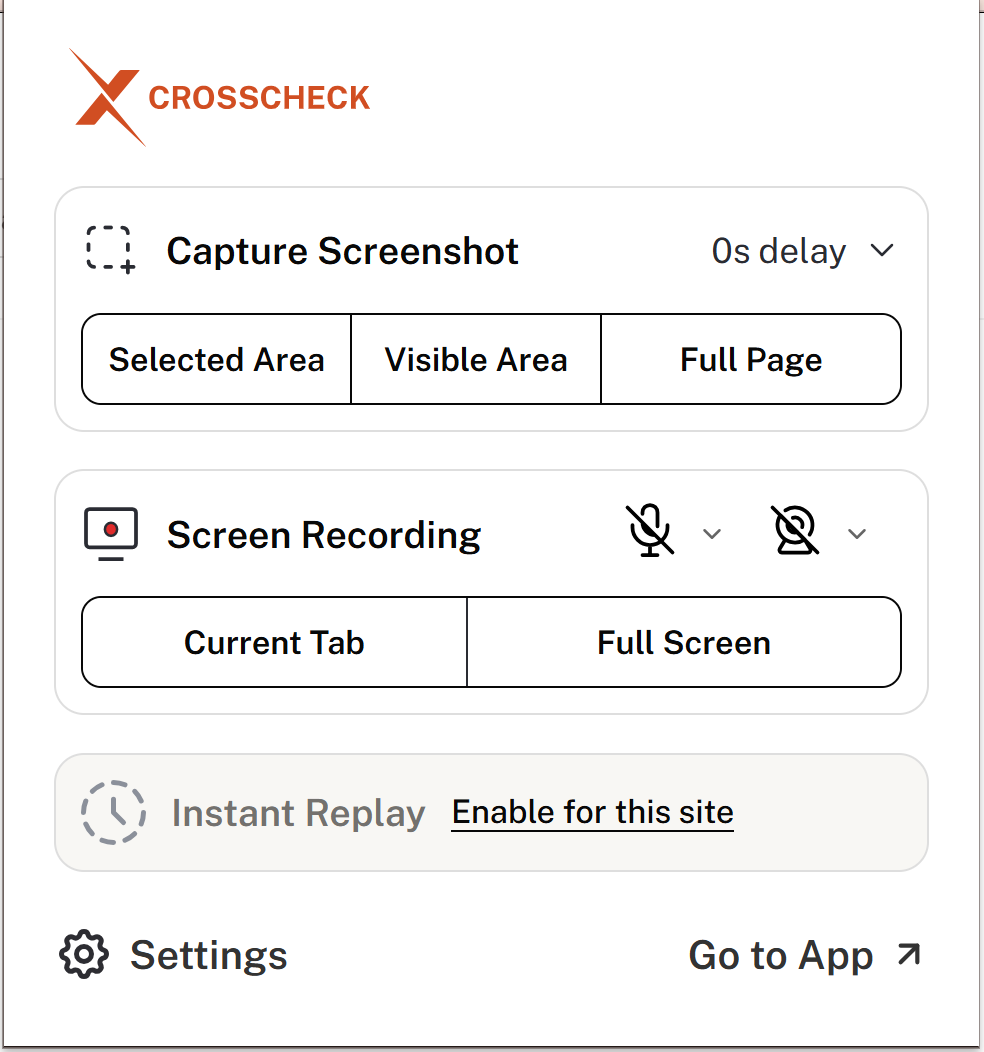
Crosscheck is a free Chrome extension built for the moment a tester or developer needs to file a bug. It captures screenshots and screen recordings, auto-attaches console logs, network requests, browser and OS metadata, and the user-action sequence — then pushes the assembled report straight into Jira, Linear, ClickUp, GitHub or Slack.
The Crosscheck product is free with no usage limits and no paid tier. There are no per-creator seats, no recording-minute caps, and no project ceilings. It is purpose-built for the narrow job of "turn a reproducible defect into a complete ticket" — not an issue tracker, not a test-management platform, not a session-analytics suite.
Where Crosscheck genuinely fits: internal QA teams and developer pods who already live in Jira, Linear or ClickUp and want every bug ticket to arrive with the debug data already attached. The Chrome-extension form factor means there's nothing to install on the server, no SDK to embed, and no usage meter to negotiate against finance.
Where it does not fit: mobile-native bug reporting (Crosscheck is web only), client-facing UAT where the reviewer can't install an extension, and shake-to-report flows inside a customer's iOS or Android app. For those, the visual-pin and mobile-SDK tools further down this list remain the right call.
The category context: most competitors in the developer-extension camp charge per creator seat once you cross a usage threshold. Crosscheck is the outlier. The team's bet is that bug reporting is too granular a workflow to monetise per-seat and that distribution comes from removing the budget conversation entirely.
Jam.dev: the most direct comparison
Jam.dev is the tool Crosscheck gets compared to most often. Both are Chrome extensions, both auto-capture console logs and network requests, both push complete bug reports into Jira, Linear and Slack. Jam has been around longer, has roughly 200,000 users, and shipped one of the earliest Model Context Protocol (MCP) integrations in the bug-reporting category — meaning a developer can paste a Jam link into Claude Code or Cursor and have the captured context loaded into the IDE automatically.
The pricing structure is where the two diverge. Jam's free plan is generous on capability but capped on volume: 30 Jams per month, 5-minute recording limit, 5 recording links. To remove those caps you're on the Team plan at $14 per creator per month (annual billing), which adds 200 AI summaries, 150 recording links and 15-minute recordings. Enterprise is custom.
Where Jam fits best: teams that have non-technical reporters — customer support, product managers, designers — who file bugs alongside engineering. The MCP integration is real and useful if your engineers are already using AI-coding tools. The 5-minute free cap is rarely a problem for a single bug but starts to bite once a tester is filing twenty bugs a week.
Where it loses to Crosscheck: any usage pattern where you'd otherwise be paying for seats. If your team is a four-person QA squad and you'd burn through the free tier in a week, the math changes quickly.
Marker.io: structured client UAT, locked behind the Team tier
Marker.io is the most polished tool in the visual-pin camp. A client opens your staging site, the Marker widget sits in the corner, they pin feedback to an element, and the report syncs into your Jira or ClickUp project with two-way status updates flowing back. When the ticket closes in Jira, the client gets a notification — that loop is the product.
The pricing reality is what most reviews skip past. The Starter plan at $39/month includes three users, but console logs, network request capture, session replay and project analytics are all locked behind the Team plan at $149/month (15 users). In other words, the technical context that makes a bug report developer-ready isn't on Marker's cheapest tier. For agencies running structured client UAT into Jira, the Team plan is the realistic starting point.
Where Marker fits best: agencies and SaaS teams running formal UAT against a staging environment with a non-technical client. The Jira integration depth is the best in the category and the two-way status sync genuinely reduces "is this fixed yet?" emails.
Where it loses: if your bugs are filed by internal QA rather than clients, you're paying $149/month for an integration layer when a Chrome extension would give your team the same console logs for free. The 15-day trial is also limited to 25 issues, which makes a real evaluation tight.
BugHerd: the agency standby
BugHerd has been the default for web agencies since well before the current cohort of competitors existed. Its pitch is unchanged and still effective: a reviewer clicks any element on your live page, leaves a comment, and BugHerd captures the screenshot, URL, browser, OS, screen resolution and HTML selector. Every pinned comment becomes a task on a built-in Kanban board, with unlimited guests on every plan — clients don't create accounts.
What BugHerd does not capture, despite some marketing copy that implies otherwise, is deep technical context. Console logs and network requests are not first-class citizens the way they are in Marker.io's Team tier or any of the Chrome-extension tools. Independent reviews from 2026 flag this gap explicitly: BugHerd treats every report as a comment thread, which is fine for "this button is the wrong shade of blue" and harder for "the API returned 500 and the page crashed."
Pricing starts at $39/month for the Standard plan (5 members), with Studio at $59/month (10 members) and Premium at $109/month (25 members) per BugHerd's own pricing page. Annual billing knocks the cost down by roughly two months' worth.
Where BugHerd fits best: design and web agencies whose feedback is mostly visual — copy, layout, colour, image swaps — and whose clients value not having to install or sign up for anything.
Where it loses: functional bug reporting where a developer needs to see the network call that failed.
Userback: bugs alongside surveys and feature requests
Userback is the broadest tool on the list. Alongside bug reports it handles in-app surveys, feature request boards, and full session replay, making it a closer competitor to product-feedback platforms like Canny or Sprig than to a pure bug-reporting extension.
For visual bug capture it covers the basics — annotated screenshots, screen recordings, browser and OS metadata. Console logs and network requests are available, but only on the Company tier and above. Session replay sits behind the Business plan. The free plan is real but tight: two projects and seven-day data retention.
Per Userback's own site, paid plans start at $7 per user per month for entry tiers, scaling up to roughly $23/user/month for the higher-end packages. Third-party aggregators list higher monthly figures ($69, $149, $289) that appear to reflect bundled team plans rather than per-user pricing — the live pricing page is the source to trust.
Where Userback fits best: product teams at SaaS companies who want one platform to collect bugs, NPS surveys and feature requests, and who care about session replay enough to pay for the Business tier.
Where it loses: any team that only needs bug reporting. The breadth that makes Userback valuable also makes it overkill, and the console-logs-on-mid-tier pricing means cheaper, more focused tools will land more developer-ready reports per dollar.
Disbug: narrated screencasts for design reviews
Disbug's differentiator is narrated screencasting with real-time annotation — a reporter records themselves talking through several UI issues in a single video, drawing arrows and circles as they go, and the recording uploads with console and network logs attached. There is also a live website editing mode that lets a reviewer propose visual changes before filing the report, which is a genuinely useful workflow for design teams iterating on a staging site.
Disbug's integrations cover Jira, ClickUp, GitHub, GitLab, Asana, Slack, Trello and Basecamp. Pricing isn't broken out in detail on most third-party listings, but the publicly cited entry point sits around $33/month for up to 10 members on annual billing, with a free tier and a 7-day money-back guarantee.
Where Disbug fits best: UI and design teams where verbal context — "this hover state should be tighter, and the icon weight is off" — carries more information than a static screenshot.
Where it loses: anywhere a single bug per ticket beats a video covering five. Stand-alone Jam or Crosscheck reports are easier to triage in a sprint board than a 6-minute narrated video covering multiple issues.
BetterBugs: AI debugging assistant at the low end
BetterBugs is a Chrome extension closest in shape to Crosscheck and Jam — auto-captured console logs, network requests, device info, screenshot and screen recording — with two things layered on top: an AI debugging assistant that generates probable reproduction steps and an impact-analysis summary, and a "Rewind" mode that retains the last two minutes of browser activity so you can capture a bug after it has already happened.
BetterBugs has a free tier and paid plans that, on third-party aggregators, start at the unusually low figure of $3.99 per user per year for the Individual plan. That is yearly, not monthly. Team and Enterprise tiers carry custom pricing and feature gates around role-based access and dedicated workspaces.
Where BetterBugs fits best: solo developers, freelancers, and small QA pods who want AI-flavoured debugging assistance without the per-seat math of larger platforms.
Where it loses: larger teams who need the workflow discipline of an established player. The AI repro-step generation is novel but still requires verification — it's a starting hypothesis, not a finished investigation.
Loom: a screen recorder pressed into bug-report duty
Loom is on this list because teams reach for it constantly when filing bugs, not because it was built for the job. A Loom video shows what happened. It does not show why it happened: there is no console log, no network panel, no captured request payload. A developer watching a Loom bug report still has to reproduce the issue locally to see what the browser was actually doing.
Loom's free Starter plan changed in 2026 — accounts created after February 2026 lose the Creator Lite option entirely, and free users are capped at 25 videos, 5-minute recordings, and 720p quality. The Business plan runs $15 per user per month, with Business + AI at $20 per user per month and Enterprise custom. Loom's 2026 acquisition by Atlassian also moves billing into the Atlassian admin console.
Where Loom fits best: narrated walkthroughs, onboarding videos, async standups — the use cases Loom was designed for.
Where it loses for bug reporting: every comparison against a dedicated tool. A Loom video plus a Crosscheck capture is a reasonable combo. A Loom video alone is the bug-report equivalent of "it doesn't work, please advise."
Pastel: a design review canvas, not a bug tracker
Pastel is included because it gets pitched as a bug-reporting tool more often than it should be. It's a website annotation canvas — reviewers leave comments pinned to a live URL, collected on a shareable link without installs or logins. Useful for client design sign-off. Not useful for filing a bug a developer needs to fix.
Pastel does not capture console logs, network requests, screen recordings, or step-by-step user actions. The Free tier limits you to one active canvas and a 72-hour comment window. Paid plans are $24/month for Solo (annual) and $83/month for Studio (annual, 5 users), with custom Enterprise pricing for larger agencies.
Where Pastel fits best: lightweight design feedback on marketing pages or staging sites with creative reviewers who don't need to file engineering tickets.
Where it loses: every bug-report use case. Don't compare it to Crosscheck or Jam — compare it to Figma comments and InVision.
How to actually choose: a decision matrix
The wrong way to choose a bug reporting tool is to read a listicle, pick the highest-ranked option, and roll it out. The right way is to start from who files the bugs and where the bugs end up.
| Workflow | Best primary tool | Honest second choice |
|---|---|---|
| Internal QA filing into Jira / Linear / ClickUp | Crosscheck | Jam (if you need MCP into Claude Code or Cursor) |
| Developer-internal dogfooding and self-reported bugs | Crosscheck or Jam | BetterBugs for solo devs |
| Non-technical client UAT on a staging site | Marker.io (Team plan for real debug data) | BugHerd if visual feedback dominates |
| Web design and copy review with clients | BugHerd or Pastel | Marker.io Starter if you'll need Jira later |
| Mobile app bug reporting (iOS / Android) | Instabug / Shake (out of scope here) | n/a — extensions don't cover this |
| Bugs blended with surveys and feature requests | Userback | Hellonext + Crosscheck split stack |
| Async narrated walkthroughs for stakeholders | Loom plus a dedicated bug tool | Disbug if narration matters for engineering too |
| Solo developer or freelancer | Crosscheck or BetterBugs | Jam free tier |
A pattern worth naming: most teams overpay for breadth they don't use. A QA team filing 40 bugs a week into Jira does not need session replay, surveys and feature-request boards. They need console logs, network requests and a Jira integration that doesn't drop fields. The same is true in the other direction — a marketing agency collecting client feedback on a landing page does not need a Chrome extension that captures network payloads. The tools have converged enough on features that the right question is which workflow is yours?, not which has the most checkboxes?.
What's changing in 2026
Three shifts are reshaping this category.
MCP integrations are turning bug captures into AI-fixable artefacts. Jam shipped one of the first MCP servers for bug context, letting a developer load a captured report into Claude Code or Cursor and have the AI propose a fix against the actual repro data. Crosscheck has followed. A bug report in 2026 is no longer just a ticket — it's an input to an agentic loop, and tools that don't expose capture data via MCP will fall behind how engineers actually write code by year-end.
The "free" floor has moved up sharply. Crosscheck ships the full extension free with no usage ceiling, Jam's free tier covers most solo workflows, and BetterBugs charges less per year than competitors charge per month. The visual-pin tools have not moved on pricing, and that gap is increasingly visible to buyers.
Buffered replay is becoming table stakes. Jam, Crosscheck, BetterBugs and Userback all now offer some form of "capture the last N seconds without hitting record." This single feature solves the most expensive bug-reporting failure mode — the tester saw it, didn't capture it, and now can't reproduce it.
FAQ
What is the best free bug reporting tool in 2026?
Crosscheck is the strongest free option for web teams because there is no paid tier — the full Chrome extension is free with no usage caps, no per-creator seats and no project limits. Jam's free tier is also strong if you stay under 30 Jams per month and 5-minute recordings. BetterBugs has a free tier and unusually low paid pricing (from $3.99/user/year) for individual contributors.
What's the difference between a bug reporting tool and an issue tracker?
A bug reporting tool captures the defect — screenshot, video, console logs, network requests, environment data — and packages it into a ticket. An issue tracker (Jira, Linear, GitHub Issues, ClickUp) is where that ticket lives, gets prioritised, assigned, and worked on. The good bug-reporting tools integrate into your existing issue tracker rather than replacing it. Don't pick a bug-reporting tool that asks you to abandon Jira.
Do I need a paid plan to capture console logs and network requests?
It depends on the tool. With Crosscheck and Jam (free tier), BetterBugs and Disbug, yes — console and network capture is included in the free or entry tier. With Marker.io, console logs and network capture sit behind the $149/month Team plan. With Userback, console logs require the Company tier and session replay requires Business. With BugHerd, deep technical capture is limited regardless of plan.
Is Loom a bug reporting tool?
No. Loom is a screen recorder. It captures a video of what happened but does not capture the technical context a developer needs to reproduce the bug — no console errors, no network requests, no environment metadata. A Loom video pairs well with a dedicated bug-reporting tool but doesn't replace one.
Which bug reporting tool integrates best with Jira?
Marker.io has the deepest two-way Jira sync — status changes flow both directions and reporters get notified when their ticket closes. Crosscheck, Jam and Userback all push complete bug reports into Jira with attached context. For teams already heavily invested in the Atlassian stack and running client UAT, Marker.io's Team plan is the most polished fit, though it's also the most expensive.
How do bug reporting tools handle the 2026 AI coding workflow?
Through Model Context Protocol (MCP) integrations. Jam shipped MCP support that lets a developer paste a Jam link into Claude Code, Cursor or Windsurf and have the captured context — video, console logs, network requests, user events — loaded into the AI's working memory. Crosscheck has its own MCP server live at mcp.crosscheck.cloud. If your team is already using AI-coding tools, MCP-native bug capture is a real workflow accelerator.
Related reading
If you're picking tools for a broader QA stack, these comparisons cover the adjacent categories:
- 10 SQA methodologies and real-world case studies — how mature teams structure quality work end-to-end.
- Best AI testing tools 2026 — the test-automation side of the same problem.
- The perfect bug report template — what a good bug ticket actually contains, tool-agnostic.
- Selenium vs Playwright vs Cypress 2026 — the framework comparison teams pair with their bug-reporting choice.
- Best visual regression testing tools 2026 — the category that catches the bugs your reporting tool then captures.
Start filing developer-ready bug reports today
Bug reporting is the narrow point in most QA workflows — the place where engineering time gets lost to "can you reproduce this?" emails. The Crosscheck team built the extension to remove that bottleneck specifically: install once, capture with one click, and every report arrives in Jira, Linear, ClickUp, GitHub or Slack with console logs, network requests, browser data and the user action sequence already attached. No seats. No usage caps. No paid tier to upgrade into.

 Add to Chrome