The Best Visual Regression Testing Tools to Use in 2026
Visual regression testing is the practice of capturing screenshots of a UI before and after a code change, then comparing them — pixel-by-pixel or with AI-powered diffing — to catch unintended visual side effects before they ship. In 2026, the category has split cleanly into two camps: AI-diffing cloud platforms (Percy, Applitools, Chromatic, Reflect) and developer-owned snapshot libraries baked into frameworks (Playwright, Cypress, BackstopJS). The right choice depends less on raw accuracy and more on where your team already lives — Storybook, an end-to-end suite, or a no-code recorder.
TL;DR — the short version
- Percy and Applitools lead on AI diffing — Percy's Visual Review Agent claims a 3x review-time reduction and ~40% fewer false positives; Applitools' Visual AI is trained on billions of app screens.
- Chromatic wins for Storybook-driven component teams — every story becomes a visual test, with TurboSnap cutting snapshot costs.
- Playwright (
toHaveScreenshot()) and Cypress (cy.screenshot()+ community plugins) cover most teams that already own an end-to-end suite — free, deterministic, no extra vendor. - BackstopJS remains the strongest open-source full-page option, MIT-licensed and actively maintained.
- Reflect is the no-code option, now owned by SmartBear, for teams without scripting capacity.
- Automated tools find scripted regressions. Manual exploratory testing — and Crosscheck as the bug-reporting layer on top — covers the visual bugs no script anticipated.
What visual regression testing actually solves
A functional test asks "did the button submit the form?" A visual regression test asks "did the button still look like a button after the last CSS commit?" These are different failure modes, and the second one slips through unit and integration suites constantly — broken margins, fonts that fail to load, components that render off-screen at unusual viewports, dark-mode contrast that collapses on one page out of forty.
The category exists because CSS is global. A tweak to a utility class in one design-system primitive can cascade across hundreds of screens, and code review cannot reasonably catch every downstream effect. Visual regression testing automates the catch.
Modern tools handle three jobs: capture the screenshot at a known browser, viewport, and DOM state; compare it against a stored baseline; and review the diffs — ideally surfacing only the meaningful ones. The 2026 shift is concentrated in that third job. Pixel-diffing is solved. The differentiator is now how aggressively a tool's AI filters anti-aliasing, dynamic content, animations, and rendering noise so reviewers see only real regressions.
Comparison table — at a glance
| Tool | Type | Pricing (2026) | AI diffing | Best for |
|---|---|---|---|---|
| Percy | Cloud SaaS | Free up to 5K screenshots/mo; Essentials $199/mo; Device Cloud $399/mo | Visual Review Agent, Intelli-ignore, Visual AI Engine | Teams on BrowserStack; cross-browser at scale |
| Applitools Eyes | Cloud SaaS | Free tier 50 Test Units/mo; Eyes Starter ~$899/mo billed annually; Enterprise custom | Visual AI trained on billions of screens; deterministic execution engine | Enterprise teams with high test maintenance cost |
| Chromatic | Cloud SaaS | Free 5K snapshots/mo; paid from $149/mo | TurboSnap; anti-flakiness detection | Storybook-driven component libraries |
| BackstopJS | Open source | Free | Pixel diff (no AI) | Self-hosted full-page regression on a budget |
| Playwright snapshots | OSS framework | Free | Pixel diff via pixelmatch | Teams already using Playwright e2e |
| Cypress snapshots | OSS framework + plugins | Cypress Cloud paid; plugins free | Pixel diff; AI via Applitools/Percy SDKs | Teams already using Cypress e2e |
| Reflect | No-code SaaS | Trial; paid tiers (custom) | Self-healing locators; AI test generation | Non-engineering teams running smoke + visual checks |
A note on the table: "AI diffing" here refers specifically to noise-filtering and meaningful-change detection at the pixel-comparison stage. Self-healing locators, natural-language authoring, and other AI features at the test-creation stage are listed where they apply but are a different capability.
Percy by BrowserStack
Percy is the most widely adopted cloud-based visual testing platform and the natural pick for teams already using BrowserStack for cross-browser coverage. A percySnapshot() call inside an existing Cypress, Playwright, Selenium, or Puppeteer test sends the rendered page to Percy's cloud, which captures it across configured browsers and widths, compares against the baseline, and surfaces changes in a review UI.
The 2025–2026 release wave is built around two AI features. The Visual Review Agent replaces raw pixel highlights with smart bounding boxes that summarise meaningful changes — Percy claims this delivers 3x faster review and filters out roughly 40% of false positives from rendering noise. The Visual Test Integration Agent automates SDK setup in your IDE from a single prompt, with Percy reporting 6x faster initial integration.
Pricing in 2026 runs Free (5,000 screenshots/month), Essentials at $199/month for 10,000 screenshots, and Device Cloud at $399/month for AI-powered testing on 30,000+ real devices with unlimited testing minutes. Percy bills in screenshots — one render in one browser at one width — so two pages across two browsers at three widths costs twelve screenshots.
Best fit: teams already paying for BrowserStack, or anyone who wants AI-noise-filtered cloud visual testing without standing up infrastructure.
Applitools Eyes and Applitools Autonomous
Applitools is the heavyweight of AI-powered visual testing. Its Visual AI engine has been trained on a corpus of app screens that Applitools describes in the billions, and the company positions Eyes as a near-zero-false-positive tool — it traces detected defects back to the exact DOM element rather than just flagging changed pixels.
In 2026 the platform runs as two complementary products. Eyes is the SDK-plus-service for visual regression. Applitools Autonomous uses NLP and AI to create, execute, and analyse functional, visual, and API tests from natural-language descriptions, with self-healing locators that adapt when the UI changes. Both bill against a shared Test Units quota — pages count as units for Eyes; monthly active tests count for Autonomous — and quotas are reallocatable month-to-month.
A 2026 differentiator worth flagging: Applitools separates authoring from execution. LLMs assist while you write tests, but the runs themselves use a proprietary deterministic engine rather than live LLM calls — meaningfully faster and more stable than agentic-at-runtime approaches.
Pricing in 2026: Free tier at 50 Test Units/month; Eyes Starter at ~$899/month billed annually; Autonomous Starter at ~$969/month billed annually; Public Cloud and Dedicated Cloud (private deployment) at enterprise pricing. All plans include unlimited users and unlimited test executions.
Best fit: enterprise QA teams where test maintenance and false-positive triage cost real engineering time, and where the budget supports a premium tool.
Chromatic
Chromatic is built by the team that maintains Storybook, and the integration shows. Every Storybook story automatically becomes a visual test — Chromatic captures snapshots of each component state and compares them across commits, giving instant feedback at the component level rather than the full-page level. Catching a broken button style in a Storybook story is faster and cheaper than catching it in an end-to-end test against a full checkout flow.
The 2026 platform leans on TurboSnap, which only re-tests components that actually changed between commits — meaningful cost-control for design systems with hundreds of stories. Cross-browser parallel capture covers Chrome, Firefox, Safari, and Edge from the same story configuration, and a built-in anti-flakiness layer filters latency, animations, and resource-loading variability.
Pricing in 2026 starts at a Free tier with 5,000 snapshots per month and moves to paid plans from $149/month for 35,000 snapshots. The most common cost surprise is overage — Chromatic bills per-snapshot above the included quota, and the per-unit cost on overage can run 2–3x higher than committing to a larger tier upfront.
Best fit: frontend teams with a Storybook-driven component library who want visual regression built directly into the component development workflow.
BackstopJS
BackstopJS is the most established open-source visual regression tool and still one of the strongest in 2026. MIT-licensed, purpose-built (not a plugin or add-on), and actively maintained, it drives headless Chrome via Puppeteer or Playwright to capture screenshots at configured viewport sizes, then compares them against approved baselines stored in the repo.
The reporting UI is the standout — an interactive HTML diff report with a before/after scrubber lets reviewers drag a slider to see exactly what changed. Configuration is plain JSON or JavaScript, which keeps it readable and version-controlled, and scenario blocks support user interactions before capture (login flows, hover states, accordion opens).
There is no AI noise-filtering — BackstopJS is a pure pixel-diff tool with misMatchThreshold controls. For teams whose baselines aren't crammed with animations or third-party widgets, that's enough.
Pricing: free.
Best fit: teams that want a full-page visual regression tool without cloud dependencies — especially useful for testing complete pages across breakpoints in CI without sending baselines to a third-party service.
Playwright visual comparisons
If your team uses Playwright for end-to-end testing, you already have a capable visual regression tool. The expect(page).toHaveScreenshot() assertion captures a screenshot and compares it against a stored baseline using pixelmatch, a fast deterministic pixel-comparison engine.
When a test fails, Playwright auto-generates three images — expected, actual, and diff — with pixel-level highlighting of what changed. Configuration is straightforward: maxDiffPixels, threshold, and mask options let you ignore dynamic regions, and a custom stylesheet hook can freeze animations or hide flaky elements during capture. Snapshots are stored next to your tests and committed to the repo, so baselines move with the codebase.
What you do not get: AI-driven noise filtering, a managed review UI, or cross-browser cloud parallelisation by default — Playwright runs locally or in your own CI. For most teams that's a feature, not a bug.
Pricing: free (part of Playwright).
Best fit: teams already invested in Playwright who want visual coverage without adding a vendor.
Cypress snapshots
Cypress does not ship visual regression as a first-class primitive the way Playwright does, but cy.screenshot() plus a small ecosystem of community plugins — cypress-image-snapshot, cypress-plugin-snapshots, cypress-visual-regression — gets most teams there. Each plugin wraps a pixel-comparison engine (usually pixelmatch or resemble.js), stores baselines in the repo, and produces diffs on failure.
For teams that want AI-noise filtering without leaving Cypress, both Percy and Applitools ship first-class Cypress SDKs — you keep your Cypress test structure and route screenshots through the cloud diffing engine. This is the most common production setup we see in the wild: Cypress for the test orchestration, an AI cloud for the diffing.
Pricing: plugins free; Cypress Cloud paid for parallelisation and recording.
Best fit: teams already running Cypress end-to-end suites who want visual coverage layered onto existing tests, optionally with Percy or Applitools handling diffs.
Reflect
Reflect is the no-code option — a browser-based recorder that turns user flows into automated tests without scripting. As of 2026 it's owned by SmartBear. Recording happens in an instrumented cloud browser session, and the platform captures clicks, hovers, field entries, drag-and-drops, file uploads, and visual validation steps from natural interaction.
Visual testing is first-class. Each visual check runs across Chrome, Firefox, Safari, and Edge on Reflect's cloud, with one-click approval of expected changes and direct ticket creation in Jira, Linear, or Azure DevOps. AI handles self-healing locators and natural-language test generation, so tests don't break every time a button moves three pixels.
The trade-offs are real. Reflect runs in a chromium-based environment without real-device coverage, and its visual assertion is a percentage-of-pixels-changed threshold — not the more sophisticated diff controls of Percy or Applitools. It also can't validate hover-revealed content or asserted-absent elements.
Pricing: two-week free trial, then custom paid tiers — pricing isn't published transparently and skews higher for parallel execution.
Best fit: product, design, or operations teams that need to run visual smoke checks without learning a test framework — and where the use cases are scripted user flows, not edge-case rendering.
Where AI diffing actually matters
The shift from pixel-diffing to AI-diffing is the defining 2026 trend in this category, and it's worth being precise about what AI does and does not change.
What AI diffing handles well: anti-aliasing differences between OS renderers, sub-pixel font shifts, animation frame variance, carousel and ad rotation, timestamp and dynamic-content noise. These produce roughly 30–50% of the noise in a naive pixel-diff workflow, and filtering them is where Percy's Visual Review Agent and Applitools' Visual AI earn their cost.
What AI diffing does not handle: the test author's decision about what to capture. If a baseline doesn't include a viewport, a theme, or a user state, no diffing engine — pixel or AI — will catch the regression that hides there. Coverage is still a human design problem.
For teams running design systems with thousands of component states across light and dark themes, the false-positive rate from a pixel-diff tool can make the suite genuinely unusable — every PR drowns reviewers in noise. That's the threshold at which paying for Percy or Applitools starts to look cheap. For teams with a smaller, more controlled baseline, open-source pixel-diff is often the right answer for longer than vendors would like to admit.
Choosing the right tool — by use case
Design systems. Chromatic is the clearest fit. Storybook-as-source-of-truth, TurboSnap to control snapshot cost, component-level diffs that map directly to the development unit. If you already run Storybook, the integration overhead is close to zero.
Marketing sites and landing pages. Full-page regression with multiple breakpoints is the dominant need. BackstopJS handles this for free; Percy adds AI noise-filtering for the cost. The deciding question: how much dynamic content (carousels, A/B tested hero variants, personalisation) is on the page? Lots of dynamic content tilts toward Percy or Applitools.
Application dashboards and complex UIs. AI noise-filtering matters most here. Applitools' Visual AI was effectively designed around enterprise dashboard volume — long lists, dynamic data, frequent partial updates. For a Series B SaaS with a complex internal dashboard, the maintenance savings on Applitools usually justify the cost. For a smaller team, Percy at $199–399/month gets most of the way there.
Mobile-first products. Percy via App Percy (Appium, Espresso, XCUITest) and Applitools for native mobile are the two serious contenders. Most open-source options stop at web.
The blind spot every automated visual tool shares
Every tool on this list automates one thing: comparing a known screenshot against a known baseline. That works perfectly for scripted flows. It misses everything else.
The visual bugs that slip to production are almost always the ones a human discovered — an unusual viewport, a long-tail user state, a hover-reveal that breaks only on touch devices, a component that renders correctly in isolation but collapses inside a specific parent. No screenshot test was written for that case because no one anticipated it. A QA engineer found it during exploratory testing.
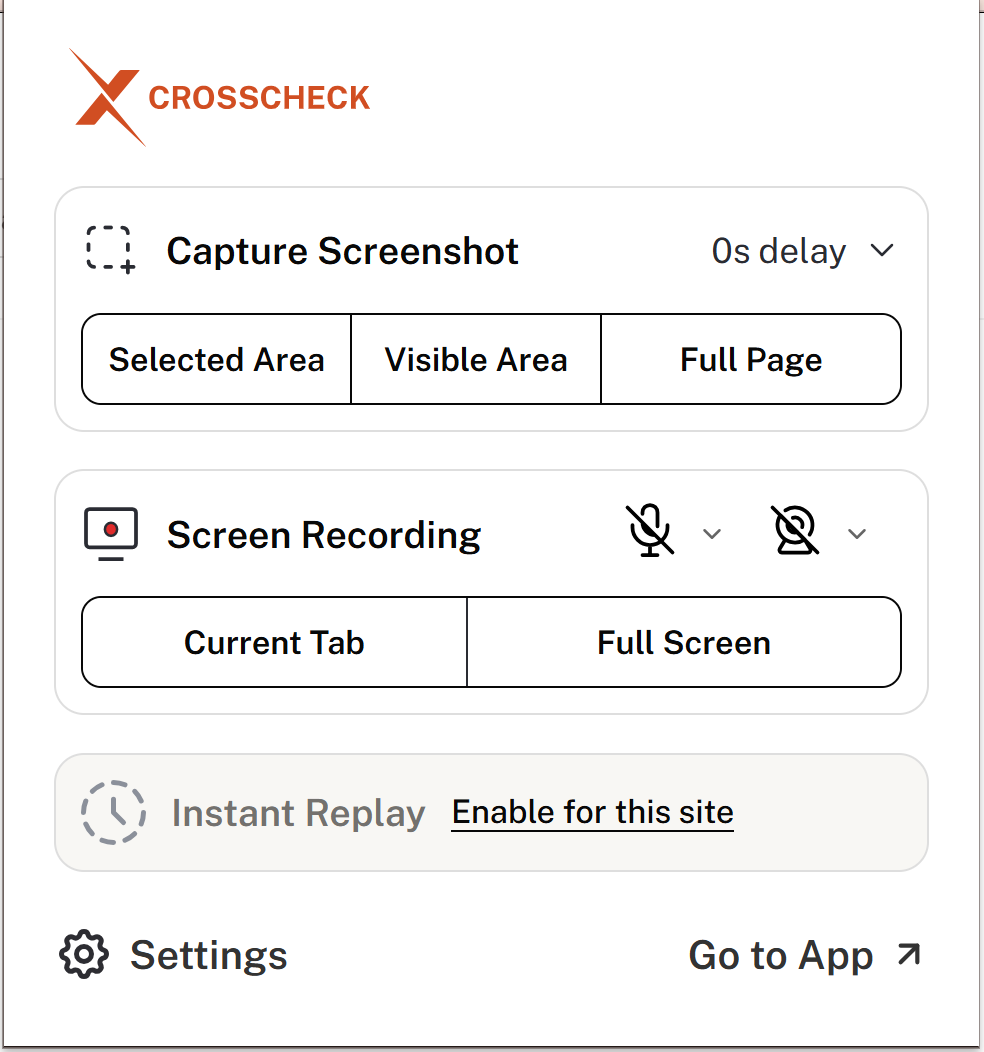
That's the moment Crosscheck is built for. Crosscheck is a free Chrome extension that captures a screenshot or screen recording of the bug, plus the console logs, network requests, and user-action sequence that led to it, then sends a complete bug report to Jira, Linear, ClickUp, GitHub, or Slack. The screenshot is the start of the report, not the whole report. Developers stop closing tickets with "cannot reproduce" because the reproduction context is already in the issue.
Crosscheck doesn't replace Percy, Applitools, or Chromatic. It covers the visual bugs they were never going to catch — the ones found by a human, in a state nobody scripted, on the way to shipping the next release.
FAQ
What's the difference between visual regression testing and end-to-end testing?
End-to-end testing verifies functional behaviour — does the form submit, does the API respond, does the user reach the success page. Visual regression testing verifies the rendering of that flow — does the form still look like a form, does the success page still match the design. Most teams run both, often inside the same test suite.
Is screenshot diff testing the same as visual regression testing?
Yes — "screenshot diff testing" is an older term for the same category. Modern tools have moved beyond raw pixel diffing toward AI-driven meaningful-change detection, but the core mechanic — capture, compare, review — is unchanged.
Do I need a paid tool, or are Playwright and Cypress snapshots enough?
For most teams under 50 engineers with a controlled baseline set, Playwright's built-in toHaveScreenshot() or a Cypress plugin is enough. You hit the limits of free tools when your baseline grows past a few hundred states, when dynamic content starts producing false positives in every PR, or when you need cross-browser cloud parallelisation. That's the threshold to evaluate Percy, Chromatic, or Applitools.
How does AI visual diffing reduce false positives?
AI diffing tools learn what kinds of pixel changes are meaningful — a button moving, a text element appearing, a colour shift — versus which are noise — anti-aliasing variance, font rendering differences, animation frames mid-transition. Percy's Visual Review Agent and Applitools' Visual AI both claim large reductions in noise-grade flagged changes (Percy publishes a ~40% figure), which is what makes large baselines reviewable at all.
Can Crosscheck replace automated visual regression testing?
No. Crosscheck is a bug-reporting extension, not a test runner — it captures bugs your team or your users find manually. The right setup runs automated visual regression on every PR (Percy, Chromatic, Playwright, or similar) and uses Crosscheck to capture the visual bugs that slip through during exploratory testing or in production.
Start reporting visual bugs that get fixed
Automated visual regression covers the scripted path. The bugs that ship anyway are the ones a human noticed — and the speed at which they reach a developer's queue, with reproducible context, is what determines whether the next release is on time.
Crosscheck is a free Chrome extension that turns a screenshot or screen recording into a complete bug report — console logs, network requests, user-action replay, environment metadata, all attached, all routed to Jira, Linear, ClickUp, GitHub, or Slack in one click.
Try Crosscheck free — it pairs with any of the visual regression tools above.
Related reading: the best AI testing tools in 2026, Selenium vs Playwright vs Cypress, and the perfect bug report template.
 Add to Chrome