The Website Feedback Tools Agencies Actually Use in 2026
A website feedback tool is software that lets clients, stakeholders, or QA reviewers leave contextual comments directly on a live website or staging URL — typically pinned to the exact element, with browser, OS, and screen-size metadata captured automatically. For agencies in 2026, the right tool turns a vague Slack message ("the button looks off on mobile") into a developer-ready ticket sitting in Jira before the next standup. The wrong one buries the team in screenshots stitched to email threads.
The market has consolidated since 2022. Some old names — InVision Notable — are gone. Newer entrants have leaned hard into AI categorisation, session replay, and two-way Jira sync. Pricing has crept up across the board, with Marker.io quietly moving its issue-sync feature from the Starter plan into Team ($149/mo) and MarkUp.io retiring its free plan entirely.
This guide compares the ten website feedback tools an agency would realistically shortlist in 2026, with verified pricing, a feature matrix, and a structural take on which tool fits which kind of agency.
TL;DR — best client feedback tools for agencies, ranked by fit
- Best for QA-heavy agencies and dev-ready bug context: Crosscheck — free Chrome extension, captures console logs, network requests, screen recording, no client install.
- Best for non-technical clients leaving live-site feedback: BugHerd — point-and-click pinning, unlimited guests, $39/mo starter.
- Best for agencies living inside Jira or Trello: Marker.io — deep two-way sync, but full sync now requires the $149/mo Team plan.
- Best lightweight tool for design reviews and approvals: Pastel — sticky-note-style canvases, free plan with one active canvas.
- Best all-in-one for SaaS-product agencies: Userback — session replay, in-app surveys, NPS/CSAT/CES, from $7/user/mo.
- Best budget pick: Ruttl — $6.60/user/mo, with CSS inspect for design-to-dev handoffs.
What "website feedback tool" actually means for an agency
The category covers three overlapping use-cases that get conflated:
1. Client review and approval. Non-technical stakeholders leave comments on a staging URL during build — visual sign-off, copy approval, legal disclaimer clearance. Pastel, Filestage, and MarkUp.io optimise for this.
2. QA bug reporting. Internal testers or developer-aware clients file bugs. The job-to-be-done is reproducibility — a screenshot without console logs, network errors, and the user's last five clicks is a bug report a developer will bounce back. Crosscheck, BugHerd, and Marker.io live here.
3. Post-launch customer feedback. After go-live, the agency measures how end users feel — NPS, CSAT, sentiment, feature requests. Userback and Usersnap straddle this and #2.
Most agencies need #1 and #2. Trying to buy one tool for all three usually means overpaying for features no one uses.
Comparison table — pricing and core features
| Tool | Starting price (2026) | Free tier | Unlimited guests / clients | Console logs + network capture | Screen recording | Two-way Jira sync |
|---|---|---|---|---|---|---|
| Crosscheck | Free | Yes (all features) | Yes | Yes | Yes | Yes |
| BugHerd | $39/mo (5 users) | 7-day trial | Yes | Yes | Yes (video feedback) | Yes |
| Marker.io | $39/mo (3 users) | 15-day trial | Yes | Yes (Team plan) | Yes (Team plan, session replay) | Yes (Team plan, $149/mo) |
| Userback | $7/user/mo | Free plan (2 projects) | Yes | Yes | Yes | Yes |
| Pastel | $24/user/mo (annual) | Free (1 active canvas, 3-day window) | Yes | Limited (device + browser) | No | Via Zapier/integrations |
| Ruttl | $6.60/user/mo (annual) | Free plan | Yes | Limited | Video (60s max) | Yes |
| Usersnap | €49/mo | 15-day trial | Yes | Yes | Yes | Yes |
| MarkUp.io | $79/mo (workspace) | None (retired Jan 2025) | Yes (workspace flat rate) | Limited | No | Via integrations |
| Filestage | $199/mo (annual) | Yes (2 active projects) | Yes | No | No | Indirect |
| Atarim | $16/mo | Free plan | Yes | Limited | No | Yes |
Prices and free-tier inclusions verified May 2026 against each vendor's pricing page. Inflation across the category since early 2024 sits at roughly 20-30% — MarkUp.io's increase is the outlier at 172%, after retiring its free plan.
1. Crosscheck — the QA-first feedback tool
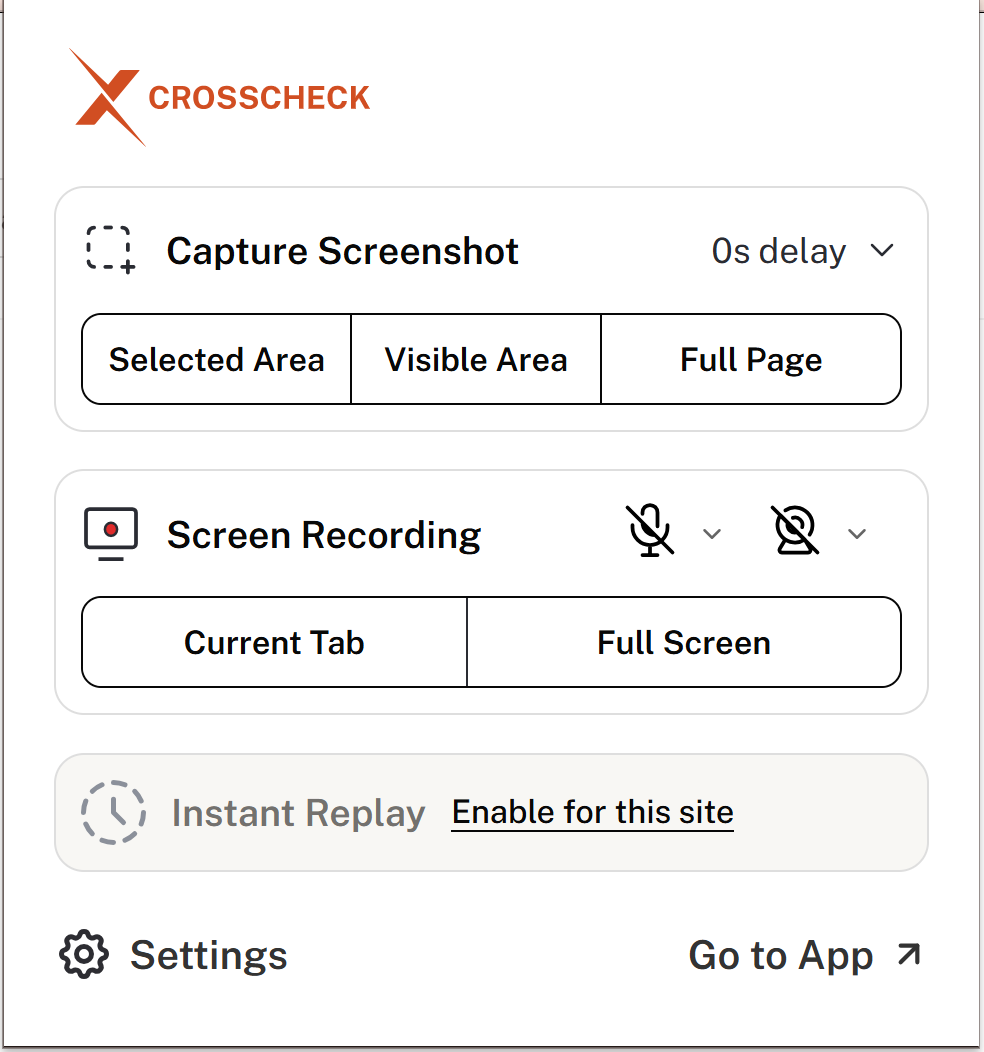
Crosscheck is a free Chrome extension that captures a complete bug report in one click — screenshot or screen recording, console errors, failed network requests, the user's last actions, device metadata, and a Playwright-ready replay of the session. The report ships straight into Jira, Linear, ClickUp, GitHub, or Slack. No client-side script, no embedded widget, no usage limits, no paid tier.
The architectural difference matters for agencies: because Crosscheck is an extension, it works anywhere your browser does. Staging environments behind basic auth, password-protected client previews, third-party platforms like Shopify or HubSpot admin panels, and SaaS dashboards that block embedded scripts — all of them work. Tools that depend on a <script> tag on the client site cannot match this in environments where you do not control the markup.
Best for: agency QA teams, developers, and tech-aware project managers who file bugs themselves and need every report to be reproducible. Less ideal for end-client comment threads — non-technical stakeholders who refuse to install a Chrome extension are better served by a pinned-comment tool below.
Pricing: free, no paid plan, no card required.
2. BugHerd — the default for non-technical client feedback
BugHerd has been refining the point-and-click pinned-feedback workflow since 2011. A client opens the staging URL, clicks the element that looks wrong, types a comment, and BugHerd captures browser, OS, screen resolution, console logs, and URL automatically — no account needed for the client. The report lands in BugHerd's built-in Kanban board, where the agency triages and pushes it into Jira, ClickUp, Trello, Asana, monday.com, or GitHub.
Two things make BugHerd the default agency pick for client review work. First, every plan includes unlimited guests and unlimited projects — clients never need accounts, agencies never juggle seat counts per client. Second, the white-label widget on Studio ($59/mo, 10 members) and above lets the agency present the tool as its own.
Pricing (verified May 2026): Standard $39/mo (5 members); Studio $59/mo (10 members, white-label); Premium $109/mo (25 members); Deluxe $189/mo (50 members). 7-day free trial, no credit card. Annual billing knocks roughly two months off.
Trade-off: BugHerd is opinionated. The Kanban-board-first UX is great for agencies that want a self-contained workspace and less ideal for teams whose source of truth is Jira and who want a thin layer that just routes tickets there.
3. Marker.io — built for Jira-native agencies
Marker.io is the tool for agencies whose project management already runs through Jira, Trello, ClickUp, or Asana. Its differentiator is deep two-way sync — a Marker.io report becomes a real Jira issue, status changes round-trip in both directions, and the engineer assigned the bug never has to leave Jira. Console logs, network requests, and full session replay are captured alongside annotated screenshots.
The 2025 pricing reshuffle caught a lot of agencies off guard. Issue-sync — the feature that makes the whole tool worth using for Jira-native teams — moved out of Starter and into the Team plan. The current tiers:
- Starter — $39/mo, 3 users, unlimited reporters, unlimited projects, core annotation and metadata capture
- Team — $149/mo, 15 users, session replay, console + network logs, custom branding, project analytics
- Business — $499/mo, 50 users, Jira server integration, webhooks, dedicated support
- Agency plan — $99/mo annual ($129/mo monthly), 15 members, 50 active websites, 50 guests — for small digital agencies with eligible criteria
The free trial gives full Team-plan access for 15 days, capped at 25 issues, no card required.
Best for: agencies that bill against Jira time and want client bug reports to flow into the same backlog the engineers already work from. The Agency plan is the right tier for most small shops — the standard Team plan gets expensive fast if you do not qualify.
4. Userback — feedback meets product analytics
Userback sits at the intersection of website feedback and user research. The core annotation loop is competitive with BugHerd and Marker.io, but Userback adds session replay — a recording of what the user was doing in the 30 seconds before submitting feedback — plus in-app surveys (NPS, CSAT, CES) and a feature-request portal. For agencies retaining post-launch SaaS clients, this replaces a feedback widget, a survey tool like Delighted, and a roadmap tool like Canny.
Pricing (verified May 2026): Free plan with 2 projects and 7-day visibility; Starter from $7/user/mo; Business adds session replay, 25 projects, AI Assist; Premium adds unlimited projects, mobile SDK, SSO, REST API, webhooks, and white-label. Per-seat pricing — model both axes against team size.
5. Pastel — sticky-notes for design reviews
Pastel deliberately scopes down. There is no Kanban board, no Jira sync depth, no session replay. There is a canvas: share a link with a client, they click anywhere on the live site, they leave a comment. That is the entire workflow, and for design-review and copy-approval cycles it is enough.
Pastel layers comments on the live website via a custom proxy rather than copying assets, so what the client sees is genuinely the live build, including navigation across pages. Browser, device, OS, and screen resolution capture automatically. Comments can be private (team-only) or shared with the client.
Pricing (verified May 2026): Free Forever (1 active canvas, unlimited free canvases with a 3-day commenting window before read-only); Solo $24/mo annual ($29 monthly), 3 premium canvases; Studio $83/mo annual ($99 monthly), 5 users, unlimited premium canvases; Enterprise custom. Premium canvases have no commenting time limit — the 3-day free-canvas window is the catch.
Best for: freelancers and small agencies running tight design-review cycles. Outgrown by larger teams that need ticket routing and engineering-grade bug context.
6. Ruttl — affordable feedback with CSS inspect
Ruttl competes on two axes: price and design-to-dev handoff. At $6.60/user/month billed annually, it is the cheapest paid plan on this list. Its standout feature is an inspect mode that lets reviewers change CSS values — margins, colours, sizes — directly in-browser and share the exact pixel values back to the developer. The 60-second video comments and built-in responsive views (mobile, tablet, desktop) round out the toolset.
Ruttl trails the leaders on automatic technical capture — console logs are limited, network capture is shallow — so it earns its place as a budget design-feedback tool rather than a serious QA bug-reporting tool.
Pricing (verified May 2026): Basic free; Pro $6.60/user/mo annual ($8 monthly); Teams $30/user/mo; Enterprise custom.
7. Usersnap — the enterprise-grade option
Usersnap is what an agency picks when the client is a Fortune 500 — Red Hat, LEGO, and Harvard are reference customers. It combines annotated screenshots, automatic metadata capture, screen recording, voice feedback, and conditional-logic surveys with AI-powered feedback categorisation and an 80-plus integration library.
The cost reflects the positioning — €49/month Starter, €109/month Growth, €159/month Professional — with the Professional tier required for the full integration stack and user-segmentation features.
Best for: mid-market agencies managing complex multi-stakeholder products, especially in regulated industries where audit trails and SSO are non-negotiable.
8. MarkUp.io — flat-rate workspace pricing, no free plan
MarkUp.io is the flat-workspace-rate alternative to per-seat pricing. One Pro plan, one workspace, unlimited users and guests, supports 30-plus file types from websites to PDFs to videos. For large agencies where 15-50 people might touch a project across its lifecycle, the math beats per-seat tools quickly.
The pricing change in January 2025 was steep. The free plan was retired entirely and the Pro tier moved from roughly $29/month to $79/month — a 172% increase that drew sharp criticism from longtime users. MarkUp.io now competes purely on the flat-rate value proposition for larger teams.
Pricing (verified May 2026): Pro $79/mo, unlimited users, one workspace, 30+ file types; Enterprise custom.
9. Filestage — structured approvals for creative work
Filestage is the approval-workflow tool. Reviewers are organised into groups — Marketing, Legal, Brand, Product — and content moves through configurable stages with explicit "Request changes" or "Approve" decisions logged per reviewer. It supports websites, but its sweet spot is high-volume creative output: videos, PDFs, documents, audio, and images. The 2025 AI features layer in brand-guideline and compliance checks automatically.
Pricing (verified May 2026): Free plan with 2 active projects and 2 GB storage; Starter $199/mo annual; Business $329/mo; Enterprise custom.
Filestage is overkill for a small agency with two clients and a Webflow build. It is the right answer for a 30-person creative agency producing daily campaigns for retainer clients with formal sign-off chains.
10. Atarim — AI teammates for creative agencies
Atarim started as WP FeedBack and has evolved into a visual collaboration platform with an unusual angle: AI teammates. Its "InnerCircle" suite covers design, UX, SEO, QA, copy, and PM — each providing on-demand audits alongside the human reviewers.
Whether this is genuinely useful or a marketing layer over a standard LLM API depends on the agency. For WordPress-heavy shops comfortable using AI as a second opinion, it pulls double duty. For agencies that already have senior reviewers in those disciplines, it is redundant.
Pricing (verified May 2026): Free plan with limited features; Plus from $16/mo; Pro $75/mo (5 users); Business $260/mo (15 users).
How to pick the right tool for your agency
There is no single "best" — there are five archetypes, each mapping to a different short list.
Small agency, non-technical clients. BugHerd Standard ($39/mo) for client review, plus Crosscheck (free) for internal QA. Total: $39/mo, unlimited free QA seats.
Dev team lives in Jira, you bill against tickets. Marker.io Agency plan ($99/mo annual) if you qualify; otherwise BugHerd's two-way Jira sync at $39/mo. Marker.io's full Team-tier sync at $149/mo only pays back at high client-review volume.
SaaS products for retained clients. Userback's Business tier covers design review, in-app surveys, NPS, and session replay — replacing three subscriptions.
Design-heavy work, clients comment in bursts. Pastel Studio ($83/mo annual), paired with Crosscheck for bugs.
Creative agency with formal approval chains. Filestage handles "Legal approves before Brand sees it" with precision nothing else matches.
A useful test: count how many of your last ten client projects required Jira-grade bug tracking versus design sign-off. If the split skews 80/20 toward design, do not buy Marker.io Team. If it skews 80/20 toward bugs, do not buy Pastel Studio.
Why Crosscheck shows up on every agency's stack
A common pattern: agencies adopt Crosscheck not as a replacement for BugHerd or Marker.io, but as the internal layer beneath them. The client-facing tool collects vague comments — "this is broken" — and Crosscheck is what the QA engineer or developer fires to turn that into a reproducible report with console errors, network failures, the exact click sequence, and a Playwright-ready replay.
Because it is a Chrome extension rather than an embedded widget, Crosscheck works on every staging environment, password-protected preview, and third-party admin panel. Because it is free with no usage limits, every QA engineer, developer, or PM can have it installed without a procurement conversation. Because the report drops directly into Jira, Linear, ClickUp, GitHub, or Slack, it lives where engineering already works.
For complementary reading, see the best bug reporting tools of 2026 and the perfect bug report template.
FAQ
What is the best free website feedback tool for agencies?
Crosscheck is free with no usage limits, no paid tier, and no seat cap — the strongest free option for agencies that need full technical capture (console logs, network requests, screen recording). For client-facing pinned-comment review, Pastel's free plan supports one active canvas with a 3-day commenting window, and Userback's free plan covers two projects with 7-day feedback visibility.
How do website feedback tools differ from bug tracking tools like Jira?
A website feedback tool sits before Jira. Jira is the system of record for engineering work — backlog, sprints, status. A feedback tool captures the raw input (the client comment, the bug, the design note), normalises it with context (browser, screenshot, console), and routes it into Jira as a properly formatted issue. Most agencies use both: BugHerd or Marker.io collects, Jira tracks.
Can clients use these tools without installing anything?
For BugHerd, Marker.io, Pastel, Userback, Usersnap, MarkUp.io, Filestage, Ruttl, and Atarim — yes, clients leave feedback through a shared link with no install or account. For Crosscheck, the reviewer installs the Chrome extension once; this is the trade-off the extension makes to capture deeper technical context than embedded widgets can.
What is the difference between Marker.io and BugHerd?
Both pin feedback to live-website elements and capture browser metadata. Marker.io is built around two-way sync with Jira, Trello, and ClickUp — the bug lives in your PM tool, not in Marker.io. BugHerd is built around its own Kanban board as the source of truth, with PM tools as one-way exports. Pick Marker.io if your team works in Jira; pick BugHerd if you want a self-contained workspace.
Is InVision Notable still available?
No. InVision (and its Notable feedback product) was retired on December 31, 2024 following Miro's acquisition. Agencies that relied on Notable have generally migrated to Pastel, MarkUp.io, or Userback.
How much should an agency budget for website feedback tools in 2026?
For a small agency (5-10 people, mixed QA and client review), a working stack runs $40-$80/month: BugHerd Standard ($39/mo) plus Crosscheck (free). Mid-market agencies (20+ people) typically land at $150-$300/month for Marker.io Team or Userback Business. Creative agencies needing formal approval workflows budget $200-$400/month for Filestage. Prices across the category rose roughly 20-30% from 2023 to 2026; MarkUp.io's removal of its free plan and price hike to $79/mo workspace flat is the outlier.
Start collecting developer-ready feedback today
Most website feedback tools were built for the moment a client clicks something and types "this looks wrong" — useful, but only half the picture. The other half is whether the engineer reading the report at 9am has enough context to reproduce and fix it without scheduling a call.
Crosscheck closes that gap. Console logs, network requests, the user's last actions, screen recording, device metadata, and a Playwright-ready replay attach to every report automatically. It runs as a Chrome extension, works on every staging environment, ships bugs into Jira or Linear or ClickUp, and costs nothing.
 Add to Chrome