End-to-End Testing Best Practices: A 2026 Field Guide
End-to-end testing is the layer that validates a complete user journey — sign-up, checkout, password reset, the workflows your business actually depends on — by driving a real browser against a real stack. Done well, it is the highest-signal layer in a quality strategy. Done badly, it produces a slow, flaky suite that nobody trusts and everyone reruns. The difference between the two outcomes is not the framework. It is a small number of disciplined decisions about selectors, test data, network behaviour, parallelisation, and what counts as an acceptable retry budget.
This guide collects the E2E testing best practices that hold up in 2026, with concrete patterns drawn from Playwright and Cypress where they earn the mention. The advice is tool-agnostic — the principles apply equally to Selenium, WebdriverIO, or whatever your stack standardised on years ago.
Key takeaways
- Stable, semantic selectors are the single highest-leverage decision.
data-testidand ARIA-role locators outlive CSS class refactors. Brittle selectors generate roughly 45% of all flaky tests through async/timing issues alone, per academic and industry research. - Test independence is non-negotiable. Each test seeds its own data, runs in isolation, and cleans up. Without isolation, parallelisation is impossible and debugging is hostile.
- Network mocking is a strategy decision, not a default. Mock third-party APIs aggressively; mock your own backend selectively. Over-mocking turns E2E tests into UI snapshot tests with extra steps.
- Sharding plus workers turns 60-minute suites into 8-minute suites. Most teams settle on 3–10 shards with 2–4 workers per shard and retries enabled only in CI.
- Retry-on-flake is a diagnostic, not a fix. Target a flake rate under 2% and quarantine anything that needs a retry to pass.
- Capture artefacts on failure. Screenshot, video, and trace files on failure are what make a 2am CI failure actually debuggable.
What is end-to-end testing in 2026?
End-to-end testing is automated browser-driven verification of a complete user workflow against a real or production-like stack — exercising UI, application servers, databases, queues, and third-party integrations in a single test run. It sits at the top of the testing pyramid because it is the only layer that proves the whole system works for the user, not just its individual components.
The pyramid economics have not changed. E2E tests are slow, expensive to maintain, and more failure-prone than unit or integration tests, so they should make up the smallest layer — typically 5–10% of total test count — and target only the critical paths the business cannot ship without. The change since 2020 is that browser automation has gotten dramatically more reliable. Playwright crossed 33 million weekly npm downloads in early 2026, a roughly 70x increase over five years according to npm registry analysis. The 2025 State of JS survey put Playwright satisfaction at 91% versus Cypress at 72% — the widest gap the survey has recorded. The frameworks have caught up to what the practice always required.
What has not improved is the discipline around how teams use them. Most flaky, unloved E2E suites are running modern tooling badly, not legacy tooling well. The rest of this guide is about that gap.
Selectors: the single highest-leverage decision
Every interaction in an E2E test starts with locating an element. The selector strategy you adopt at the start of a project compounds — for better or worse — across every test, every refactor, every UI change for the lifetime of the suite. Get it right early.
The rule: semantic, stable, scoped
The minimum bar in 2026 is to prefer locators in this order:
- Role-based locators —
getByRole('button', { name: 'Sign in' }). These match what assistive technology sees and rarely change. - Labelled locators —
getByLabel('Email address')for inputs,getByText('Continue to checkout')for unambiguous text. data-testidattributes — added explicitly by developers as test contracts. The Playwright team recommends these as the default when role-based options are ambiguous.- CSS classes and XPath — last resort. Both break the moment a designer renames a class or restructures a div.
The reason role-based locators belong at the top is that they survive design system migrations. A button is still a button after a Tailwind redesign. A .btn-primary-v3 class is not.
data-testid as an explicit contract
The argument against data-testid is that it puts test concerns into production markup. The argument for it is that production markup already has a test contract — it just was not negotiated. When a developer renames a CSS class, they have no signal that anything depended on it. When they remove a data-testid, every test referencing it fails loudly, and the failure is the conversation.
Treat the attribute like a public API. Document which screens have stable test IDs, review changes to them like you would review any other contract, and use a consistent naming convention — data-testid="checkout-submit" beats data-testid="btn1" for the same reason submitOrder() beats fn1().
Selectors and flakiness
Selector strategy is not just about maintenance — it is about flakiness. Microsoft Research found that 13% of their test failures in large-scale CI were flaky rather than actual defects. Google's internal data is similar: roughly 16% of their entire test suite exhibits some flakiness. Multivocal research consistently shows that ~45% of those flakes come from async/wait and timing issues, where a test interacts with an element that has not finished rendering. Role-based locators with modern frameworks' auto-waiting (Playwright, Cypress 15) eliminate most of that class entirely.
Test independence and deterministic data
Independence is the second non-negotiable. Every test sets up its own data, executes in isolation, and leaves no state behind. Without this, parallelisation is impossible, test failures cascade across the suite, and debugging becomes archaeology — figuring out which earlier test corrupted the state that broke the current one.
What independence actually requires
- Unique data per test. Generate a unique email, organisation name, or workspace ID per run — UUID-based or timestamp-suffixed. Hard-coding
[email protected]guarantees collisions the moment two tests run concurrently. - Seeded fixtures, not shared databases. Each test creates the data it needs through an API call, factory function, or a seeded fixture — never by relying on data left behind by another test.
- No ordering dependencies. A test must pass whether it runs first, last, or alone. Frameworks reorder tests for parallel execution; assuming serial order will break.
- Explicit teardown. Anything created by a test is cleaned up afterwards, or — preferably — written into a sandboxed account that is wiped wholesale between runs.
The fastest way to enforce this is at the framework level. Playwright's test.beforeEach and fixture system, Cypress's beforeEach plus cy.task for backend setup, and a per-test database transaction that rolls back at the end all push teams toward isolated-by-default tests rather than isolated-by-discipline.
Deterministic data generation
Realistic data matters — tests that only validate against perfect inputs miss the long string, the Unicode name, the boundary value that production users supply. But "realistic" is not the same as "random". Random data without a seed produces flaky tests by design. Use a fixture library like Faker.js with a fixed seed per run, or generate edge cases explicitly and store them in a fixtures file.
For workflows that depend on a populated database — multi-tenant SaaS, marketplaces, anything with relational complexity — invest in a factory pattern that mirrors your production schema without using real user PII. The team that builds factories early ships E2E tests months faster than the team that hand-curates SQL fixtures.
Network mocking: when to mock, when not to
The network is where E2E tests get philosophical. Mock everything and you have a UI test in a costume. Mock nothing and your suite breaks every time a third-party API has a bad afternoon. The right strategy is a layered one.
Mock aggressively at the third-party boundary
Anything you do not own, you mock — payment processors in Stripe test mode (or fully stubbed), email delivery (catch with Mailosaur or stub), analytics endpoints (block entirely), SMS providers, CAPTCHA challenges, ad networks. These services are not what your E2E tests exist to validate. They are noise that adds latency, cost, and flakiness.
Playwright's page.route() and Cypress's cy.intercept() make this trivial. The pattern is the same in both: match the URL, return a deterministic response, assert that your application handles it correctly. A side benefit is that you can test the error paths — what happens when Stripe returns a 503, what happens when an email send fails — by returning those responses on demand.
Mock selectively at your own backend
This is where the judgement lives. Mocking your own backend speeds tests up, eliminates whole classes of flakiness, and lets the test focus on UI behaviour. It also means the test no longer proves the backend works — only that the UI handles the contract correctly.
The pragmatic split most teams converge on:
- Critical revenue paths — signup, checkout, subscription changes — run against the real backend with a seeded database. These are the workflows where a contract mismatch would actually cost money, so the test needs to validate the contract.
- Secondary and edge-case flows — empty states, error states, rate-limit behaviour — use mocked responses. Reproducing these states against a real backend is expensive and often impossible.
- Authentication state — bypass UI login via API token injection or storage-state reuse, even for the "test the happy path" suite. Logging in through the UI on every test wastes minutes per run and adds nothing.
The test for whether a mock is the right call is simple: if the mocked response could diverge from the real backend without anyone noticing, you have built a UI snapshot test. If the response is governed by a typed schema or contract test that runs separately, you can mock safely.
Capture screenshots, video, and traces on failure
A test that fails in CI at 2am with the message Element not found is worse than no test at all — it consumes engineer time and produces no signal. Modern frameworks ship the answer to this for free; the discipline is just turning it on.
Playwright's trace viewer is the new bar
Playwright's trace viewer captures a full timeline of the test — DOM snapshots at every step, network requests, console output, screenshots, video — into a single artefact viewable in a browser. The 2026 best practice is trace: 'on-first-retry' in your config: traces only generate when a test actually fails and gets retried, so you get full replayable evidence without the storage cost of tracing every run. Cypress's equivalent — automatic screenshots on failure plus the full command log replay in the Cypress Cloud dashboard — fills the same role.
The configuration takes minutes. The payback is every debugging session that does not require local reproduction. A trace artefact attached to the CI failure tells the engineer exactly which step failed, what the page looked like, what the network was doing, and what assertion fired — without anyone touching their laptop.
Video on every run vs. on failure
Video on every test run is overkill in 2026. Storage adds up, and most successful runs produce no diagnostic value. The standard pattern is video on failure only — Playwright's video: 'retain-on-failure', Cypress's video: true combined with videoCompression: 32 and selective upload. Combined with the trace, the video is the second screen you reach for when a trace alone leaves a question unanswered.
Sharding, parallelisation, and the time-to-feedback math
The reason most CI suites take 30+ minutes is not that the tests are slow individually. It is that they run serially on one machine. Sharding fixes this, and the math is dramatic.
How sharding works
Sharding splits a test suite into N independent slices that run on N machines in parallel. Playwright's CLI takes --shard=1/4, --shard=2/4, etc., and a GitHub Actions matrix strategy spins up the machines automatically. A 60-minute serial suite becomes an 8-minute parallel suite with four shards — and the Playwright sharding documentation lays out the merge-reports flow for stitching the results back together.
The sharding granularity matters. Without fullyParallel: true, Playwright assigns entire test files to shards, so one file with 200 tests can starve the others. With fullyParallel: true, individual tests are distributed across shards, producing far more even load.
Workers per shard
Inside a shard, workers parallelise further across CPU cores on that machine. The 2026 consensus settles around 3–10 shards with 2–4 workers per shard. Pushing workers higher saturates memory and starts producing Resource-Affected Flaky Tests — research covering 52 projects found that 46.5% of flaky tests are RAFTs, where the test passes or fails based on machine resources rather than code. Profile memory before adding workers.
Cypress and parallel execution
Cypress's parallelisation requires the paid Cypress Cloud service for orchestration — one of the structural reasons teams have migrated to Playwright for cost-sensitive setups. If you are on Cypress, plan for that line item; the productivity gain is still worth it for most teams, but Playwright's free native sharding is a legitimate differentiator.
Retry-on-flake budgets
Retries are the most misused feature in modern test runners. Used as a diagnostic, they are essential. Used as a coping mechanism, they hide the real problem and let the suite rot.
The right way to use retries
Enable retries only in CI — usually retries: 2 — and turn them off locally. The intent is to prevent a single hiccup from blocking a merge while surfacing the test as flaky in the report. Playwright labels a test that fails once and passes on retry as "flaky" (not "passed"), which is the signal teams need to act on.
The standard configuration is:
- Retries in CI only, set to 1 or 2.
- Tracing on first retry.
- Test marked flaky in the HTML report.
- A budget for total flake rate — target under 2%.
Quarantine, do not normalise
A flaky test stays in the suite at the cost of trust in the entire suite. Engineers stop investigating failures because "it's probably flaky", and real regressions slip through. The teams that hold the line on this have a written policy: a test that needs retries to pass is quarantined immediately, gets an owner and a deadline, and is deleted if not fixed within two weeks. Microsoft's published policy is exactly this — and they report an 18% reduction in overall flakiness within six months of enforcing it. Slack's "Project Cornflake" effort dropped their CI failure rate from 57% to under 4% through automated detection and quarantine. The pattern works.
Critically, retries should never be silently increased to make the green build chart look better. The flakiness is still there; you just stopped seeing it.
Page object model vs. function-style organisation
For a decade, the page object model (POM) was the consensus answer to E2E test organisation. In 2026, that consensus has softened. Both styles have current adherents and both are defensible — the choice is about codebase conventions, not correctness.
Page object model
POM encapsulates each page or major component as a class with methods for its interactions. A LoginPage class exposes fillEmail(), fillPassword(), submit(), and assertError(). Tests compose these methods rather than calling the framework's API directly. The benefit is clear separation between "what the test does" and "how the page works" — when a button selector changes, the fix lives in one class.
POM still earns its keep in large, long-lived suites where the same flows appear across dozens of tests. It also creates a discoverable abstraction for new contributors.
Function-style / actions style
The newer pattern — sometimes called the screenplay or actions style — uses plain functions that take the test context as an argument. await loginAs(page, user), await addToCart(page, productId), await completeCheckout(page). The benefit is less ceremony, no class hierarchies, and tests that read more like prose. Playwright's documentation has shifted toward recommending this style for new projects, particularly when combined with fixtures for shared setup.
The right answer is whichever style the team can maintain consistently. The wrong answer is mixing both — half the suite as POM, half as function-style — which produces the worst of both abstractions.
Common E2E mistakes that still cost teams time
Some failure modes have persisted across every E2E framework, language, and decade. Worth naming them explicitly.
Hard-coded sleep(2000) everywhere. A timing band-aid that slows the suite, fails under CI load, and still does not prevent the original flakiness. Use framework-native auto-waiting or explicit waitFor assertions on the condition you actually care about.
E2E for everything. Covering every code branch end-to-end is how a suite hits 2,000 tests and 90 minutes of runtime. Unit and integration tests exist precisely so E2E does not have to validate every helper. Reserve E2E for critical user journeys.
Running tests only before release. A pre-release gate is a slow feedback loop — the defect was introduced days earlier, when context was fresh. Run E2E on every PR; a smoke subset on each commit, the full suite on merge.
Ignoring maintenance. E2E tests are living code. Treating them as write-once means accumulating broken or skipped tests that nobody fixes. Budget maintenance time; review test changes in PRs alongside the feature.
Letting the suite grow unchecked. More tests is not better. Audit quarterly — delete duplicates, merge overlapping scenarios, and challenge whether each test is earning its CI minutes. A focused 200-test suite outperforms a sprawling 2,000-test suite that nobody trusts.
For deeper coverage of these patterns and how they connect to the broader QA function, the 10 SQA methodologies guide covers the strategy layer underneath the tactics.
Choosing a tool: Playwright, Cypress, Selenium
The tooling debate has narrowed sharply. For new projects in JavaScript or TypeScript, the realistic shortlist is two names.
| Tool | Best for | Strengths | Trade-offs |
|---|---|---|---|
| Playwright | New projects, multi-browser, cost-sensitive teams | Free native sharding, multi-browser (Chromium/Firefox/WebKit), trace viewer, auto-waiting, multi-tab support | Newer ecosystem than Selenium; smaller talent pool than Cypress in some markets |
| Cypress | Web-only projects, DX-focused teams | Time-travel debugger, interactive runner, mature Cloud features, large plugin ecosystem | Paid Cloud for parallelisation, no WebKit/Safari, limited multi-tab/origin |
| Selenium | Polyglot enterprises, existing investment | Broadest language support (Java/Python/C#/Ruby/JS), largest ecosystem, WebDriver BiDi in v4 closes the gap on real-time control | Steeper setup, historically more flake-prone than modern alternatives |
The State of JS 2025 data is unambiguous: Playwright gained +14% in usage and won Most Adopted, while Cypress satisfaction sat at 72% to Playwright's 91%. Within JavaScript, Selenium is no longer the default choice for greenfield work — that is a 2010s decision that persists in legacy stacks. For a deeper side-by-side, see the Selenium vs Playwright vs Cypress comparison and the broader best test automation frameworks roundup.
What does not differentiate the tools meaningfully anymore: cross-browser support (all three handle it, with different mechanics), CI integration (all are first-class), or community size (all are large enough). The differentiators in 2026 are licensing model, language support, and whether your team has existing investment to protect.
FAQ
How many E2E tests should a project have?
Enough to cover every critical user journey end-to-end, and no more. For most products this lands between 20 and 200 tests, depending on product surface. If you are over 500 E2E tests, the suite likely contains coverage that belongs in unit or integration tests.
What is an acceptable flake rate?
Target under 2%, with 95–98% pass rate on stable code. Above that, the suite loses credibility and engineers stop trusting failures. Quarantine flaky tests rather than tolerating them in the main suite.
Should I mock my backend in E2E tests?
Selectively. Mock third-party services aggressively. Run critical revenue flows (checkout, signup) against the real backend with seeded data. Mock secondary and edge-case flows where reproducing the state against a real backend is expensive.
How long should the E2E suite take?
The PR feedback loop should land under 15 minutes ideally, under 30 minutes at the outside. Beyond that, developers stop running it locally and merge without confidence. If the suite is slower, shard it across CI runners rather than cutting coverage.
Page object model or function-style?
Either, consistently. POM scales well for large, long-lived suites. Function-style is leaner for newer projects. The mistake is mixing both within the same repo.
Where E2E tests stop and bug reports start
Even a disciplined E2E suite with high coverage and a sub-2% flake rate cannot catch everything. Real users hit edge cases the suite was never written to cover — unusual referral paths, cached browser state, exotic device profiles, race conditions that only appear under specific user behaviour. That residual surface is where manual exploratory testing still matters, and it is where most bug-report quality issues originate. A tester finds an issue, files a ticket, and the developer spends an hour asking for the console output that was not captured, the network request that was not noted, the steps that were not written down clearly.
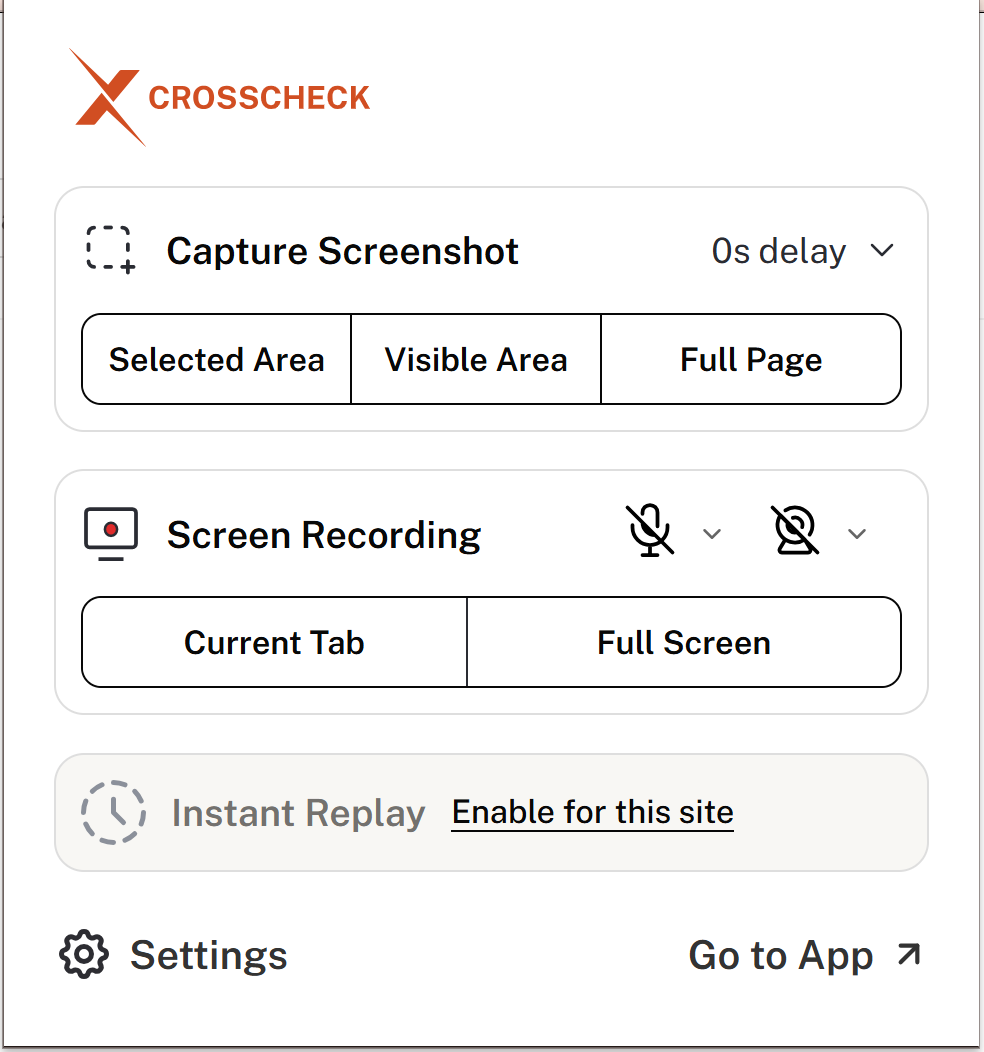
This is the part of the workflow where Crosscheck plugs in. Crosscheck is a free Chrome extension that captures the full context of a bug in one click — screenshot or screen recording, console logs, network requests, and environment metadata — and files a complete report directly to Jira, Linear, ClickUp, GitHub, or Slack. The E2E suite handles the known critical paths at scale; Crosscheck handles the unknown unknowns that surface during manual testing, demos, and customer reports. Pair the two and the time-to-fix loop closes meaningfully faster.
For teams formalising the manual side of this workflow, the perfect bug report template and the best bug reporting tools roundup cover what a complete bug report should contain and how to standardise it across the team.
Start improving your E2E discipline today
A good E2E suite is not the one with the most tests. It is the one engineers trust enough to act on. Stable selectors, independent tests, deterministic data, selective mocking, sharded execution, a real retry-on-flake budget, and full artefacts on failure — these are the disciplines that get a suite to that bar. Pick one to improve this sprint. Most teams find that converting CSS-class selectors to data-testid or role-based locators alone removes a category of flakiness that had been bothering them for months.
For the edge cases your automation misses, Crosscheck captures the full bug context in one click — so the manual half of your quality strategy is as crisp as the automated half.
 Add to Chrome