How to Build a QA Workflow That Survives a Team of 2-15
A QA workflow for a small team is the smallest set of repeatable habits that lets engineers ship without becoming the reason production breaks. For a team of 2-15 people, that almost never means hiring a dedicated tester — it means agreeing on a bug-report standard, a triage owner, a thin layer of automation on the critical path, and a PR checklist that fits on one page. Do those four things and the workflow holds up through a Series A. Skip them and quality decays one shortcut at a time until somebody quits.
Key takeaways
- One person owns triage at a time. Rotate weekly. No "everyone owns quality" — that means nobody does.
- The minimum viable test pyramid for a small team is roughly 70% unit, 20% integration, 10% end-to-end — and an E2E suite that only covers the three or four flows that take money or lose customers.
- Peer review is the QA system until a team passes 15-20 engineers. A PR checklist standardises what the reviewer is looking for.
- Automation enters CI when a bug recurs. Don't write the test until the second incident — write it then, and never again.
- Free tooling is enough. Crosscheck for bug capture, Playwright for E2E, Sentry's developer plan for production errors, Linear's free tier for tracking. Total cost: zero.
What "QA workflow" actually means for a small team
A QA workflow is the sequence of checks a change passes through between a developer's laptop and a paying customer's screen. For a 200-person organisation that sequence has staging gates, a test management platform, release captains, and signed-off matrices. For a small team it has to compress to four moves: a developer self-checks, a peer reviews, an automated suite runs on merge, and somebody owns what happens when a bug lands in production.
The trap most small teams fall into is copying enterprise process at one-twentieth the scale. A 12-person team running a sprint with named QA leads, regression matrices, test plans per ticket, and a separate UAT pass is performing QA theatre — engineers route around it inside two months. The opposite trap is shipping with no process at all, which works until the third production incident in a month and somebody writes a Slack message that starts "we need to talk about quality."
The workflow below is the middle path. It works for a 2-person founding team, a 7-person seed-stage startup, and a 15-person product team a year past Series A — only the cadence and depth of automation changes across that range.
Who owns triage when nobody's full-time QA
Triage is the step where a new bug report gets a severity, a priority, and a single human assigned to fix it. On a small team, the failure mode is that this never happens. Bugs land in a Slack channel, get a few thumbs-up reacts, and drift. A week later somebody asks "did we ever fix that thing?" and the answer is no.
The fix is structural — one person owns triage for a defined window, then it rotates. The owner has three jobs each day they hold the role:
- Acknowledge every new bug within a few business hours. Acknowledgement is not "I'll look at this" — it is severity, priority, and owner assigned.
- Reproduce or punt. If the bug can be reproduced from the report, it stays. If not, the triage owner has the authority to bounce it back to the reporter with specific questions.
- Run the standup-time bug review. Five minutes at the start of the daily standup, the triage owner reads the new bugs aloud, calls the owners, and confirms what's in scope for the sprint.
A weekly rotation works better than a daily one for teams under ten engineers — context compounds, the owner gets pattern recognition by Wednesday, and handoff is a Friday-afternoon Slack message rather than a daily ceremony. For teams in the 10-15 range, rotating per sprint reduces overhead further. The point isn't the cadence; the point is that there's always exactly one name attached to "who decides what we do about this bug."
Spread the role across senior engineers, the technical PM, the founder if they're still hands-on. It builds product context across the team and prevents any one person from becoming the permanent bottleneck on bug decisions.
What gets manual testing vs what gets automated
The 2026 default that small teams keep getting wrong is "everything should be automated." It shouldn't. Automation is expensive to write, to maintain, and to debug when it breaks for reasons unrelated to the feature it tests. A test suite is software that has to be kept alive like any other, and a small team has finite hours.
The rule that holds up across most product teams:
| Coverage type | What it catches | When to use it |
|---|---|---|
| Manual exploratory testing | Visual regressions, UX confusion, edge cases nobody scripted | Every PR, every release. The human in the loop. |
| Unit tests | Logic bugs in pure functions, regressions in business rules | Anywhere logic gets complex enough that you'd want a guardrail when refactoring. |
| Integration tests | API contracts, database interactions, service boundaries | At the seams between modules — payment processing, auth, anything with external dependencies. |
| End-to-end tests | Critical user flows breaking silently | The 3-5 flows that, if broken, cost the company money the same day. |
| Visual regression | Accidental CSS or layout changes | Only if you have a high-traffic marketing surface or a design system. Skip otherwise — overhead exceeds value at small scale. |
Notice what's missing: no row for "every feature gets a full E2E suite." Cover the critical path end-to-end, the complex logic with unit tests, the service boundaries with integration tests. Everything else gets exercised by manual exploratory testing during PR review and the triage owner's regression pass before release.
This is a deliberately narrow pyramid. The 70/20/10 shape is roughly right, but the absolute numbers matter more for a small team. Twenty E2E tests is a healthy upper limit until you have a dedicated test engineer. Hundreds of unit tests on the parts of the codebase with real logic, none on getters and setters, no obsession with coverage percentage.
Peer review as the QA system
The single highest-leverage habit a small team can adopt is treating code review as quality review, not just architecture review. Most engineers were trained to comment on naming, structure, and approach. The QA-aware reviewer adds three more questions:
- What breaks if the input is empty, null, or maximum length? Most production bugs at small companies come from inputs the author didn't think to test.
- What happens when the dependency this code calls is slow or returns an error? Timeouts, retries, partial failures — they're not edge cases at scale, they're the median path.
- Did the author test this themselves? The PR description should answer this. If it says "tested locally" with no further detail, the reviewer asks for specifics.
Pair this with a PR template that prompts the author to fill in the same blanks before requesting review, and the system becomes self-policing. The reviewer's job stops being "find every defect"; it becomes "confirm the author has thought about the failure modes."
This works at small scale for the same reason it stops working at large scale. On a 7-person team the reviewer knows the part of the system being changed and can spot a missing edge case from context. At 70 engineers the reviewer is often unfamiliar with the surrounding code, and peer review degrades into surface-level commentary. That's why dedicated QA roles emerge around the 15-25 engineer mark — the social structure that made peer-review-as-QA effective stops scaling.
The 10 SQA methodologies post covers how peer review fits alongside other quality practices once teams scale past the small-team threshold.
When to introduce CI tests, and which ones
A common mistake is wiring up CI on day one with a placeholder test suite. The CI pipeline then sits idle for months while the team ships, until somebody adds a real test, watches it pass, and forgets about it for another month. CI without a forcing function is theatre.
The forcing function is this: add a test to CI the second time a bug recurs. Not the first time — first incidents are how you discover the bug exists. The second time means the fix didn't hold, or the regression came back, or the class of bug has appeared in a new place. That's the signal that a guardrail is worth the cost of maintaining.
CI for a small team should contain, in order of addition:
- A linter and type-checker on every PR. Free, fast, catches a class of trivial defects.
- Unit tests for the code under active development. Not retrofitted to legacy code. Written alongside new features when the logic is complex enough to warrant it.
- Integration tests on service boundaries as those boundaries solidify. Early in a startup, the boundaries move every sprint and tests written against them break constantly. Once the architecture stabilises, integration tests become cheap.
- A small E2E suite on the critical path. Three to five flows: sign-up, log-in, the primary product action, billing if applicable.
- A nightly or weekly fuller regression run if and only if the E2E suite has grown beyond what's tolerable in PR latency.
Playwright is the right default for new E2E suites in 2026. According to the State of JS 2025 survey (released January 2026), Playwright's developer satisfaction sits at 91% against Cypress's 72%, and Playwright's weekly npm downloads have grown to roughly 33 million versus Cypress's 6.5 million — a 5x gap that didn't exist three years ago. Microsoft's backing, free parallelisation, and cross-language SDK make it the lower-friction choice for teams starting from zero. For teams already on Cypress, there's no need to rip it out; the ecosystem is mature. For greenfield, Playwright is the bet.
The Selenium vs Playwright vs Cypress comparison breaks down the tradeoffs in more depth if the team is deciding between frameworks.
A free tooling stack that doesn't compromise
A small-team QA workflow can run entirely on free tiers. The stack:
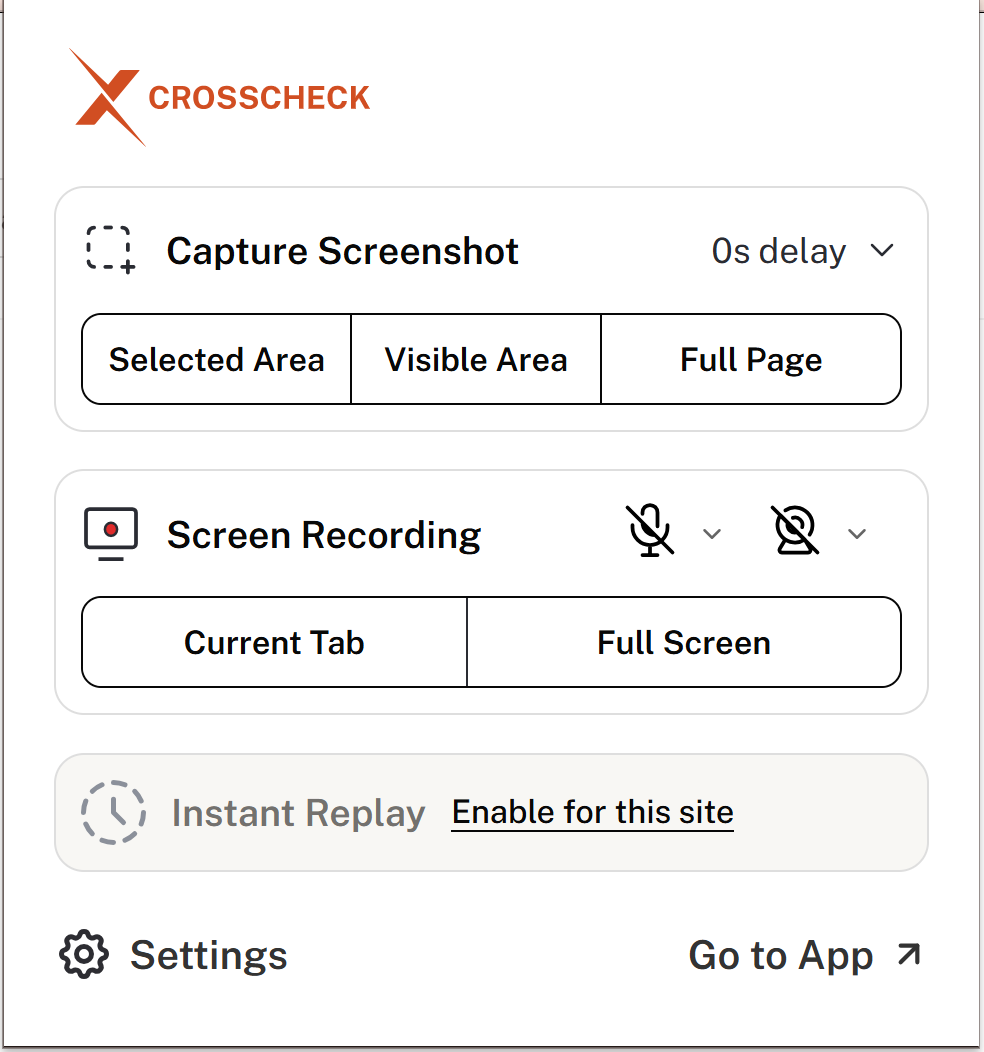
Bug capture: Crosscheck. A free Chrome extension that records screenshots, screen recordings, console logs, and network requests, then files a complete bug report to Jira, Linear, ClickUp, GitHub, or Slack. No usage limits, no paid tier. The reason this matters specifically for small teams: when one person is wearing the PM, QA, and support hat, the time cost of writing a thorough bug report determines whether bugs actually get filed. Cut that cost to ten seconds and the team's effective coverage goes up.
End-to-end testing: Playwright. Open source under Apache 2.0, free to run anywhere. No per-seat fees, no parallelisation tax. Works against Chromium, Firefox, and WebKit out of the box.
Production error monitoring: Sentry Developer plan. Free forever, 5,000 errors per month, 30-day retention, one user with dashboard access (the rest of the team can still deploy the SDK and capture events). For a startup with under a thousand daily actives and reasonable error hygiene, the 5K limit is enough — set inbound filters to drop browser-extension noise and bot traffic to make the quota last the month.
Issue tracking: Linear free plan. Unlimited members, 250 non-archived issues, 2 teams, 10 MB file uploads. The issue cap is the constraint that bites first — a product team running two-week cycles with 25 issues each will hit 250 within a couple of months, and archiving discipline becomes a habit. For teams that find the cap restrictive, the paid tier starts at $10 per user per month, which remains cheap for the value relative to Jira.
Communication: existing Slack or Discord. A dedicated #bugs channel where the triage owner posts the daily snapshot. No new tool required.
That's the entire stack. Total monthly cost for a team of 10: zero, until Linear's issue cap forces an upgrade. Anyone proposing a more expensive tool needs to justify what specifically it adds to this baseline.
The one-pager PR checklist
The PR template below fits on a printed page. Paste it into your repository's .github/pull_request_template.md (or the equivalent in GitLab, Bitbucket, etc.) and require it for every merge.
## What changed

[One paragraph. Plain English. What does this PR do and why?]

## How I tested

[Specific. "Manually tested signup, login, password reset on Chrome 132 and Safari 18.
Verified the API returns 400 for empty email. Ran the unit tests."]

- [ ] I tested the happy path
- [ ] I tested at least one error state
- [ ] I tested with empty / null / unusual input
- [ ] I ran existing tests locally

## What could break

[Honest list of risks. "If the user already has a session cookie from the old flow,
they'll see a 500." This earns trust faster than claiming nothing could break.]

## Reviewer checklist

- [ ] Code matches the description
- [ ] Edge cases the author missed
- [ ] Anything that touches money, auth, or data deletion got extra scrutiny
- [ ] If a bug is fixed: is there a regression test?
That's the whole thing. The "what could break" section is the highest-leverage part — most engineers, on a small team where everyone trusts each other, will tell the truth in that field. The reviewer reads it, focuses there, and the merge is faster than a pro-forma "looks good." Over time the team develops a shared sense of what gets flagged and what doesn't, which is what good engineering culture actually is.
When to evolve past this workflow
The workflow above starts to creak somewhere between 15 and 25 engineers. The signs are consistent:
- Triage backlog grows faster than the triage owner can drain it. The weekly rotation produces handoffs where bugs get re-explained instead of resolved. A part-time or full-time dedicated triage role helps.
- The PR queue lengthens because reviewers don't know the code being changed. Sub-teams form, code ownership becomes a useful concept, and the peer-review-as-QA system needs supplementing with subject-matter reviewers.
- The E2E suite grows past what a developer is willing to wait for on every PR. Test parallelisation, selective runs based on changed files, and a nightly full pass become worth the engineering time to set up.
- Customer-reported defects start exceeding internally-found ones. This is the clearest signal that the catch-rate of the existing workflow has fallen behind the rate of change.
At that point the conversation shifts toward a first dedicated QA hire — more often a quality-focused SDET or a tech lead who owns release engineering, not a manual tester. The evolution of QA roles has pushed the function toward embedded quality engineering: the dedicated hire writes test infrastructure, owns CI performance, and contributes to release tooling rather than executing manual test plans.
For teams that aren't there yet — most teams reading this — the workflow above is enough. Resist the urge to add more.
FAQ
How big should a QA team be at a 10-engineer startup?
Zero dedicated QA engineers, usually. A 10-engineer startup is better served by a rotating triage owner, a strong PR checklist, and a small Playwright suite on the critical path. The first dedicated QA hire makes sense around 15-25 engineers, and that hire should be a test engineer or SDET — someone who writes test infrastructure, not someone who executes test plans manually.
What's the minimum viable test pyramid for a small team?
Roughly 70% unit tests on the parts of the codebase with real logic, 20% integration tests at the service boundaries, 10% end-to-end tests on the three to five flows that take money or lose customers. The absolute numbers matter more than the ratios — a small team's E2E suite should sit under 25 tests in the first year, not chase coverage targets borrowed from larger orgs.
How do you do QA without a QA team?
Ownership rotates. One person owns triage at a time, the PR review process catches what the author missed, a thin layer of automation guards the critical path, and a free bug-capture tool like Crosscheck cuts the time cost of filing complete bug reports. The system works because it doesn't pretend to be more than it is.
When should a startup add CI tests?
Tests get added to CI the second time a bug recurs, not the first. The first time is how you discover the class of bug exists; the second is the signal that a regression guardrail is worth the maintenance cost. Starting with linting and type-checking on every PR — both free, both fast — is the cheapest baseline that pays for itself within weeks.
Is Playwright or Cypress better for a small team in 2026?
Playwright for new projects in 2026 — State of JS 2025 satisfaction scores favour it 91% to 72%, and the npm download gap is roughly 5x. Cypress remains a defensible choice for teams already on it; the ecosystem is mature and the interactive debugging experience is loved by many testers. The cost gap matters more at scale: Playwright's free parallelisation is meaningfully cheaper than Cypress Cloud once test suites grow.
Make bug reporting the cheapest part of the workflow
The cheapest quality win for any small team is removing friction from bug reporting. A bug that takes ten minutes to file gets filed half the time. A bug that takes ten seconds gets filed every time — more issues caught, fewer regressions shipped, more developer context preserved between discovery and fix.
Crosscheck is built for that. One click captures the screen, the console, the network trace, and the user's last few actions, then ships the complete report to Linear, Jira, ClickUp, GitHub, or Slack. Free Chrome extension, no usage cap. For a 2-15 person team where QA runs on shared ownership and tight feedback loops, removing the bug-reporting bottleneck is the highest-leverage change available.
 Add to Chrome