From Bug Reporter to Quality Advocate: How the QA Role Is Evolving
The future of QA is not "fewer testers because AI." It is a steady migration of the role from the end of the pipeline to every stage that produces quality — planning, architecture, code review, release, production telemetry — with AI absorbing the scripted middle and humans owning the judgment at both ends. Capgemini's World Quality Report 2025-26 found that 89% of organizations are now piloting or deploying generative-AI-augmented quality workflows, yet only 15% have scaled it across the enterprise. That gap is where the QA role is being rewritten in 2026.
Key takeaways
- QA's centre of gravity is moving upstream. The traditional end-of-pipeline gatekeeper role is shrinking; embedded quality work — requirements review, architecture input, release engineering — is growing.
- AI augments, it does not replace. Generative AI is now producing test scripts, triaging failures, and analysing logs, but 76% of enterprises run human-in-the-loop review processes to catch AI-generated mistakes (World Quality Report 2025-26).
- The bug-reporting bottleneck has widened. AI-assisted developers merge roughly 60% more pull requests, but those PRs contain about 1.7x more issues — so the quality system, not the typing, is now the constraint.
- Scope keeps expanding. Accessibility, performance, data quality, and security have moved from specialist niches into mainstream QA charters, accelerated by the European Accessibility Act enforcement that began June 28, 2025.
- Durable QA careers combine engineering depth, systems thinking, and the ability to argue quality risk in business terms.
What "quality advocate" actually means
A quality advocate is a QA professional whose primary contribution is shaping quality decisions before, during, and after a release — not just verifying work after it is built. The role is defined less by where the person sits on the org chart and more by which conversations they are invited to.
The traditional bug-reporter role had a narrow remit: receive a build, execute a plan, file defects, sign off. The quality-advocate role is wider on three axes. Earlier — present at requirements and architecture stages, where the most expensive defects are seeded. Wider — accountable for accessibility, performance, security, and data integrity, not just functional correctness. Longer — involved in post-release triage and production telemetry, feeding what production actually breaks back into the next sprint.
This is not a rebrand. It is a measurable shift in scope, and it is happening because the economics of the old model stopped working in DevOps environments.
Why the traditional QA model broke
The end-of-pipeline QA function was sustainable when releases happened quarterly and the bug-find-to-bug-fix loop could absorb a few days of friction. That world is gone for most teams. Mature engineering organizations now deploy multiple times per day, and even mid-sized SaaS teams typically ship weekly. In that environment, a QA function downstream of development is structurally a bottleneck — it can only respond to defects, not prevent them.
Late-catch bugs are also more expensive on every dimension that matters. Developer context is lost between writing the feature and receiving the bug report, so investigation takes longer. Re-test cycles consume capacity that was supposed to be spent on the next sprint. And the friction between development and a downstream QA team — receiving large bug batches at the end of a sprint, every sprint — corrodes the working relationship in ways that no retrospective fixes.
There is a deeper limit too. A QA team testing finished code can catch implementation bugs. It cannot catch the design choice that produced the bug in the first place, or the architectural decision that will make the same class of bug appear three sprints later. Those defects originate upstream of where the traditional QA role operates. Moving QA into those upstream conversations is not optional in a fast-moving release cadence — it is the only way the function stays relevant.
The 2026 reality: AI's real effect on QA work
There is no shortage of marketing claiming AI will eliminate QA jobs. The actual data from 2025-2026 tells a more specific story, and it matters because it predicts which parts of the role are at risk and which are not.
What AI is genuinely automating
Capgemini's World Quality Report 2025-26 reports that 10% of teams are already using AI to generate up to 75% of their automation scripts. Across surveyed organizations, average productivity gains from generative-AI-augmented QA workflows came in at 19%. Self-healing locators — Playwright, Cypress, Mabl, Testim — now recover from common DOM changes without human intervention in the majority of cases. AI-driven failure triage tools route flaky tests into a separate review queue rather than blocking the build. None of this was production-grade in 2022. All of it is table stakes in 2026.
Synthetic test data generation has also moved fast. Synthetic data usage in testing rose from 14% of organizations in 2024 to 25% in 2025 according to the same report. That trend matters for QA roles because building and maintaining test data was historically one of the most time-consuming, lowest-judgment activities on a QA team's plate.
What AI is not automating
The same report flagged that 76% of enterprises have implemented explicit human-in-the-loop review processes to catch AI failures — hallucinated assertions, biased outputs, unsafe automation against production-like environments. The hands that catch those failures belong to QA professionals.
Exploratory testing has proven hard to automate, and unlikely to become trivially automatable soon. The act of detecting that something feels wrong, following an unexpected finding into an uninstrumented corner of the application, and asking the question the test suite was not designed to ask — this is pattern recognition built on product context, not from training data. Commercial agentic testing tools are improving rapidly, but the World Quality Report 2025-26 explicitly frames them as partners, not replacements, with QE staff providing the human-in-the-loop judgment.
Quality advocacy and stakeholder communication are similarly resistant to automation. Translating "the cart API returns 400 under specific cookie conditions" into "we will lose conversions in markets where users have third-party cookies disabled" is a translation problem AI handles unevenly. It requires understanding which audience needs which level of detail and what they will do with it.
Who is most exposed
The QA roles most exposed to AI displacement in 2026 are the ones where work is overwhelmingly scripted, manual, and repetitive — large regression suites maintained by hand, manual smoke testing of stable features, low-context defect entry. The roles least exposed are the ones already adjacent to engineering, product, and customer-impact reasoning. BCG's 2026 analysis categorised software-quality roles as "amplified" by AI: accelerated, but not eliminated, because system-level judgment is still the binding constraint.
IEEE-USA's 2026 outlook went further, projecting that demand for QA testers will rise in the medium term — partly because AI-assisted developers produce more code, and code that needs testing more carefully, not less.
The bug-reporting bottleneck nobody talks about
Test speed has improved by orders of magnitude in the past five years. Bug reproduction time has not. That gap is becoming the dominant inefficiency in modern QA workflows, and it is one of the clearer signals of where the role is heading.
Here is the dynamic in practice. AI-assisted developers using tools like Copilot, Cursor, and GitHub's experimental test-generation features merge roughly 60% more pull requests than developers without those tools, according to industry telemetry compiled in the World Quality Report 2025-26. The same data shows those AI-influenced pull requests contain about 1.7x more issues than entirely human-authored code. The volume goes up. So does the per-PR defect rate. Someone has to catch all of those defects, document them in a way developers can act on, and verify the fix.
In that environment, a bug report missing the console log, the network trace, or a reliable reproduction path is not a minor inconvenience. It is the rate-limiter on the entire release pipeline. A QA professional who can file a complete report in three minutes — screenshot, video, console state, network calls, environment metadata — is materially more valuable to the team than one who files an incomplete report in one minute and triggers a half-hour clarification thread.
This is why the perfect bug report template and the tooling around it has become a strategic concern, not just a hygiene one.
Embedded quality, in five concrete stages
"Embedded quality" gets used loosely in 2026, sometimes as a synonym for sticking a QA engineer on a feature team without changing anything about what they do. Genuine embedded quality means QA professionals contribute at each stage where quality decisions are made.
In requirements and planning. A QA professional reviewing user stories before development begins is hunting for ambiguities that will produce inconsistent implementations, acceptance criteria that cannot be verified, and edge cases nobody has accounted for. Catching these issues before any code is written is orders of magnitude cheaper than catching them in test.
In design and architecture reviews. This is the most often-skipped slot, and arguably the most valuable one. Tight coupling between services, missing error boundaries, inadequate observability — these are quality problems that originate in architecture, not implementation. A QA engineer with enough engineering depth to read a sequence diagram or an API contract can flag these concerns before they become expensive realities.
During development. Shift-left testing is well-established as a concept, but its implementation varies wildly. At its best, QA engineers work alongside developers — reviewing pull requests for edge cases, writing tests in parallel with feature code, verifying acceptance criteria incrementally. At minimum, unit and integration coverage are part of the definition of done, not an afterthought.
In deployment and operations. Quality decisions do not stop at the merge button. Feature flag configurations, canary rollouts, rollback procedures, and production health checks all shape what users actually experience. QA professionals who understand release engineering contribute to in-flight quality, not just pre-release verification.
In post-production. Customer-reported defects, error-rate spikes, and performance degradations are quality signals that should inform the next planning cycle. A QA function that participates in root cause analysis and feeds findings into the backlog drives systemic improvement rather than per-release verification.
At each of these stages, the QA professional is applying judgment to decisions that have not yet been made. That requires a fundamentally different posture from the test-execution role most QA job descriptions still describe.
The expanding scope: accessibility, security, performance, data
Beyond when QA happens, the what keeps expanding. In 2026, several adjacent disciplines have either folded into QA scope or now expect QA participation by default.
Accessibility-as-CI. The European Accessibility Act took effect on June 28, 2025, applying WCAG 2.1 Level AA requirements (via EN 301 549) to new products and services placed on the EU market — including any non-EU business serving EU customers. Penalties run as high as €100,000 or 4% of annual revenue per infringement, with the deadline for existing services landing on June 28, 2030. The practical effect is that automated accessibility checks — Axe, Pa11y, WAVE — are now part of CI for any team that takes the regulation seriously, and QA owns the verification. See best accessibility testing tools and WCAG for the current landscape.
Performance and reliability. Users experience slowness as a defect — and Core Web Vitals tie that directly to organic search visibility. Load testing, performance regression baselines, and production performance monitoring increasingly sit inside the QA charter rather than in a separate performance team.
Security testing. Penetration testing remains specialist work, but QA engineers are increasingly expected to verify common failure modes: injection vulnerabilities, broken access control, session management flaws. The concept of security regression testing — making sure known vulnerability classes have not been reintroduced — fits naturally inside the QA discipline.
Data quality. For products that process or display significant data — analytics platforms, fintech, anything ML-adjacent — data quality has become a first-class QA concern. Pipeline tests, transformation validation, and cross-system integrity checks all show up in QA charters that didn't include them five years ago.
Each expansion requires QA professionals to develop adjacent domain knowledge — not to a specialist's depth, but enough to design meaningful tests and interpret the results without leaning on someone else.
Agentic testing: the next frontier
The World Quality Report 2025-26 named agentic technologies — autonomous AI agents that execute multi-step test plans — alongside generative AI as the two forces actively reshaping quality engineering. Tools like Mabl's MCP-integrated agents, Testim's Agentic Test Automation, and QA Wolf's managed agent service are commercial today; open-source frameworks let teams build their own with reasonable effort.
The current limit of agentic testing is consistency. Agents can complete a defined journey reliably when the path is well-instrumented; they are still poor at understanding intent under ambiguous UI states, which is exactly where exploratory testing earns its keep. The shape of the QA role in an agentic future is the obvious one: humans define the test strategy and own the judgment calls, agents execute the volume work, and the QA professional reviews the results with the context to know when an agent missed something the test plan didn't anticipate.
Teams experimenting with agentic testing now — even just on regression coverage — are positioning themselves for what will be expected delivery infrastructure within the next two years. For a broader survey of the tooling landscape, see best AI testing tools 2026.
Skills that hold value through 2030
The skill profile of a QA engineer in 2026 looks different from 2020. Five capabilities are doing most of the work in distinguishing durable careers from at-risk ones.
Engineering depth. The ability to read code, author and maintain automated tests, understand CI/CD pipelines, and work fluently in the same environments developers work in. The gap between "QA engineer" and "software engineer" is narrowing. The technical floor is rising every year.
Systems thinking. The ability to reason about how components interact, where failure modes emerge under load, and what risks live at the seams between services. The defects that matter most are usually not the ones easiest to find — they are the ones that emerge from interactions no single test was designed to cover.
Communication and influence. Quality advocacy requires the ability to argue risk in terms that non-QA stakeholders act on. That means translating technical findings into business impact, calibrating detail to audience, and being willing to push back when a release decision underweights risk. This is a learned skill, not an innate one.
Domain knowledge. QA engineers who understand the business their product serves — user workflows, regulatory environment, competitive context — design more meaningful tests than those who only test against the spec. Domain knowledge is a multiplier on every other skill.
Adaptability. The technology landscape is changing faster than at any previous point in the profession. The specific tools that matter in 2026 will look different by 2030. The durable skill is the ability to learn new tools quickly and evaluate them critically — particularly the AI-augmented ones, where vendor claims and real capability still diverge.
For QA professionals earlier in their career, the same skills frame the on-ramp into the role. How to become a QA engineer in 2026 walks through the practical sequence.
What organizations need to change
The future of QA roles is only half about what QA professionals do. The other half is whether the organization gives them conditions where the evolution is possible.
Four organizational shifts separate companies where the role evolves from companies where it stays stuck on the end of the pipeline.
Bring QA into planning by default. If QA is not in the room when requirements are written and acceptance criteria are defined, QA cannot catch the quality problems that originate there. This requires a deliberate change to the planning ritual, not a statement of intent.
Measure quality outcomes, not test output. Organizations that measure QA by test case count and bug count create incentives that optimize for those metrics rather than for actual product quality. The outcomes that matter are defect escape rate, mean time to resolution, regression frequency, and production incident rate. Shifting to outcome-based measurement is the prerequisite for everything else.
Give QA a seat at the architecture table. This is rare and disproportionately valuable. QA engineers in architecture reviews bring a quality perspective that is otherwise absent — usually because they have spent the last several years staring at the failure modes the architecture team would prefer to abstract away.
Invest in QA career development. The skills the future role demands require ongoing investment in training, tooling, and time. Organizations that treat QA as a cost centre will find their QA function cannot evolve at the pace the role demands — which means the company hits the wall the World Quality Report describes: AI adoption stalls at the pilot stage because the team running it doesn't have the skill ceiling to take it further.
The World Quality Report 2025-26 found that 58% of enterprises are now actively upskilling QA teams in AI tools, cloud testing, and security. That is the leading indicator. Where that investment is happening, the role is evolving. Where it isn't, the function is sliding into irrelevance regardless of how busy the calendar looks.
FAQ
What is a quality advocate in QA?
A quality advocate is a QA professional whose primary contribution is shaping quality decisions across the entire product lifecycle — from requirements and architecture through release and production — rather than only verifying completed work at the end. The role replaces the traditional bug-reporter posture with embedded participation in planning, design, development, deployment, and post-release triage.
Will AI replace QA engineers by 2030?
Not according to the current data. Capgemini's World Quality Report 2025-26 found that 76% of enterprises now use human-in-the-loop review on AI-driven quality workflows, and BCG's 2026 analysis categorised software-quality roles as "amplified" — accelerated by AI, not replaced. IEEE-USA's 2026 outlook actually projects rising demand for QA testers, in part because AI-assisted developers produce more code that needs more careful testing.
What skills do QA engineers need in 2026?
The five skills doing the most to predict durable QA careers in 2026 are engineering depth (the ability to write and maintain automated tests), systems thinking, communication and influence with non-QA stakeholders, domain knowledge of the product's industry, and adaptability — particularly the ability to evaluate AI-augmented tools critically as the vendor landscape shifts.
How does shift-left testing relate to the quality advocate role?
Shift-left testing is one component of the quality-advocate role. It refers to QA work happening earlier in the development cycle — at requirements, design, and code review stages — rather than at the end. The quality-advocate role extends shift-left in both directions: also shifting right into deployment, observability, and post-production triage.
What is agentic testing and when will it matter?
Agentic testing uses autonomous AI agents to execute multi-step test plans without per-step human instruction. It is commercially available today through tools like Mabl, Testim, and QA Wolf. The World Quality Report 2025-26 identified agentic technologies as a force actively reshaping quality engineering — most teams using it pair it with human review for now, but it is on track to become standard delivery infrastructure within the next two years.
How is the European Accessibility Act changing QA work?
The European Accessibility Act took effect on June 28, 2025, applying WCAG 2.1 Level AA (via EN 301 549) to new products and services in the EU market, with non-compliance penalties reaching €100,000 or 4% of annual revenue. The practical result is that accessibility testing — automated scanning with Axe, Pa11y, or WAVE plus manual screen-reader verification — is now an enforced QA responsibility rather than an optional best practice for any team selling into the EU.
File complete bug reports as quality advocates
As QA professionals take on a broader scope — embedded in teams, contributing across the development lifecycle, operating in fast-moving CI/CD environments — the tools they reach for need to keep pace. The bug report itself remains the moment where quality work either compresses or stalls. A report missing the console state, the network trace, or a reliable reproduction path is the rate-limiter on the entire release pipeline.
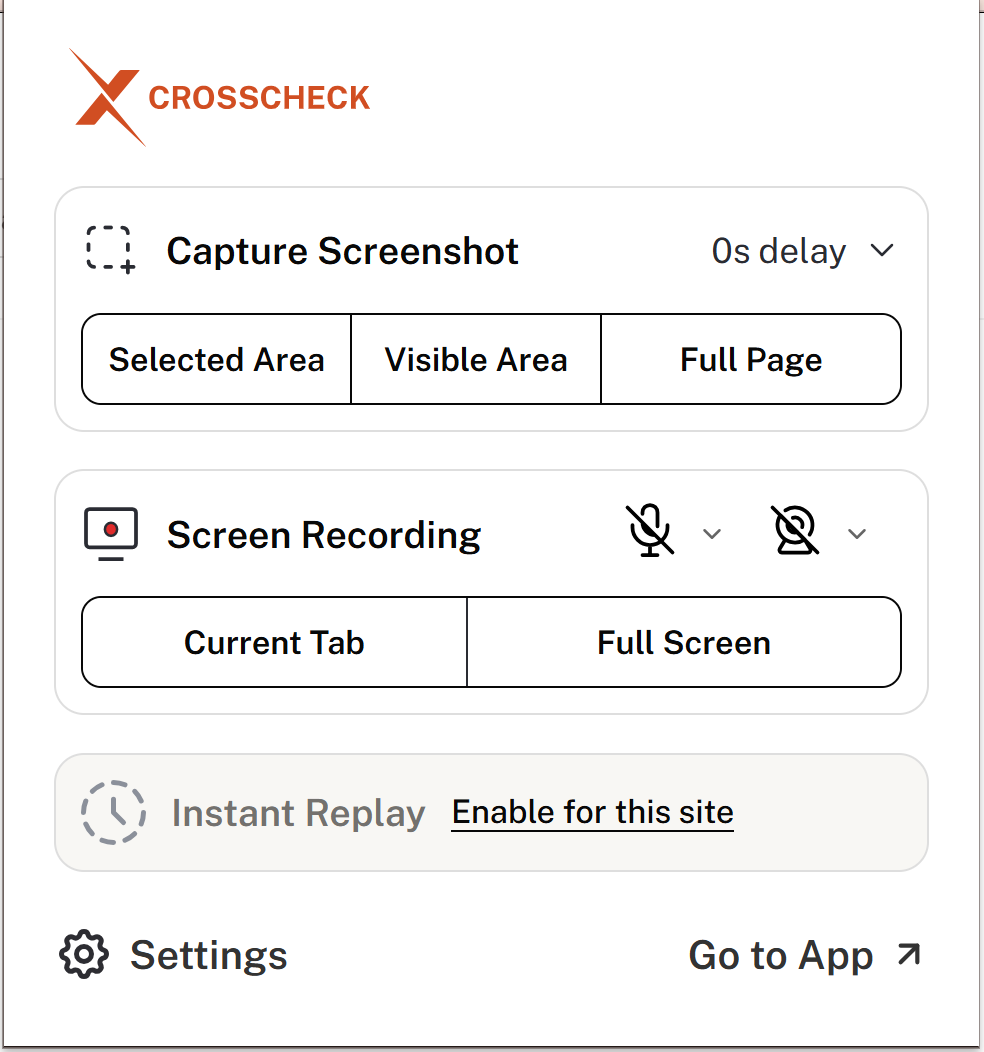
Crosscheck is a free Chrome extension built for the way modern QA actually works. When you find a defect — in an exploratory session, during pre-release verification, or while triaging a production issue — Crosscheck captures the screenshot or session replay, the full browser console log, every network request, and the environment details (browser version, OS, viewport) in a single action. The report goes straight to Jira, Linear, ClickUp, GitHub, or Slack with no usage limits and no paid tiers.
If you are filing bugs in 2026, the goal is a report that is complete the first time and a clarification thread that never starts. Try Crosscheck free.
 Add to Chrome