Linear vs Jira for QA: The Honest 2026 Comparison
Linear vs Jira for QA comes down to one trade-off: Linear is a fast, opinionated issue tracker built for small-to-mid engineering teams; Jira is a configurable enterprise platform with deep workflow customisation and a 4,000+ app ecosystem. If your QA function is embedded in a 5–100-person engineering team and bug reports are mostly straightforward, Linear will be faster and cheaper to live with. If your QA function operates as its own department, runs formal verification workflows, or feeds compliance reports, Jira's configurability is worth the overhead it costs you.
This guide breaks down where each tool actually wins for quality assurance work in 2026 — not the marketing version, the version where you have to file 40 bug reports a week and explain defect density to a VP every quarter.
TL;DR — what you need to decide
- Linear is local-first, keyboard-driven, and built around a flat issue model with a 0–4 priority integer (0 = No priority, 1 = Urgent, 4 = Low). Pricing: free up to 250 issues, $10/user/month Basic, $16/user/month Business.
- Jira is workflow-engine-driven, hierarchical (epic > story > subtask > bug), and supports almost any QA process you care to model. Pricing: free up to 10 users, $7.91/user/month Standard, $14.54/user/month Premium.
- Severity is a custom field in both tools. Despite common belief, Jira does not ship a native Severity field — it was deliberately removed years ago — and Linear handles severity through labels. Either way, you build the field yourself.
- The split is roughly the 50-person mark. Below it, Linear's speed compounds. Above it, Jira's reporting and integration depth become hard to replace.
- A bug report is only as good as its evidence. Whatever tracker you pick, the quality of the data attached to each ticket — console logs, network requests, repro steps — matters more than the tool's logo.
Two products built on opposing philosophies
The philosophical split predicts the rest of the comparison.
Jira was released by Atlassian in 2002 as a bug tracker, then grew into a general-purpose platform that could absorb marketing ops, legal intake, IT service desks, and software development under one roof. Its core promise is flexibility — almost any workflow, any reporting requirement, any team structure can be modelled if you are willing to configure it. The Atlassian Marketplace, launched in 2012, surpassed $2 billion in lifetime sales. Configuration depth is the product.
Linear launched in 2019 with the opposite premise. It is an opinionated, developer-first issue tracker built around speed and a small set of strongly held defaults. It does not try to serve every team in an organisation — it serves software engineers and product teams who want to move fast without negotiating with their tooling. The configuration surface is deliberately narrow because the Linear team treats most configuration as friction in disguise.
For QA teams, this has practical consequences. Jira lets you encode almost any verification process — including the gnarly ones with sign-offs, traceability matrices, and ITIL-style approvals. Linear's opinionated approach means the process is mostly decided for you, and your job is to fit your work into Linear's shape rather than bend the tool into yours. Neither is objectively right. The right one is the one whose default shape matches your actual workflow.
UI, speed, and the feel of using each tool daily
This is the difference you notice in the first ten minutes — and the one that compounds across a year of bug filing.
Linear uses a local-first architecture: workspace data lives in the browser's IndexedDB, sync happens in the background via a GraphQL API, and the UI optimistically renders state changes before the server confirms them. Most interactions — searching, status changes, moving a ticket between cycles, filing a new bug — feel essentially instant. Keyboard shortcuts are first-class; experienced users navigate without touching the mouse. The visual design is restrained and designer-first.
Jira is slower. Even with the performance work Atlassian shipped through 2024 and 2025, loading a Jira board generally takes one to three seconds depending on workspace size and the marketplace apps installed. The interface has accumulated more than two decades of features, and navigation can require several clicks through menus whose hierarchy is not always intuitive. New joiners typically need a Jira-fluent colleague to walk them through where things live.
For a QA engineer who opens 20–60 tickets a day, the speed delta is not just aesthetic — it is roughly 30–60 minutes of cumulative wait time per week that Linear gives back.
Bug tracking and severity: what each tool actually gives you
This is the most misunderstood comparison in the Linear vs Jira debate, so it is worth being precise.
Issue structure
Jira offers a hierarchical model — Epics contain Stories, Stories contain Subtasks, Bugs are a distinct issue type with their own workflow, screens, and fields. Traceability becomes natural: a defect links to the story it was found against, which links to the epic, which links to a release. For QA processes that need an audit trail from requirement to test case to defect — common in regulated industries — Jira's hierarchy is genuinely load-bearing.
Linear uses a flat model. Everything — features, tasks, bugs, tech debt — is an Issue. Issues live inside Projects and Cycles and support parent-child sub-issues, but there is no first-class Epic > Story > Subtask hierarchy. For most product engineering teams that is a feature: less ceremony, less classification. For regulated QA work it is a real constraint you should not paper over.
Priority and severity (the part most articles get wrong)
Linear ships a 5-level priority field as an integer: 0 = No priority, 1 = Urgent, 2 = High, 3 = Medium, 4 = Low — the canonical mapping the Linear API exposes. There is no built-in severity field. Teams that distinguish severity from priority typically encode it with labels (sev-1, sev-2, sev-3) or a workspace convention.
Jira does not ship a native Severity field either, despite what many comparison articles claim. Atlassian deliberately removed Severity from the default schema years ago, reasoning that business users confused it with Priority. Today, severity in Jira is a custom field — usually a single-select dropdown — that an admin adds and binds to bug-related screens. Jira Service Management has Severity built in for incidents; Jira Software does not. The honest summary: both tools require you to build severity yourself. Jira has more native machinery to make the custom field feel first-class (icons, colours, screen schemes), but it is still a custom field.
Custom workflows and transitions
This is where Jira's flexibility earns its overhead. The workflow engine lets you define arbitrary statuses, transitions with conditions and validators, post-functions that fire on state change, and permission schemes that gate who can move what. For QA teams running formal verification — where a closed bug must be approved by a second reviewer, or a failed retest auto-reopens a ticket and re-notifies the original assignee — Jira's configurability is the right tool for the job.
Linear gives you a fixed set of status categories (Backlog, Todo, In Progress, In Review, Done, Cancelled, Duplicate) that you can rename and add custom states under, but the categories themselves are fixed. There are no conditions, validators, or post-functions in the Jira sense. If your QA process needs a status machine more complex than "a thing is being worked on or it isn't," Linear will fight you.
Reporting and defect metrics
Jira's built-in reports cover burndowns, velocity, cumulative flow, control charts, and (on Premium and above) cross-team capacity planning via Advanced Roadmaps. Defect density by component, escape-rate dashboards, mean time to resolution by severity — all of this is buildable natively or with reporting apps from the Marketplace (eXtended Reporting, Custom Charts, Power BI Connector).
Linear's reporting is sprint-focused and intentionally light: cycle health, throughput, triage workload, basic team velocity. Linear Insights, available on Business and above, adds analytics dashboards but is not aimed at the QA-manager-presenting-to-a-VP use case. For teams where defect metrics are part of the operating cadence, Jira's depth is hard to substitute.
Workflows: cycles vs sprints
Both tools support Scrum and Kanban patterns, but the experience differs.
Jira's sprint model is mature and explicit — plan from the backlog, set capacity, run a sprint review, close the sprint, review the burndown — all first-class actions in the UI. For teams running textbook Scrum, the workflow was designed with those ceremonies in mind. The downside is that the ceremony is visible in the tool whether you want it or not.
Linear uses Cycles instead. A cycle is a time-boxed window (commonly one or two weeks) during which issues are actively worked. When a cycle ends, incomplete issues automatically roll forward — no manual closure, no retrospective artifact, no required ceremony. Lightweight agile teams love this; teams that treat sprint rituals as load-bearing process miss the structure.
For QA specifically, Jira's sprint model makes intra-sprint test coverage easier to track — which stories have linked test cases, which defects are blocking acceptance, which bugs were filed-and-fixed within the same window. Linear can do the same job, but more of it falls on team discipline.
Integrations and the surrounding ecosystem
This gap is the largest in the comparison and probably the most underweighted.
Jira integrates with 3,000+ apps through the Atlassian Marketplace (the broader marketplace lists 4,000+ items across Confluence, Bitbucket, and other Atlassian products). The QA-relevant slice is unusually deep — test management (Zephyr, Xray, TestRail), BDD tooling, requirements traceability, security and compliance scanners, monitoring, customer support. Whatever else is in your stack, it almost certainly has a Jira integration.
Linear integrates with 2,200+ tools depending on the count. The set skews developer-first: GitHub, GitLab, Figma, Sentry, Slack, Intercom, plus the recently expanded MCP (Model Context Protocol) support added April 30, 2026, which lets AI agents act on Linear data from outside the workspace. What exists is generally high quality. What does not exist is harder to substitute — particularly QA-specific tooling for test case management, performance testing, and accessibility scanning, where Jira's catalogue is meaningfully thicker.
If your QA team uses a Chrome extension like Crosscheck to capture bugs with full evidence — console logs, network requests, annotated screenshots, screen recordings — both tools are supported, but Jira's native bidirectional sync is older and more battle-tested. Teams moving to Linear should sanity-check that every tool in their QA stack supports Linear's API before committing.
Pricing in 2026: what it actually costs
Both tools use per-user monthly pricing and both have free tiers. The headline numbers are close. The total cost of ownership is not.
Linear (verified May 2026)
- Free — up to 250 active issues, 2 teams, 10MB file uploads
- Basic — $10/user/month — unlimited issues, 5 teams, admin roles, full API access
- Business — $16/user/month — unlimited teams, private teams, Triage Intelligence, Linear Insights, Asks, Zendesk and Intercom integrations
- Enterprise — custom (SAML/SCIM lives here)
Linear cut its Business tier price aggressively through late 2025 and early 2026 — Business sat at $50/user/month in mid-2025 before dropping to $16. Read that as a signal: Linear is fighting harder for mid-market accounts.
Jira (verified May 2026)
- Free — up to 10 users, 2GB storage
- Standard — $7.91/user/month — project roles, advanced permissions, 1,700 automation rule runs/month
- Premium — $14.54/user/month — Advanced Roadmaps, sandbox, 1,000 rule runs per user, 24/7 support, AI features
- Enterprise — custom pricing, annual only
A few quiet realities behind the Jira sticker price. Maximum Quantity Billing, rolled out July–October 2025, ties monthly bills to peak headcount rather than end-of-month seats. Atlassian has historically raised prices 5–15% annually. And the QA add-ons most teams end up buying from the Marketplace — Zephyr Squad, Xray, eazyBI — typically add $5–15 per user per month on top of base Jira. A Jira Standard + Xray + Confluence stack can land closer to $18–22/user/month than the $7.91 headline.
For a 30-person engineering team, the realistic comparison is roughly Linear Business ~$480/month vs Jira Standard + Xray + Confluence ~$540–660/month. Linear's pricing is more honest at small scale. Jira wins at the very low end (free up to 10 users) and the very high end (negotiated Enterprise contracts).
A decision matrix by team type
| Team profile | Recommendation | Why |
|---|---|---|
| 5–25 engineers, embedded QA | Linear | Speed compounds, ceremony is overhead, severity by label is fine |
| 25–75 engineers, embedded or hybrid QA | Linear, watch the limits | Works until you need formal workflow gates or deep reporting |
| 75+ engineers, QA as a distinct department | Jira | Workflow engine, custom fields, reporting are load-bearing |
| Regulated industry (fintech, healthtech, govtech) | Jira | Traceability, audit, permission schemes — Linear cannot match |
| Heavy Atlassian-stack org (Confluence + Bitbucket) | Jira | Lock-in is real and the integrations are tight |
| Designer-led or product-led shop, fast cycles | Linear | Cycles, keyboard-first UX, low ceremony |
| Mid-market team unsure | Start on Linear, switch when blocked | You will know exactly which Jira feature you are buying when the time comes |
The 50–75 person mark is the rough crossover point. Below it, Linear's defaults usually beat Jira's flexibility because most teams do not actually exercise that flexibility. Above it, Jira's depth becomes hard to replicate with workarounds.
QA-specific feature comparison
| Feature | Linear | Jira |
|---|---|---|
| Native issue hierarchy | Flat (sub-issues only) | Epic > Story > Subtask > Bug |
| Native Severity field | No — labels | No — custom field (Jira Software) |
| Priority model | Integer 0–4 (Urgent–Low) | Custom, configurable |
| Custom workflows / transitions | Limited | Conditions, validators, post-functions |
| Test case management | Not native | Marketplace (Zephyr, Xray, TestRail) |
| Defect reporting | Insights (Business+) | Native + Marketplace apps |
| Sprint / cycle management | Cycles (automated rollover) | Sprints (full Scrum support) |
| UI speed | Sub-50ms common actions | 1–3s for board loads |
| Learning curve | Low | Steep — onboarding usually weeks |
| Integration breadth | 2,200+ | 3,000–5,000+ |
| Pricing transparency | High | Moderate (Marketplace adds cost) |
| Enterprise compliance | Limited (Enterprise tier needed) | Yes — purpose-built |
Migration friction (the part nobody warns you about)
Moving from Jira to Linear, the workflow flattening is the hard part. Linear's importer handles the data — issues, comments, attachments, history — reasonably well, but custom workflows, custom fields, and the layered permission schemes you have built over years do not translate. Teams that migrate successfully typically use the move as an excuse to simplify, accepting that some Jira power they used twice a year is not worth carrying forward.
Moving from Linear to Jira, the failure mode is the opposite: teams over-configure Jira on day one, building custom workflows and screen schemes for processes they never actually ran, then spend the next year unwinding them. The safer move is to start Jira close to default and only customise where a real ceremony demands it. Either way, tooling does not fix process. If bug triage was chaotic in Linear, it will be chaotic in Jira with more fields.
How Crosscheck fits either tracker
Whichever tool wins for your team, the upstream problem rarely changes. Bug reports show up with vague repro steps, no console logs, no network traces, and a screenshot from someone's phone — and the developer spends 40 minutes reconstructing state the tester already had on their screen.
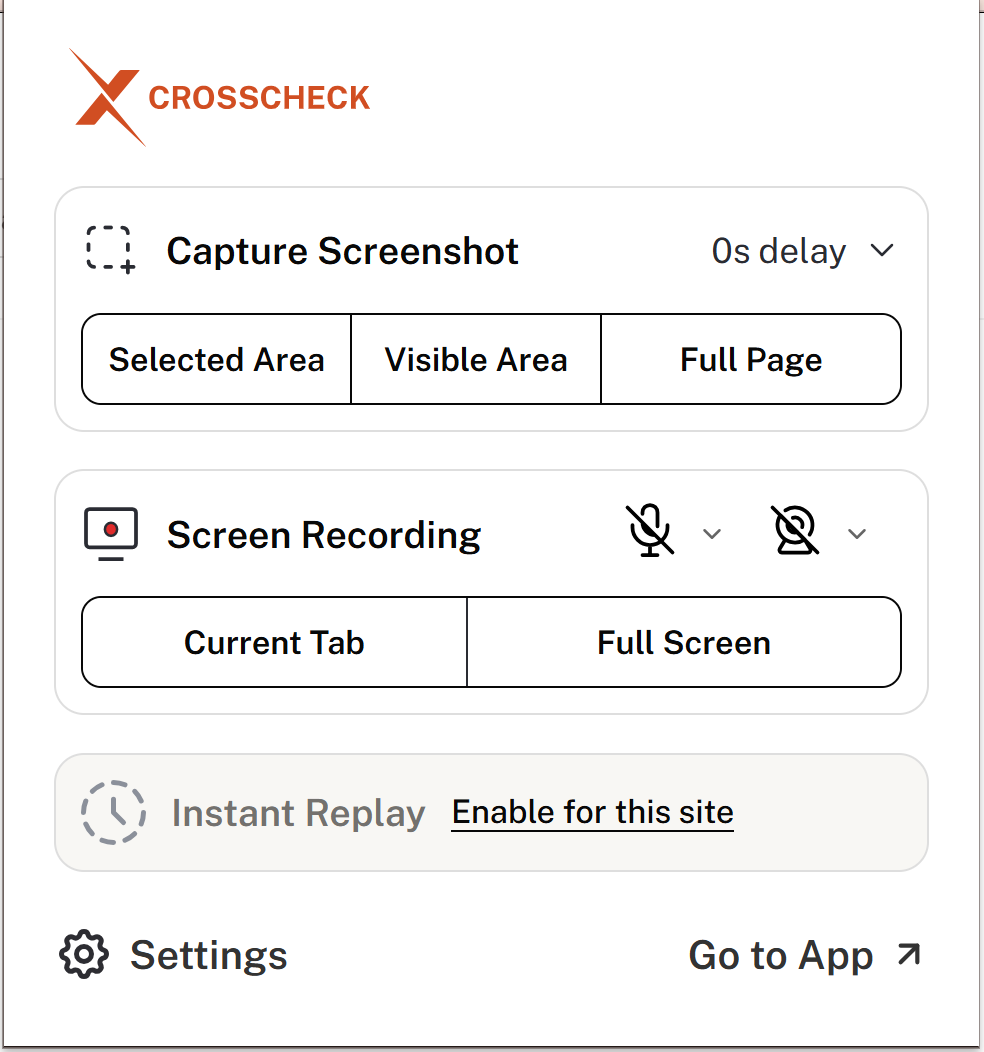
Crosscheck is a free Chrome extension that captures the full context of a bug at the moment it happens: screenshot or screen recording, console log timeline, network request trail, URL, browser and OS, plus any annotations. That bundle goes directly into Linear or Jira (or ClickUp, Slack, GitHub) as a complete ticket — no copy-pasting, no follow-up DMs, no "can you send me the console output?" round-trips. The tracker is a strategic choice. The evidence in each ticket is a daily one — and it drives cycle time more than which logo sits at the top of the page.
FAQ
Is Linear a good Jira alternative for QA teams?
For embedded QA teams of 5–75 people whose process does not require custom workflows, formal sign-off chains, or test case management, Linear is a strong Jira alternative — faster, cheaper at mid-market, lighter to operate. For QA teams in regulated industries or large enterprises with traceability requirements, Linear lacks the depth Jira purpose-built over two decades. The Jira alternative for QA question is really about your team's process maturity and compliance burden.
Does Linear have a severity field for bugs?
No. Linear does not ship a built-in severity field. Teams that distinguish severity from priority typically use labels (sev-1, sev-2, sev-3). The Linear priority field is a 0–4 integer (0 = No priority, 1 = Urgent, 4 = Low) and is the closest thing the tool gives you out of the box.
Does Jira have a native severity field?
Jira Software does not. Atlassian removed Severity from the default schema years ago because it confused business users who already had Priority. You add Severity back as a custom field — typically a single-select dropdown — and bind it to bug-related screens. Jira Service Management is the exception: it has an editable Severity field for incident management.
Which is cheaper, Linear or Jira?
Under 10 users, Jira's free tier wins. From 10 to roughly 50 users, Linear is often cheaper once you include the Marketplace apps most Jira QA teams end up buying. Above 100 users, Jira's Enterprise pricing can be negotiated down and the integration depth often justifies the cost. The verified 2026 sticker prices: Linear Basic $10/user/month, Business $16; Jira Standard $7.91/user/month, Premium $14.54.
Can I use both Linear and Jira together?
Some organisations do — engineering on Linear, the wider business on Jira — bridged with sync tools like Unito or Exalate. It works, but the overhead of maintaining two trackers is real. For most teams, picking one and committing is cheaper than running both.
Pick the tool that matches your defaults
The honest takeaway is the same one most experienced engineering leaders land on. Linear is the better default for product engineering teams under 75 people who want speed and low ceremony. Jira is the better default for organisations where QA is a real function with its own process, reporting, and compliance load. The wrong answer in both directions is choosing the tool whose marketing matches your aspirations rather than the one whose defaults match your actual workflow.
Whichever you pick, the part that moves cycle time most is not the tracker — it is the quality of evidence in each report. Try Crosscheck free to capture full-context bug reports straight into Linear or Jira from the browser.
 Add to Chrome