Building a QA Process With No QA Team: A 2026 Startup Playbook
A startup QA process without a dedicated QA team is a documented set of quality gates — definition-of-done, peer review, automated tests in CI, structured bug capture, staged releases — that engineers and founders operate themselves until headcount justifies a specialist hire. The point is not to imitate a QA department on the cheap. It is to be intentional about the same five or six decisions a QA department would make, so that quality compounds with the codebase instead of degrading with it.
This is the dominant model right now. According to Revelio Labs research cited across 2026 startup hiring guides, the median Series A headcount has shrunk from 57 employees in 2020 to about 47 in 2025 — lean teams are the default, and a full-time QA hire typically does not arrive until the engineering team crosses 15 to 30 people. Everything before that is founder-led or developer-owned QA, which is what this playbook covers.
Key takeaways
- No QA team is not no QA process. The same gates exist; engineers operate them. The teams that skip the gates do not save QA cost — they defer it and pay in churn and hotfixes.
- Definition-of-done is the cheapest quality investment. A written list of what "done" means catches more bugs per dollar than any tool you can buy.
- Free-tier tooling is genuinely sufficient. Playwright, Vitest or Jest, GitHub Actions (2,000 free private minutes a month), Sentry Developer (5,000 free error events a month), and Crosscheck cover the testing, CI, observability, and bug-capture stack at zero spend.
- Peer review, dogfooding, and a small beta panel are the three QA substitutes that scale better than hiring would at this stage.
- The first QA hire arrives when release confidence drops and engineers are losing hours per sprint to manual regression — not at a fixed headcount.
Why "we test our own code" is not a QA process
The default at most pre-QA startups is some informal mix of: developers run the feature manually before pushing, someone clicks around staging, and the team monitors Slack for complaints after deploy. It is not nothing — it is just not a process.
Developers test their own code with the benefit of knowing exactly what they built. They click through the happy path because that is the path their mental model leads them to. They do not test the edge case they never imagined. They do not notice that their change broke a seemingly unrelated feature three screens away. They do not test on the browser or device that a meaningful percentage of users actually use.
Ad hoc testing also has no memory. There is no record of what was tested, what was skipped, or what the expected behaviour actually is. When a bug is reported in production, there is no way to know whether it was tested and missed or never tested at all — which means there is also no way to improve the process.
The fix is not to hire a tester. The fix is to replace the informal habit with something intentional and improvable. Everything below is that replacement.
What founder-led QA actually looks like
Founder-led QA is the practice of the founders — or the most product-aware engineers on a small team — owning the role of "the user advocate" until the company can afford to specialise it out. It is the model used at almost every successful seed-stage company, including some that grew far past the point where one might expect it to scale.
The practical shape of it is small. A founder spends a few hours a week using the product like a real customer would, files bugs the same way a paying customer would, and is the loudest voice in the room when a release feels risky. They are not writing test cases. They are bringing the user's perspective into a room that otherwise contains only people who know how the sausage is made.
Three habits define a useful founder-QA practice:
- A weekly user-flow walk. Once a week, the founder runs through the three or four flows that matter most to the business — sign-up, the core value-delivery flow, billing — without a script, on the most common browser and device combination the customer base actually uses.
- A real bug filing discipline. When the founder finds something, it gets filed in the same tracker the engineers use, with the same level of detail any other reporter would be expected to provide. No special Slack channel, no "I'll just tell you about it" — that habit corrodes the bug-reporting culture faster than anything else.
- Release sign-off as a judgement call. Before any visible change reaches all users, the founder gets a build to look at. Not to approve in detail — to flag the things that feel wrong from the outside.
This is the lightest possible quality function. It exists because the alternative — a team of engineers and no user advocate in the room — is the failure mode that produces technically correct software that nobody wants to use.
Define "done" before you do anything else
The single highest-leverage QA decision at a startup with no QA team is writing down what "done" means. Most teams have an implicit version of this in their heads. The implicit version is the problem. Engineers ship to slightly different bars, regressions slip through the gap between those bars, and the team has no shared language for whether a piece of work is actually finished.
A written definition-of-done for an early-stage team does not need to be elaborate. A useful one fits on a sticky note:
- Acceptance criteria from the ticket are checked off
- Unit tests cover the new business logic
- Manual verification of the primary flow has been completed
- No new console errors or network failures introduced
- Tested on the two browser/device combinations that cover most of the user base
- Peer review approved, CI is green
That is it. The list will evolve — accessibility checks will join when the customer base demands it, smoke tests will get added when release confidence drops — but starting with five or six explicit items beats starting with zero. The biggest gain from writing this down is not the list itself. It is the conversation the team has when they disagree about whether something on the list applies to a given piece of work.
Peer review as QA (not just code correctness)
Code review is the most underused QA tool available to small engineering teams. Most teams use it primarily as a correctness check — does the code do what the author thinks it does? — but a reviewer who is thinking about quality asks a different set of questions, and those questions are where the QA value lives.
A peer reviewer doing quality work checks:
- Edge cases. What happens with empty input, null, very long strings, unexpected formats, network failures? Has the author considered each of these, and is there a test for the ones that matter?
- Error handling. What happens when the API call fails? Is the error surfaced to the user in a way they can act on, or does the UI silently freeze?
- Regression risk. Does this change touch anything that could break behaviour elsewhere? Are there tests covering those areas?
- Testability. Is the code structured in a way that is testable? A function that does five things with hidden dependencies is signalling that the design needs more work before merge.
- Acceptance criteria. Does the implementation actually match what the ticket asked for? Tickets and code drift during development — peer review is the last cheap chance to catch the drift.
For peer review to function as a quality gate, the team has to agree on two non-negotiables: no self-merging, and CI must be green before approval. Teams that nominally have code review but routinely merge without it — because a deadline is tight, or the PR is "obviously fine," or no one responded — do not have code review. They have code review as a formality, and the bugs find their way through.
The free tooling stack for a startup with no QA team
A startup at this stage can build a credible QA tooling stack at zero recurring cost. The pieces have all matured to the point where the free tiers are not crippled — they are genuinely production-grade for a small team.
| Layer | Tool | Free-tier reality (2026) |
|---|---|---|
| Bug capture | Crosscheck | Free Chrome extension, no usage limits, no paid tier. Captures screenshots, screen recordings, console logs, and network logs into one report; sends to Jira / Linear / ClickUp / Slack / GitHub. |
| Unit testing | Vitest (Vite stacks) or Jest | Vitest is the rising default and was named the fastest-growing testing library in the State of JS 2025 ecosystem alongside Playwright. Jest still has nearly double the install base for legacy stacks. |
| End-to-end testing | Playwright | The clear E2E winner in State of JS 2024 — 94% retention, 92% satisfaction versus Cypress's 74%, and 45.1% adoption among QA professionals (compared with Cypress at 14.4% and Selenium at 22.1%). Fully open-source. |
| Visual regression | Playwright toHaveScreenshot() or Chromatic free tier | Built-in pixel diffing in Playwright covers most needs without a paid service. |
| CI | GitHub Actions | 2,000 free private-repo minutes/month on the Free plan, 3,000 on the $4/seat Team plan, unlimited for public repos. A typical small-team workload of 50 runs/day at 8 minutes each stays well inside the allotment. |
| Error monitoring | Sentry Developer plan | Free forever, 5,000 errors/month, 30-day retention. Enough to baseline a low-traffic production app — disable performance monitoring to preserve the quota for actual errors. |
| Bug tracking | Linear / Jira / GitHub Issues | All have viable free tiers for sub-10-person teams. |
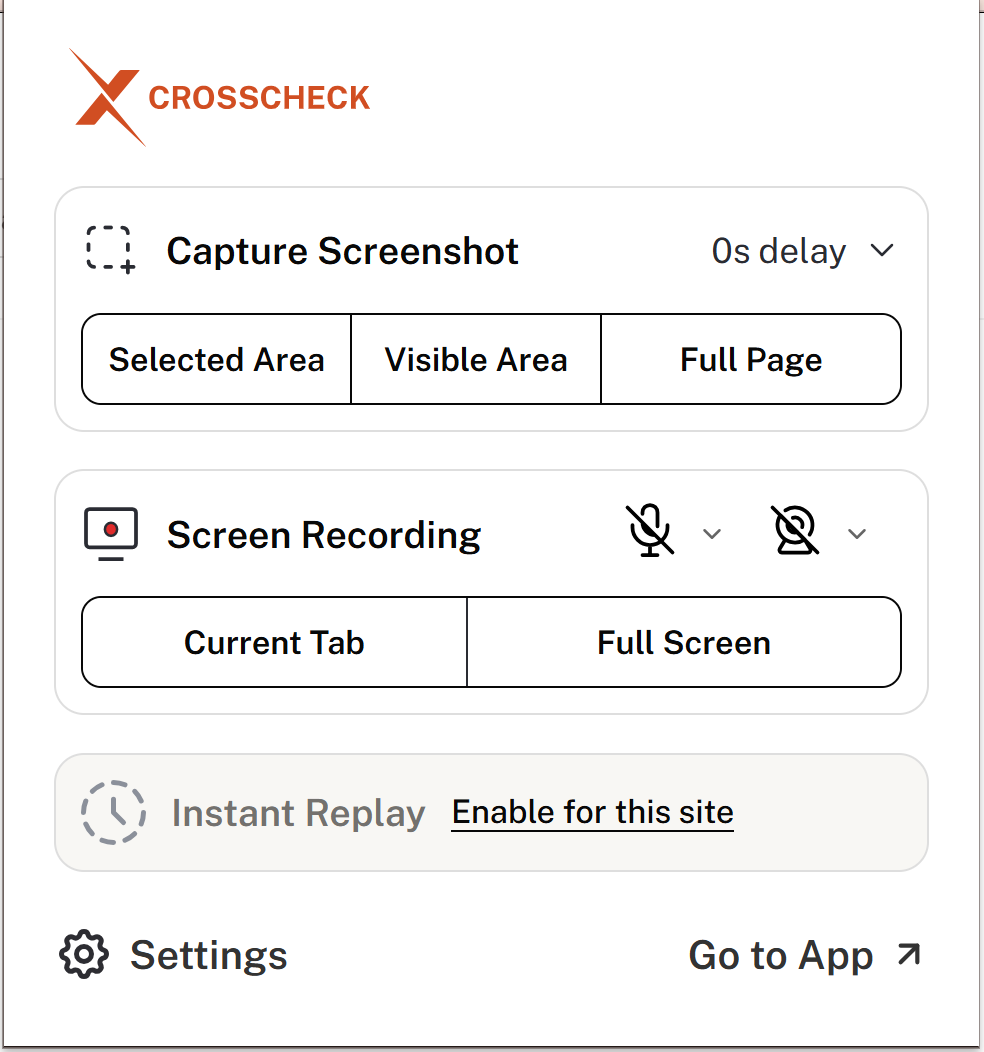
Two notes on this stack. First, the bottleneck in a small team is rarely the tools — it is the discipline of using them. Adding a paid tier of anything before the free tier is consistently used is wasted spend. Second, the bug capture layer disproportionately matters at this stage. When the founder, a designer, or a developer finds something broken, the cost of writing a high-quality reproducible bug report manually — repro steps, browser version, console errors, network failures, a screenshot — is high enough that it often does not happen. A tool that compresses that to one click is the difference between bugs that get fixed in the next hour and bugs that get fixed three sprints later, when half the context is gone.
For startups looking to make the bug-capture layer feel automatic, Crosscheck is the natural starting point — it is the layer most teams underinvest in, and it has the highest leverage per minute of setup.
Automate the right tests, not all the tests
Automation is not an all-or-nothing investment. The goal for a no-QA-team startup is not comprehensive coverage. It is strategic automation of the tests that catch the most failures per unit of maintenance cost.
A pragmatic order of operations:
- Unit tests for business logic first. Calculation logic, validation functions, data transformations, state machines. These are fast to write, fast to run, and catch regressions immediately. If your stack is JavaScript or TypeScript, Vitest is the modern default — its usage has grown over 400% since 2023 according to State of JS data — and Jest remains the dominant choice in established codebases.
- A small set of end-to-end tests for the flows that matter to the business. Authentication, the core value-delivery flow, payment. Three or four well-maintained Playwright tests on the critical paths catch the regressions that would actually cost real money.
- Visual regression on the highest-risk pages. Playwright's built-in screenshot diffing handles most cases — the marketing homepage, the checkout flow, the pricing page. A change that breaks these silently is the most embarrassing class of regression.
- Self-healing locators and AI-assisted test generation come later. Tools like Playwright with Copilot, Mabl, and Testim can help once the team has a baseline — they accelerate maintenance, but they do not solve the absence of a test culture.
Whatever runs locally must also run in CI. Tests that are not automatic are tests that get skipped under deadline pressure. Set GitHub Actions (or GitLab CI, or CircleCI) to run on every pull request, and make a failing pipeline a merge blocker. That single rule is what converts automated tests from optional nice-to-have into an actual gate. For deeper reading on choosing automation tooling, see Selenium vs Playwright vs Cypress and the best test automation frameworks for 2026.
Dogfooding and a small beta panel
The cheapest user-testing system available to a startup is its own team plus a handful of friendly external users. Both pieces need to be deliberate to work.
Dogfooding — the team using its own product in real workflows — only catches bugs if the team is actually using the product in real workflows. For a B2B startup, that means routing real work through the tool. For a consumer product, it means making it the default for the team. Half-hearted dogfooding ("everyone has the app installed, but nobody opens it") finds nothing. The teams that do it well make it a Monday-morning ritual or tie it to a shared metric the team checks each week.
A beta panel of 20 to 50 real users — recruited from early signups, existing customers willing to try unreleased builds, or a friendly community — closes the gap between internal testing and the messy reality of production. The panel does not need to be formal. It needs three things: a way for them to get the build, a low-friction way for them to file bugs, and an acknowledgement that their reports actually moved something. The last of those is what keeps the panel reporting.
This is where bug-capture tooling matters most. A beta user who has to write up reproduction steps in plain English will file one report and stop. A beta user who can click an extension, narrate a 20-second recording of the bug, and send it without thinking will file ten. That difference is the difference between a beta panel that compounds and one that decays after a month.
Build a bug-reporting culture, not just a bug tracker
A bug tracker is software. A bug-reporting culture is what makes the software useful. The most common failure mode at small startups is a tracker that is too heavy — so much process required to file a bug that developers start Slacking issues to each other and skipping the tracker entirely. Six months later, nobody knows what the actual bug backlog is.
Four conventions hold the culture together:
- Every bug gets filed. Not just the ones the team agrees are important. The "is this important" filter happens in triage, not in deciding whether to write the report.
- Reports include enough information to reproduce the bug without the reporter being present. That bar is high enough that it is worth investing in tooling to lower the friction.
- There is a clear owner for triage. Usually one engineer or the founder. The role rotates, but at any given moment one person is accountable for the backlog.
- The team reviews open bugs on a regular cadence. Even a 15-minute weekly triage prevents the backlog from becoming a graveyard. During triage, each new bug gets a severity, an owner, and a target ("this sprint," "next sprint," "when we next touch this area"). For the severity question specifically, a practical severity-versus-priority guide is worth keeping near the triage rotation.
The single highest-impact investment in this culture is making it easy to file a high-quality report. This is the gap Crosscheck was built to close: a browser extension that captures screenshots, screen recordings, console logs, and network requests in one click, packages them into a bug report with full technical context, and sends it straight to the tracker. No manual digging for console errors. No trying to remember the exact reproduction steps. No back-and-forth asking the reporter for more information.
For a team without QA staff, the bug-capture layer is the multiplier — every founder, designer, support agent, and beta user becomes a competent bug reporter the moment the friction drops to zero.
A lightweight release process
The release process is the last cheap chance to catch a regression before it reaches everyone. A startup with no QA team cannot afford a multi-day regression pass before every release — but it can afford a structured, ten-minute pre-release check.
A staging environment that mirrors production is non-negotiable. Testing in production is not a strategy. A staging environment costs roughly nothing on modern cloud providers and is the precondition for any release process more sophisticated than "deploy and watch the error tracker."
A short pre-release smoke test. Before every significant release, run a fixed list of the most critical user flows that must work. Sign-up, sign-in, the core value-delivery flow, payment if applicable. Keep the list short enough that the whole thing takes ten to fifteen minutes — if it takes longer, it will be skipped when the release is under deadline pressure. The smoke test is a sanity check, not a regression pass.
Feature flags for risk management. For higher-risk changes, ship the code without exposing it. Flags allow the team to roll out to a small percentage of users — or to internal users only — and create a feedback loop before the change reaches the full base. For startups that release frequently with limited testing resources, flags do more for release safety than any amount of additional manual testing.
Real-time error monitoring catches what slipped through. Sentry's free Developer plan covers 5,000 events a month with 30-day retention, which is sufficient for most early-stage apps if performance monitoring is disabled. A new error class spiking after a deploy is the fastest signal that something is wrong — usually faster than a user complaint.
When to make the first QA hire
The processes above can carry a startup a long way. But there are clear signals that the next hire should be a QA engineer rather than another developer:
- Release confidence is consistently low. The team ships with a sense of dread, not knowing what might be broken or what the release will break. This signal usually shows up before the bug count does — the team's instinct that the process is no longer sufficient is more reliable than the metrics.
- Bugs are frequently reaching users. Occasional production bugs are inevitable. Frequent bugs — or bugs affecting core flows — indicate the prevention mechanisms are failing.
- Manual regression is consuming significant engineering time. When developers spend hours per sprint on manual regression rather than building, the opportunity cost of not having a QA person becomes real.
- The product enters a regulated industry or enterprise market. Compliance requirements, enterprise procurement, and security certifications often require documented QA processes and dedicated quality ownership that ad hoc developer testing cannot provide. The European Accessibility Act, which became enforceable on June 28, 2025, has accelerated this signal for any product serving EU customers.
- The codebase complexity outpaces the team's ability to reason about regressions. A developer who knows their own code well still does not know every downstream effect of a change on parts of the codebase they did not write.
The first QA hire does not have to be a senior. A mid-level QA engineer earns roughly $95,000-$115,000 in US base salary in 2026 (Bureau of Labor Statistics and Glassdoor 2026 figures cited across hiring research), and a strong adaptable hire at that level — capable of owning the manual regression process, maintaining the smoke test suite, and triaging the bug backlog — immediately increases the team's quality output at a lower cost than another developer.
Match the role to the actual need. "QA engineer" covers a wide range. On one end is a manual tester who writes detailed plans and executes them by hand. On the other is a QA automation engineer (sometimes called an SDET) who builds and maintains automated test infrastructure in Playwright or Cypress and owns the CI pipeline. The two roles command different salaries — automation engineers run $110,000-$140,000 and up — and solve different problems. Hiring the wrong type is the most common failure mode of the first QA hire. For deeper background on the role itself, the future of QA roles covers where this hire is heading through the rest of the decade.
FAQ
What is the minimum viable QA process for a startup with no QA team?
A written definition-of-done, mandatory peer review, a small CI pipeline with unit tests and one or two end-to-end tests on critical flows, a structured bug tracker, and a pre-release smoke test. These five things — implemented with free-tier tooling — replace 80% of what a dedicated QA team would do at the seed stage.
Can a startup ship to production without any QA at all?
Technically yes; in practice it is the fastest route to user churn and emergency hotfixes once the codebase has more than a few hundred users. The teams that skip QA do not avoid the cost — they pay it later, in reputation and in the engineering hours lost to firefighting.
What are the best free QA testing tools for startups in 2026?
Playwright for end-to-end testing, Vitest or Jest for unit tests, GitHub Actions (2,000 free private-repo minutes a month) for CI, Sentry's Developer plan (5,000 free errors a month) for production monitoring, and Crosscheck — a free Chrome extension with no usage limits — for bug capture. This stack is genuinely production-grade for a small team at zero recurring cost.
Should developers write their own tests, or hire a dedicated QA engineer?
Both, in sequence. Developers should write their own tests from day one — it is the right model and remains the right model even after a QA hire arrives. A dedicated QA engineer joins when release confidence consistently drops and manual regression is consuming significant engineering time, usually somewhere between 8 and 20 engineers.
How does a solo QA tester or development team handle QA without dedicated QA staff?
By treating QA as a process, not a person. The same gates a QA team would run — definition-of-done, peer review, automated tests in CI, bug triage, smoke tests, staged rollouts — are operated by the engineers and the founder. A small beta panel of 20-50 friendly users extends the team's coverage without adding headcount. Bug-capture tooling like Crosscheck compresses the time cost of filing actionable reports so that everyone in and around the team becomes a competent reporter.
When is the right time to hire a first QA engineer?
When the bottleneck is identifiable — release dread, frequent user-facing bugs, hours per sprint lost to manual regression, or compliance requirements that demand documented QA. The 2026 consensus is no fixed headcount trigger; the signal is post-PMF with paying users, plus measurable release risk, plus enough product stability that automated test investment will compound. For most lean startups, this lands somewhere between Series A and Series B, in the 15-30 engineer range.
Make bug capture the first thing you fix
Of all the gates in a no-QA-team process, the bug-capture layer is the one where small startups consistently leave the most leverage on the table. Definition-of-done is free. Peer review is free. CI is free. But the friction between someone finding a bug and a developer being able to reproduce it is where days of engineering time disappear every sprint — and it is the easiest gap to close.
Crosscheck is a free Chrome extension built for this gap. Install it, and every bug that a founder, designer, support agent, beta tester, or developer finds gets captured with screenshots, screen recordings, console logs, and network requests in one click, then sent straight into Jira, Linear, ClickUp, Slack, or GitHub with full technical context attached. No paid tiers. No usage limits. The fastest way to make the bug-reporting culture this playbook depends on actually happen.

 Add to Chrome