How to Record a Bug: A Practical Guide to Video Bug Reports
A screen recording bug report is a short video — usually under a minute — that shows the exact sequence of actions, UI states, and timing that produced a defect, attached to a ticket so a developer can reproduce the issue without a back-and-forth thread. Done well, it replaces three rounds of "what did you click?" with thirty seconds of footage. Done badly, it adds a 14-minute file to the ticket and slows everything down.
This guide covers when video bug reports earn their place over a screenshot, how to record bug clips that developers can actually act on, and which tools — Loom, CleanShot X, the macOS and Windows built-ins, Chrome DevTools Recorder, and Crosscheck — fit each job in 2026.
Key takeaways:
- Record video when the bug lives in motion, timing, or a multi-step sequence — otherwise a screenshot wins.
- Keep clips under 60 seconds, trim wasted intros, and narrate with captions rather than voice so the report stays skimmable.
- Highlight the cursor, record only the relevant region, and attach console and network logs alongside the video.
- Loom is for async demos; CleanShot is for quick clips; Chrome DevTools Recorder produces JSON flows, not video; Crosscheck captures retroactively with the technical context already attached.
When a screen recording beats a screenshot
Screenshots are the default for a reason — they are small, instant, and easy to mark up. A misaligned button, a typo in a heading, a missing icon, a wrong colour token: all of these fit on a single frame, and a still image with an arrow on it is the right artifact.
Video earns its place when the bug stops being a state and starts being a sequence. Four categories almost always justify a recording.
Intermittent bugs. A 500 that only fires on the third retry. A dropdown that breaks once every dozen page loads. A race condition between two API calls. A 20-second clip with the timestamp visible turns "I swear I saw it" into reproducible evidence.
Multi-step flows. Checkouts, onboarding wizards, file-upload pipelines, multi-page forms. If the bug requires understanding state from steps 1–3 to make sense of the failure on step 4, a screenshot of step 4 is useless. The recording carries the context.
Animation and transition failures. A modal that opens with the wrong easing curve. A spinner that flickers. A toast that overlaps the navbar for 300ms before settling. The bug is the motion — no single frame captures it.
Timing-sensitive issues. Anything dependent on debounce, throttle, network latency, focus order, or rapid input. A user double-clicking submit and triggering two payments looks identical to a single payment in a screenshot. On video, the duplicate request is obvious.
Outside these categories, lean toward an annotated screenshot. Video is heavier to produce, heavier to review, and harder to skim — and developer time spent scrubbing footage for the relevant three seconds is the most expensive cost in any bug-reporting workflow.
How to record a bug report developers can actually use
The quality of a bug recording is determined less by resolution than by editorial discipline. A 12-minute raw screen capture where the bug appears at minute eight is not a bug report — it is homework. Six rules separate a useful clip from one that quietly gets ignored.
1. Keep it under 60 seconds
A clip that runs longer than a minute almost always contains setup, drift, or repetition that could be cut. Aim for 20–45 seconds. The goal is one bug, one sequence, one outcome. If the reproduction genuinely needs longer — a slow migration, a long-running queue — split it into two clips and label them.
2. Trim the wasted intro
The first five seconds of most recordings show the recorder finding the right tab, the right window, or the right cursor position. Cut it. Modern tools — CleanShot X, Loom, Crosscheck's in-browser trimmer — all support post-recording trimming. Use it. The first frame the developer sees should already be in context.
3. Narrate with captions, not voice
Voice narration costs the report on three fronts. Voiceover cannot be skimmed, search engines and AI assistants cannot index it, and developers in shared workspaces cannot play it without headphones. On-screen captions placed at the moment of the action — "promo code applied", "checkout button stops responding here" — read in two seconds and survive being muted. They also age better; a teammate revisiting the ticket six months later does not need to listen at 1.5x.
4. Highlight the cursor
A cursor highlight — a coloured ring, a click-burst, a magnified pointer — turns a passive recording into a guided walkthrough. The eye tracks motion, and the cursor is where the action is. CleanShot X and Loom enable it by default; on Windows the PowerToys "Mouse Highlighter" utility handles it; macOS's QuickTime shows clicks but not the cursor ring, so a third-party tool is usually worth installing.
5. Record only the relevant region
Full-screen recordings expose Slack notifications, browser tabs, and personal bookmarks that have nothing to do with the bug — and they make the actual UI smaller and harder to read. Region recording (a single browser tab, or a rectangular area around the affected component) keeps the relevant pixels large and the noise out. Every serious recording tool supports it; use it as the default and reach for full-screen only when the bug crosses applications.
6. Attach the technical evidence separately
A video shows what the user saw. It does not show the 401 on the API call, the React warning in the console, or the failed asset request blocking a re-render. A bug report with only video is half a bug report. Pair the recording with console logs, network requests, and environment details — browser, OS, viewport, build hash. The fastest tools (Crosscheck, Jam) capture this metadata automatically alongside the video; with Loom or CleanShot you will attach it manually.
Screen recording vs. session replay vs. flow recorder
Three different things sit under the umbrella of "recording a bug," and conflating them is the most common source of friction in QA discussions.
| Method | Captures | Output size | Retroactive? | Best for |
|---|---|---|---|---|
| Traditional screen recording | Pixels, frame by frame | Several MB per minute | No — must hit record first | Demos, walkthroughs, known reproductions |
| DOM-based session replay | DOM mutations + user interactions | 50–200KB per minute | Yes (rolling buffer) | Intermittent bugs, exploratory testing |
| Chrome DevTools Recorder | Step-level JSON (clicks, inputs, navigation) | Tiny — a JSON file | No | Reproducible flows you want to automate |
Screen recording is a video file. Familiar, shareable, plays in any browser or media player. The limitation is that nothing under the pixels is captured — no console errors, no network payloads, no DOM state.
Session replay captures DOM mutations and user events, then reconstructs the page in-browser on playback. Because it stores structural deltas instead of frames, file sizes are roughly two orders of magnitude smaller, and developers can inspect elements during the replay as if it were a live page. Tools like Crosscheck, Jam, FullStory, and LogRocket use this model.
Chrome DevTools Recorder is a different beast — it ships inside Chrome's DevTools and records a flow (a sequence of steps) as JSON or as a Puppeteer script. You replay the flow with one click, measure its performance, and export it to Cypress, Nightwatch, or Puppeteer for automation. It is not a screen recorder; it is closer to a free, browser-native end-to-end test builder. The right use case is "I want to turn this reproduction into a regression test", not "I want to attach a video to a ticket".
The biggest practical difference between screen recording and session replay is when you have to start. Screen recording demands that you anticipate the bug. Session replay runs as a rolling buffer — it keeps the last few minutes whether or not a bug occurred, so the recording exists by the time you decide you need it.
Tool comparison: which screen recorder for which job
The market for screen recording is crowded, and not every tool is built for bug reporting. The right choice depends on whether you need async communication, planned recordings, or retroactive bug capture.
| Tool | Best for | Cost | Bug-specific features |
|---|---|---|---|
| Loom | Async team demos, customer videos | Free tier; paid from $12.50/user/mo | None — pure video, no console or network capture |
| CleanShot X (Mac) | Quick clips with annotations | $29 one-time or $8/mo Cloud | Cursor highlight, instant trim, GIF export |
| macOS Screenshot.app | Built-in, zero setup | Free | Region recording, click indicator |
| Windows Snipping Tool / Xbox Game Bar | Built-in on Windows 11 | Free | Region recording (Snipping Tool added video in 2024) |
| Chrome DevTools Recorder | Turning reproductions into automated flows | Free | Step-level JSON, performance measurement, Puppeteer export |
| Jam | Bug reports with technical context | Free tier; paid from $10/user/mo | Console logs, network requests, video |
| Crosscheck | Retroactive bug capture with full technical context | Free | Instant Replay (rolling DOM buffer), console, network, user action timeline, screen recording |
Loom, acquired by Atlassian for ~$975M in November 2023, is the most widely used async video tool in software teams. Loom AI now auto-generates titles, summaries, and chapters, and the Jira integration lets you attach a Loom to an issue without leaving the editor. For bug reporting specifically, the limitation has not changed since the acquisition — Loom records pixels and audio, not console or network state.
CleanShot X is the macOS power-user choice. One-time pricing, fast region recording, cursor highlighting, built-in trimming, scrolling capture. Not a bug-reporting tool — no technical-context capture — but as a screen recorder, faster and cleaner than almost anything else on the Mac.
Built-in OS recorders are underrated. macOS's Screenshot toolbar (Shift+Cmd+5) records full screen or a selected region with click indicators and basic trimming. Windows 11's Snipping Tool added screen recording in 2024 and Xbox Game Bar (Win+G) handles per-window recording. For a one-off bug clip, the built-in tool is often the right answer.
Chrome DevTools Recorder ships inside Chrome's DevTools panel and records flows as JSON or Puppeteer scripts — not video. Its real value sits between bug reporting and test automation: reproduce the bug once, export the flow, hand the developer a script they can replay step-by-step or convert to a Cypress test.
Jam is the closest direct comparison to Crosscheck. Video plus console logs and network requests, pasted into Jira or Linear. The trade-off is that recording must be started before the bug — no retroactive buffer — and the replay is video-based, so file sizes are larger.
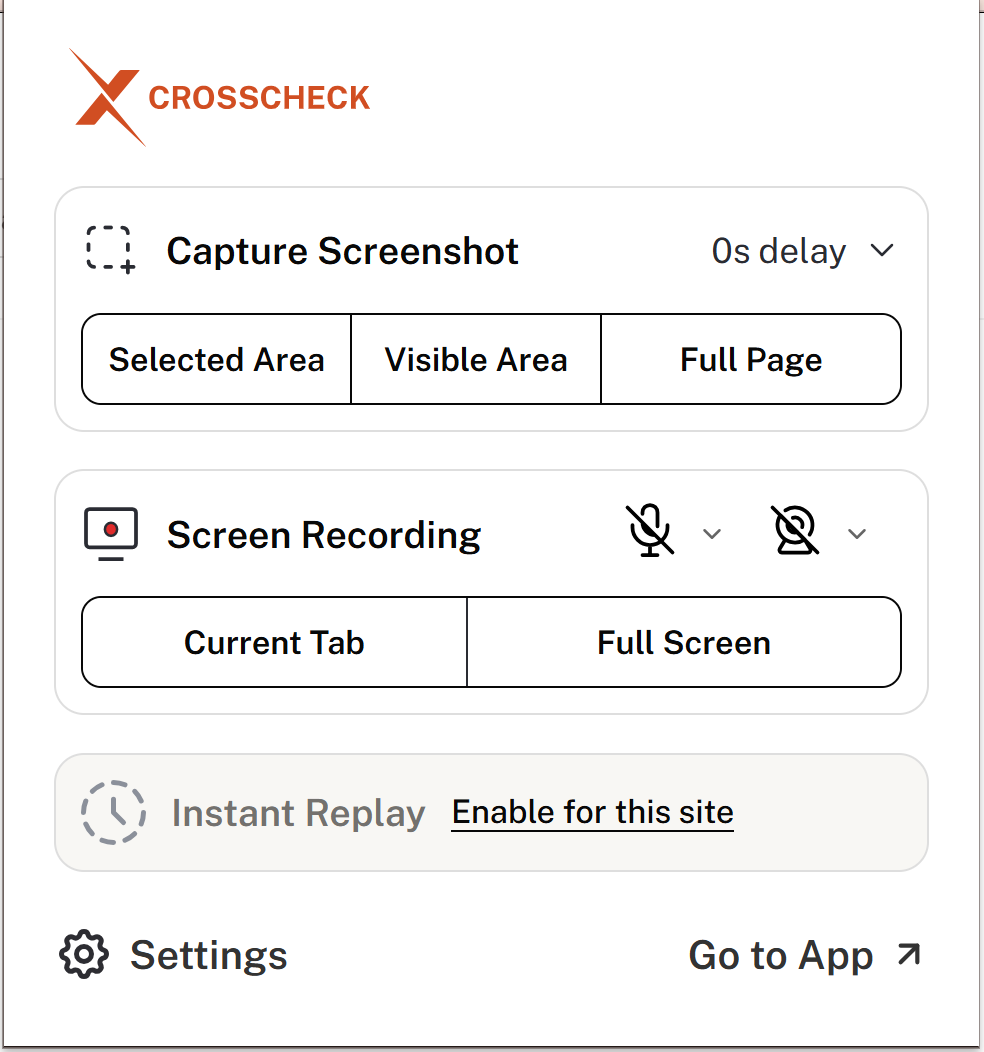
Crosscheck is the Chrome extension the Crosscheck team builds. It supports both deliberate screen recording (tab or full desktop) and Instant Replay — a rolling DOM-based buffer of the last few minutes of the session, captured the moment you decide to file a report. Every recording comes with console logs, network requests, the user action timeline, and environment metadata already attached. Reports drop straight into Jira, Linear, ClickUp, Slack, or GitHub. Free, no usage limits.
When to skip the recording entirely
Recording is not the default. Three signals suggest a screenshot or a written reproduction beats a video:
- The bug is visible in one frame. A misaligned button, a missing icon, a wrong colour. Annotate the screenshot and ship.
- The reproduction is one or two steps. "Open the homepage, click 'Sign in', the modal does not appear." A written sentence is faster to read than a 30-second video is to play.
- The bug is in the console or network, not the UI. A failed request, a deprecation warning, a CORS error. Paste the log. Video adds nothing.
A useful rule: if you can describe the bug in two sentences and a developer can reproduce it from those sentences, do not record. Reach for video when the description needs more — or when the bug stops being reproducible on demand and starts being something you have to catch.
A 60-second checklist before you attach the clip
Before the recording goes into the ticket, run through six checks:
- Is the clip under 60 seconds? If not, trim it or split it.
- Did the recording start from a known, reproducible state — a URL or login screen the developer can reach independently?
- Are the relevant moments captioned or annotated so the report is skimmable on mute?
- Is the cursor visible and highlighted?
- Are console logs, network requests, and environment details attached or auto-captured?
- Is there a one- or two-sentence written description of expected vs. actual behaviour?
A recording that clears all six is a bug report that ships with itself — a developer can act on it without a single follow-up. That is the bar.
Where recording fits in the 2026 QA stack
The bottleneck in QA tooling has migrated. AI-assisted test generation, self-healing locators, and parallel cloud execution have pulled test runs from hours to minutes. The slowest step in the loop is no longer running the tests — it is filing the bug once a test fails or an exploratory tester finds something the suite missed.
That is the gap screen recording fills, and it is why retroactive capture has become the more interesting half of the conversation. A team using session replay does not have to remember to hit record. Combined with auto-captured console and network logs, the marginal cost of filing a complete bug report drops from "five minutes of write-up" to "thirty seconds of trimming". Across a sprint with 40 bugs, that compounds.
Two adjacent reads from the Crosscheck blog: the best bug reporting tools for 2026 and the perfect bug report template.
FAQ
How long should a bug-report screen recording be?
Under 60 seconds, ideally 20–45. A clip longer than a minute almost always contains setup or repetition that could be trimmed. If the reproduction genuinely needs more, split it into two clips with clear labels.
Should I narrate with voice or captions?
Captions. Voice narration cannot be skimmed, cannot be indexed by search, and cannot be played in a shared workspace without headphones. On-screen captions placed at the moment of each action read in two seconds and survive being muted.
What is the difference between screen recording and session replay?
Screen recording captures pixels frame by frame and produces a video file. Session replay captures DOM mutations and user events, then reconstructs the session in-browser on playback — smaller files (50–200KB per minute vs. several MB), inspectable on replay, and capturable retroactively from a rolling buffer.
Can I use Chrome DevTools Recorder for bug reports?
It records flows, not video. The output is a JSON file or a Puppeteer script you can replay or export to Cypress. It is excellent for turning a reproduction into an automated regression test, but it is not the right tool for attaching a video to a Jira ticket.
Is Loom still good for bug reporting after the Atlassian acquisition?
Loom remains the leading async video tool and now integrates natively with Jira, but it still records video only — no console logs, no network requests, no DOM state. For demos, walkthroughs, and customer-facing communication it is excellent. For bug reports specifically, you will either pair it with manual log attachment or pick a tool built for the job.
What is the smallest possible setup to record a bug?
On macOS, Shift+Cmd+5 opens the built-in screenshot toolbar with screen recording. On Windows 11, the Snipping Tool (Win+Shift+S) and Xbox Game Bar (Win+G) both record. No install, no signup, free.
Start filing bug reports developers can act on
Screen recording is a tool, not a default. For interaction-dependent failures, timing-sensitive bugs, and anything that lives in motion rather than in a single frame, video collapses the communication gap between what a tester saw and what a developer needs to reproduce. For the long tail of single-frame defects, a screenshot wins.
The Crosscheck team built the extension around the recording problem QA teams hit most often — the bug you only notice after it has happened. Instant Replay captures the last few minutes of the session retroactively, packages it with console logs, network requests, and the user action timeline, and drops the whole thing into Jira, Linear, ClickUp, Slack, or GitHub in a single click. Free, no usage caps, no paid tiers.


 Add to Chrome