TDD vs BDD, Honestly Compared: Origins, Tooling, and What Works
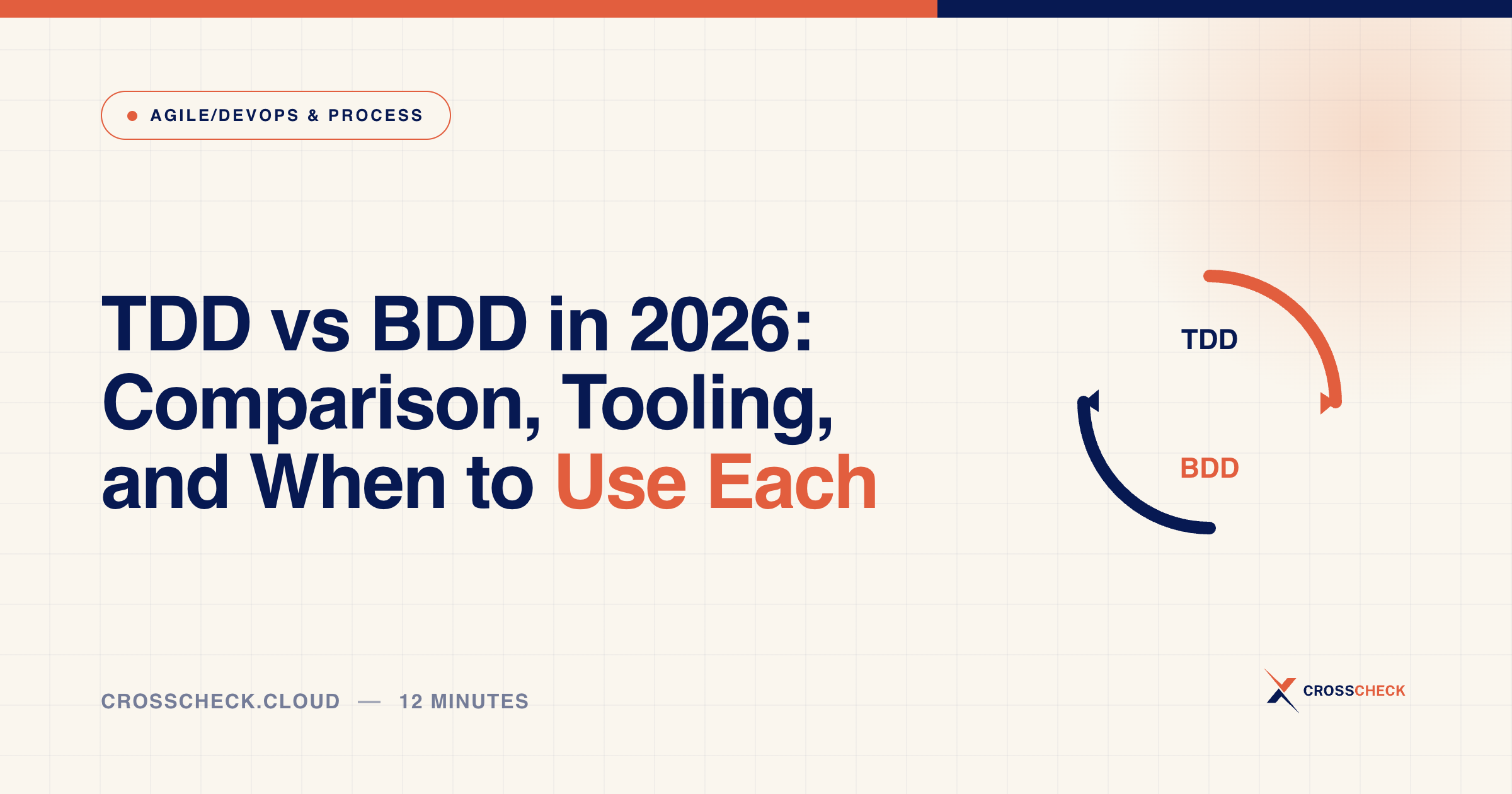
TDD and BDD are both test-first practices, but they solve different problems. TDD — formalised by Kent Beck in Test-Driven Development: By Example (2003) — is a developer design discipline built around the Red-Green-Refactor cycle, with unit tests written first to shape the code that follows. BDD, introduced by Dan North at ThoughtWorks in 2003–2004 and popularised by his March 2006 Better Software article "Behavior Modification", reframes the idea around behaviour and stakeholder language, using Given-When-Then scenarios so business, QA, and engineering agree on what "working" means before code is written. In 2026 the gap between the textbook and how teams actually practise either one is the part worth understanding.
Key takeaways
- TDD is a design practice for developers, expressed in code, scoped to units.
- BDD is a collaboration practice for cross-functional teams, expressed in plain-English Gherkin, scoped to features.
- Red-Green-Refactor drives TDD; Given-When-Then drives BDD.
- Tooling differs sharply: Jest, Vitest, pytest, JUnit, RSpec for TDD; Cucumber, Reqnroll, Behave for BDD.
- Pure TDD is rare in the wild, and most "BDD suites" are step-definition wrappers around integration tests with no business participation — the failure modes matter more than the textbook definitions.
- AI-assisted TDD with GitHub Copilot and Visual Studio 2026 has shifted the cost-benefit math of writing tests first.
What is Test-Driven Development?
Test-Driven Development is a software-design practice in which a developer writes a failing automated test for a small unit of behaviour, writes the minimum production code to make it pass, then refactors that code while keeping the tests green. Kent Beck described the rhythm as Red, Green, Refactor — write a little test that doesn't work, make it work quickly while "committing whatever sins necessary in process", then eliminate the duplication you created getting it to pass. Beck's 2003 book and the Extreme Programming community turned an existing habit into a teachable discipline.
The Red-Green-Refactor cycle in practice
The discipline lives in keeping the three phases separate.
Red. Write a test for a small unit of behaviour that does not yet exist. Run the suite. The new test fails — a test that fails before any code is written confirms it exercises something real.
Green. Write the smallest amount of production code that makes the failing test pass. Make it run, then make it right. Mixing refactoring into the green phase is the most common way new TDD practitioners lose the thread.
Refactor. Clean the code up — remove duplication, extract names, collapse branches. The test suite is the safety net that lets you change the shape of the code without fearing regressions. Skipping refactor is the second most common failure mode; the code becomes a sediment of "just enough to pass" choices.
What TDD actually optimises for
TDD is sold as a testing practice and adopted as a coverage practice, but its real value is design pressure. Writing the test first forces you to imagine how a unit will be called before you write it, which produces smaller functions, clearer interfaces, and fewer hidden dependencies — code that is painful to test in isolation is almost always code doing too much. The regression suite is a useful byproduct, not the reason to do it.
What TDD does not solve is alignment. It operates at the unit level, written by developers in technical vocabulary. A codebase can hit 100% TDD-driven coverage and still solve the wrong problem. That gap is what BDD was invented to close.
What is Behavior-Driven Development?
Behavior-Driven Development is a collaboration and specification practice in which developers, testers, and business stakeholders agree on system behaviour through structured conversation, capture it in plain-English scenarios, and use those scenarios as both acceptance criteria and executable tests.
Dan North developed BDD as a coaching technique at ThoughtWorks in 2003–2004. He had been teaching TDD on agile projects and kept hitting the same wall: nobody could agree on where to start, what to test, or how to name a test in a way that explained what it was for. He started writing JBehave — a JUnit replacement built around "behaviour" rather than "test" — in late 2003, and the Given-When-Then template emerged through a 2004 conversation with business analyst Chris Matts. The term reached a wider audience in March 2006 with North's Better Software article "Behavior Modification".
Given-When-Then and the Gherkin format
The most visible BDD artefact is Gherkin, the structured plain-English syntax used by Cucumber and its descendants:
Feature: User login

  Scenario: Successful login with valid credentials
    Given the user is on the login page
    When they enter a valid email and password
      And they click the login button
    Then they should be redirected to the dashboard

  Scenario: Failed login with incorrect password
    Given the user is on the login page
    When they enter a valid email and an incorrect password
      And they click the login button
    Then they should see an error message
Each line maps to a step definition — a function in code that performs the action or asserts the outcome. A product manager, business analyst, or enterprise customer can read the scenario and confirm whether it matches what they want. That is the promise: one artefact that serves as conversation record, acceptance criteria, automated test, and living documentation.
The "three amigos" and where BDD earns its keep
BDD practitioners talk about "three amigos" sessions — short workshops in which a developer, a tester, and a business representative work through scenarios together before any code is written. A login feature looks trivial until the three sit down and discover nobody has agreed what a "valid" email is, the password rules in the policy document do not match the legacy backend, and suspended accounts behave subtly differently. Skip the conversation, and the scenarios are just slow tests with extra ceremony.
What BDD does not solve
BDD does not replace unit testing. A passing scenario tells you a feature works end-to-end; it does not tell you which function failed, and it gives only coarse coverage of internal edge cases. BDD suites also run slowly because they exercise the full stack. The bigger pitfall is cultural: when scenarios are written by developers in isolation, after the code is already shipped, BDD becomes slow integration tests with English-language step labels — the most common reason teams quietly abandon Cucumber after a year.
TDD vs BDD: a side-by-side comparison
| Dimension | TDD | BDD |
|---|---|---|
| Originator | Kent Beck (formalised 2003) | Dan North (2003–2004) |
| Primary audience | Developers | Developers, testers, business stakeholders |
| Core loop | Red-Green-Refactor | Discovery → Formulation → Automation |
| Language | Code, in the host language | Gherkin (plain English) + code step definitions |
| Level of abstraction | Unit / function | Feature / user-facing scenario |
| Primary purpose | Design and regression | Alignment and acceptance |
| Test ownership | Developer | Cross-functional team |
| Execution speed | Fast (milliseconds) | Slow (seconds to minutes, full stack) |
| Documentation value | Technical | Business-readable |
| Failure mode when half-adopted | Coverage theatre, no design benefit | English-labelled integration tests, no alignment |
The most important row is the last one. Almost every team that picks up TDD or BDD picks up the syntax and skips the discipline that makes it work — and the resulting damage looks very different in each case.
TDD tooling in 2026
TDD tooling is mature in every serious language ecosystem. The choice is almost always between speed, conventions, and what is already wired into your CI.
Jest remains the most-downloaded JavaScript test runner — roughly 30 million weekly npm downloads in April 2026 — with built-in assertions, mocking, snapshot testing, and coverage. Vitest is now the recommended default for new projects: it grew from under 4 million weekly downloads in early 2023 to roughly 20 million by April 2026, took the top-satisfaction slot in the State of JS 2024 testing survey at 96% retention, and was adopted as Angular 21's default runner in late 2025. In 2026, picking Vitest needs no justification; picking Jest does (React Native, large existing suite, plugin lock-in).
pytest is the de-facto Python runner. JUnit 5 is the default in Java, NUnit and xUnit.net in .NET, RSpec in Ruby, and Go's standard testing package in Go. Mocha with Chai and Sinon still appears in long-lived Node services where teams compose their own stack.
The best TDD tool is the one that runs fast enough you actually run the tests on every save. A multi-second feedback loop kills the cycle — the test-first habit decays into test-after, and the design pressure disappears.
AI-assisted TDD with Copilot and Visual Studio 2026
The cost-benefit math of writing tests first has shifted because AI assistants now handle a real share of the boilerplate. Visual Studio 2026 v18.3 made GitHub Copilot Testing for .NET generally available, with a purpose-built @Test agent that generates and runs unit tests scoped to a single member, class, file, project, solution, or current git diff — using Roslyn analysers, MSBuild, and Test Explorer rather than command-line invocations. The Copilot /tests slash command across VS Code, JetBrains, and Visual Studio reads existing conventions in the repo and produces tests that match the project's style.
The useful workflow this enables is not "Copilot writes the test for you". It is closer to: a developer writes a clear failing test by hand to drive design, then asks Copilot to suggest the minimum implementation to make it pass. The test still does the design work. The counter-trend is worth naming: plenty of teams now use Copilot to generate tests after the implementation, then call it "TDD" in the standup. That is coverage theatre — see the best AI testing tools for 2026 for the broader pattern.
BDD tooling in 2026
BDD tooling centres on parsing Gherkin and binding each step to executable code.
Cucumber is still the most widely used BDD framework, with official ports for JavaScript, Java, Ruby, Python, Kotlin, and others — the default for teams with mixed stacks.
SpecFlow was the Cucumber-compatible standard for .NET teams for over a decade — and it is gone. Tricentis ended SpecFlow effective 31 December 2024; the GitHub repositories were deleted on 1 January 2025. The actively maintained successor is Reqnroll, a community fork started in early 2024 by the original SpecFlow team. Reqnroll is API-compatible, supports .NET 8 and 9, and by early 2025 was already powering over 5,000 projects. New .NET BDD work in 2026 should start on Reqnroll.
Behave is the standard Python BDD framework and pairs cleanly with Selenium or Playwright for browser scenarios. Behat is the PHP equivalent, common in Symfony and Drupal shops. Cypress and Playwright can be combined with Cucumber preprocessor plugins to run Gherkin in the browser — useful when a team already owns an E2E suite and wants a BDD-style acceptance layer on top. For where each runner wins, see Selenium vs Playwright vs Cypress.
A useful sanity check on BDD tool choice: if the .feature files are only ever read by the developer who wrote them, you do not need Gherkin — you need a regular test runner with descriptive it strings. The overhead of step-definition wiring is the price you pay for non-technical readability; if nobody non-technical ever reads them, you are paying a tax for nothing.
When to use TDD
TDD is most valuable when the work is dense with logic and the unit boundary is meaningful.
- Logic-heavy code paths. Business rules, calculation engines, state machines, parsers, scheduling algorithms. Writing the test first forces you to enumerate edge cases up front.
- Libraries and APIs consumed by other developers. If your output is a public surface, TDD produces a clean, testable interface as a byproduct. A function that is hard to test is hard to use.
- Refactoring existing code. Characterisation tests that document the current behaviour give you a safety net before you touch legacy code.
- Solo or small, fully technical teams. TDD needs no non-technical participation and fits inside an engineer's day when the developer already has enough business context.
TDD is least valuable for fast-changing UI code where the "unit" is hard to define cleanly. Component-level tests for a button that re-renders three times a week are a tax, not an investment.
When to use BDD
BDD pays for itself when the gap between "what the business wants" and "what gets built" is the real bottleneck.
- Recurring misalignment between business and engineering. If features are built correctly but solve the wrong problem, the three-amigos conversation attacks the root cause by forcing explicit agreement before any code is written.
- Vague or inconsistently applied acceptance criteria. Gherkin scenarios formalise the criteria unambiguously. A scenario either passes or it does not.
- Complex domains with interdependent business rules. Insurance, healthcare, payments, regulated workflows. A suite of executable Gherkin specifications becomes living documentation that is always current and verifiable.
- Non-technical stakeholders who genuinely want to participate in quality. Product managers and business analysts who can read and edit
.featurefiles can contribute directly to test coverage.
BDD is least valuable when the team writing the scenarios is the only team that ever reads them — you have paid for slow tests and indirection through step definitions without buying any cross-functional alignment.
Combining TDD and BDD
The teams that get the most out of either practice usually do not pick. They use both at the level each one is good at.
- Define features with BDD. Run three-amigos sessions to produce Gherkin scenarios before development begins. These become the acceptance criteria engineering, QA, and product have signed off on.
- Build the units with TDD. While implementing the feature, develop each unit of logic test-first with Jest, Vitest, or pytest. These tests are fast and guide the internal design.
- Verify with the BDD layer in CI. The BDD scenarios run as an integration gate. When the suite is green, the feature satisfies the acceptance criteria.
This gives you TDD's design benefit at the unit level and BDD's alignment benefit at the feature level. The trap to avoid is duplicating the same behaviour at both levels — usually a sign the BDD scenarios have drifted into implementation detail they were never supposed to live in. For a broader view, see 10 SQA methodologies and real-world case studies.
Common pitfalls — and what teams actually do wrong
The textbook descriptions make both look cleaner than they are in practice. The failure modes are predictable.
Writing BDD without real collaboration. Gherkin scenarios authored by developers in isolation are slow integration tests with extra ceremony. The value of BDD is the conversation; the Gherkin is the receipt.
Using BDD for unit-level coverage. Scenarios that test implementation details — "Given the cache is in state X" — rather than user-facing behaviour are fragile. Keep BDD at the feature level and let TDD handle the internals.
Skipping refactor in TDD. The third step is the one that delivers the design benefit. Teams that skip it accumulate passing tests over messy code, then conclude "TDD doesn't work" without realising they have only ever done two-thirds of it.
Treating TDD as a coverage metric. Adopting TDD to hit an 80% line-coverage target misses the point. The value is the design pressure of writing the test first, not the number — a suite written after the implementation can hit the same coverage and produce none of the same benefits.
For where automated tests stop and exploratory work begins, see the best test automation frameworks for 2026.
FAQ
What is the main difference between TDD and BDD?
TDD is a developer-facing design practice in which unit tests are written in code, before the implementation. BDD is a collaboration practice in which cross-functional teams agree on system behaviour through Given-When-Then scenarios written in plain English. TDD operates at the unit level; BDD at the feature level.
Is BDD just TDD with a different syntax?
No. North started by reframing TDD around behaviour, but BDD evolved into a discovery practice with three-amigos conversations, Given-When-Then specification, and living documentation. A team can use Cucumber and not be doing BDD; a team can do BDD without Cucumber.
Does AI-assisted coding replace the need for TDD?
No. Copilot and Visual Studio 2026's @Test agent reduce boilerplate, but the design pressure of writing the test first is still a human discipline. AI-generated tests written after the implementation lock in whatever the code already does — the opposite of what TDD is for.
Which is faster to adopt — TDD or BDD?
TDD. A single developer can adopt it on Monday with no organisational change. BDD needs buy-in from at least three roles, a forum for three-amigos conversations, and tooling that ties Gherkin to step definitions — which is why BDD adoption stalls when it is treated as a tooling decision.
Is pure TDD common in production teams?
Honestly, no. Many engineers use TDD some of the time, but few practise strict Red-Green-Refactor on every change. Most teams mix — TDD for complex business logic and refactoring, test-after for UI plumbing.
What replaced SpecFlow for .NET BDD?
Reqnroll. After Tricentis ended SpecFlow on 31 December 2024, Reqnroll — a community fork by the original SpecFlow team — became the maintained, API-compatible successor for .NET 8 and 9.
Where Crosscheck fits
TDD and BDD shape the quality of code before it ships. They do not catch the bugs that escape into a real browser, on a real device, with a real user's session state — and those bugs consume most of an engineering team's reactive time. The pinch point in 2026 is not test speed; it is the cost of reproducing a bug once it lands.
Crosscheck is a free Chrome extension built for that gap. One click captures a screen recording, full console logs, network requests, and environment details, then files a ticket into Jira, Linear, ClickUp, GitHub, or Slack. The developer gets what they would have gotten from a unit test failure: real evidence, not "it broke when I clicked the thing". For BDD teams, that evidence often becomes a new Gherkin scenario; for TDD teams, a new failing unit test before the fix. See the perfect bug report template for the format that turns a capture into a ticket developers will not bounce back.

 Add to Chrome