AI Bug Reporting: Where AI Helps (and Where It Still Fails)
AI bug reporting is the use of machine learning and large language models to help draft, classify, deduplicate, prioritise, and route bug reports — typically from a mix of screenshots, console logs, network traces, and stack traces. In 2026 it is not a single product category. It is a layer that sits across error tracking (Sentry, Datadog), bug-capture extensions (Jam, Crosscheck), and test platforms (Mabl, Applitools), automating the parts of triage that used to consume the first hour of every engineer's morning.
The honest version of the story matters here. AI in bug tracking is genuinely useful for summarising long error stacks, predicting severity, surfacing duplicates, and routing tickets — tasks where pattern-matching against historical data works well. It is much weaker at writing reliable reproduction steps from scratch, which still depends on either captured session data or a human who actually saw the bug.
Key takeaways
- An AI bug report generator is most reliable when it has structured input — console logs, network requests, a screenshot, a stack trace — not just a prose description.
- The four tasks AI does well in 2026: title generation from captured context, severity prediction, duplicate detection via vector similarity, and stack-trace summarisation.
- Reproduction steps generated purely from text are still unreliable. Steps generated from a recorded session are accurate; steps generated from a tester's memory through an LLM are not.
- Sentry's Seer Autofix reports a 94.5% root cause accuracy and a 53.6% issue-fix rate on its public benchmarks (Sentry, 2026).
- Tooling consolidating fastest: Sentry Seer, Datadog Watchdog, Mabl Auto TFA, Jam AI Debugger, and bug-capture extensions exposing structured data over MCP to Claude, Cursor, and ChatGPT.
What "AI bug reporting" actually means in 2026
The phrase covers four distinct workflows that often get bundled together. Treating them separately makes the trade-offs visible.
Pre-submission drafting. An engineer or tester captures something — a screenshot, a screen recording, a console error — and an AI bug report generator drafts the title, the description, the suspected component, and a first-pass severity. Jam's AI feature does this; so does Crosscheck when paired with an LLM via MCP. The output is a draft, not a final ticket.
Post-submission triage. A bug arrives in Jira, Linear, or Sentry. An LLM or classical ML model assigns labels, predicts severity, identifies duplicates, and recommends an owner. Mabl's Auto TFA, Datadog Watchdog, and Sentry's Issue Grouping all sit here.
Root-cause analysis. Given a stack trace plus repository context, an agent tries to identify the failing line and explain why. Sentry Seer is the most mature example, with Cursor Cloud Agent handoff added in 2026 (Sentry docs).
Fix suggestion or auto-PR. The agent goes one step further and proposes a code patch, sometimes opening a draft pull request. This is still experimental — accurate enough to be useful as a starting point, not yet reliable enough to merge without review.
The teams getting the most value are the ones that recognise the boundary between drafting and final authoring. AI handles the first 70%. A human still owns the last 30%.
The five tasks AI is genuinely good at
1. Title generation from screenshot + log
When a bug-capture tool sends a screenshot and the associated console error to an LLM, the resulting title tends to be more specific and more searchable than what a tired tester writes at 4pm. "Checkout button does nothing" becomes "Stripe intents.create returns 400 when promo code is applied — checkout CTA stays disabled". The model has the error message and the screen state. It produces a title future engineers can actually grep.
This works because the input is structured. A model handed only a vague prose description ("button is broken") will hallucinate specifics. A model handed a captured TypeError: Cannot read properties of undefined (reading 'amount') and a screenshot of the failing checkout step gets the title right.
2. Severity prediction
Severity assignment is one of the most inconsistent steps in manual triage. The same defect rated P0 by one tester gets P2 from another. Classical ML on historical labelled data outperforms human consistency here — not because the model is smarter, but because it applies one rulebook to every report.
Academic work on CodeBERT and similar fine-tuned models has reported severity-prediction improvements over classic ML baselines, with effect sizes that vary widely by dataset and metric. In production, vendors generally don't publish hard accuracy numbers — Sentry's Issue Grouping and Mabl's failure classifications are evaluated by feel as much as by F1 score. The honest claim: AI-driven severity prediction reduces variance, even where it doesn't beat the best human triager.
3. Duplicate detection via vector similarity
This is the workflow where AI bug reporting most clearly pays for itself. Modern duplicate detectors embed each bug report (title, description, stack-trace tokens) into a vector and compare cosine similarity against the open backlog. Two reports that say "the checkout button does nothing" and "clicking Buy Now does not submit the order" land in nearly the same vector space, even though they share almost no exact words.
Sentry's Issue Grouping does this with stack traces. Datadog's Error Tracking groups by error fingerprint plus context tags. For inbound user-submitted reports — beta programs, internal QA Slack channels — the same approach can collapse 30 versions of the same complaint into one ticket before triage even starts.
4. Routing to the right team
Once a report is classified, routing becomes mechanical. A label of component: billing plus severity: P1 plus region: EU maps to a specific Jira board, a specific on-call rotation, and a specific Slack channel. This isn't glamorous AI — it is rules running on top of AI classifications — but it removes the human bottleneck where a triage lead reads everything and assigns it manually.
5. Summarising long error stacks
A 400-line Sentry event with nested promise rejections and minified frames is genuinely painful to read. An LLM summary that reduces it to "Unhandled rejection in payment-service at processIntent:142; root cause likely a null customer.address after the GDPR delete-account flow" saves the first ten minutes of investigation. Sentry's Seer publishes a public benchmark of 94.5% root-cause accuracy on its evaluation set (Sentry, 2026).
That number deserves a footnote — root-cause "correctness" is judged by Sentry's own raters against their own corpus, not by an independent audit. Treat it as directional, not absolute. Even so, the experience of using Seer day-to-day is that the first paragraph it generates is almost always useful, even when the proposed fix isn't.
What AI bug reporting still can't do
Write reproduction steps from prose alone
This is the single most important limit to understand. An LLM given a sentence like "the button breaks sometimes" cannot reliably produce reproduction steps. It will invent plausible-looking steps that don't match what actually happened. That's hallucination, and it leads to engineers chasing ghosts.
AI-generated reproduction steps are accurate only when the model has access to a recorded session — a sequence of clicks, keystrokes, network calls, and console events — that it can transcribe into a step list. Crosscheck, Jam, and BrowserStack Bug Capture all work this way: the recording is the source of truth; the LLM is the transcriber. If the recording is missing or partial, the steps will be missing or partial too. AI cannot recover information the capture layer didn't collect.
Tell you whether a bug matters to a particular user
Severity prediction works on technical signals — error class, affected component, frequency, breadth. It cannot tell you that this specific bug breaks a workflow used by your three biggest customers. Business impact still needs a human with context, or at least a lookup against a CRM that the AI is allowed to query.
Reliably propose code fixes for non-trivial bugs
Sentry's Seer Autofix lands a working code fix on 53.6% of issues where it identifies a root cause (Sentry, 2026). That number is high enough to be useful as a starting draft and far too low to merge unreviewed. Auto-PR features are best treated as "junior engineer's first attempt" — sometimes correct, often close, always worth reviewing.
Replace the person who first noticed the bug
The hardest part of any bug report is the noticing. A user clicks the checkout button, the spinner appears for slightly longer than it should, and they decide to file a report. No AI runs that loop yet. Bug-capture tools and observability platforms can compress everything that happens after — drafting, deduplication, routing — but the human at the start of the chain is still load-bearing.
The 2026 tool landscape
Five tools account for most of the active AI bug-reporting work being done in production. Each occupies a different slot in the pipeline.
| Tool | Primary slot | What its AI actually does | Honest limit |
|---|---|---|---|
| Sentry Seer (Autofix) | Post-error root cause | Reads stack trace + repo context, proposes root cause, drafts code patch, optional Cursor handoff | Code fix lands ~54% of the time; needs paid plan + repo access |
| Datadog Watchdog | APM + log anomaly detection | Baselines normal behaviour, flags severe anomalies, links faulty deploys to the version that caused them | Generates alerts, not bug reports; tied to Datadog ingest |
| Mabl Auto TFA | Failed test triage | Summarises why a test run failed using logs + screenshots, suggests failure category, pre-fills Jira issue | Only triages mabl-run tests; subscription add-on |
| Jam AI Debugger | Bug-capture drafting + root cause | Uses captured session + logs + network to draft repro and suggest fixes; opt-in OpenAI API | Quality depends on the capture; OpenAI-only |
| Crosscheck (with MCP) | Bug-capture + AI hand-off | Auto-captures console, network, user actions; exposes structured bug context to Claude, Cursor, ChatGPT via Model Context Protocol | Drafting and analysis happen in the AI client, not the extension; verify any suggested code |
The shared pattern: each tool collects structured signal first, then lets an LLM operate on it. The tools that fail in production are the ones that try to LLM-ify prose-only reports without the underlying capture layer.
For a wider survey of AI testing tools beyond bug reporting specifically, see the 10 best AI-powered testing tools changing QA in 2026.
How an AI-augmented bug report flows in practice
A realistic example, end to end. A QA engineer at a Series B fintech files a checkout regression on a Tuesday morning.
0:00 — QA hits the bug. Screen recording, console logs, network requests, and user-action sequence are auto-captured by the browser extension. Nothing typed yet.
0:30 — The capture is sent to the team's AI bug report generator. It produces a draft title ("POST /api/checkout/confirm 500 — null reference in OrderService.calculateTax"), a draft description summarising the failing call, and a P1 severity prediction based on the affected endpoint.
0:45 — Before the ticket is created, a vector-similarity check runs against open Jira issues. Three near-duplicates from the past week are surfaced. QA confirms it is the same bug as BILL-3142, adds the new recording as a comment, and the new ticket is never opened. Triage time: under a minute.
1:30 — In a separate flow, Sentry Seer has already noticed the same error spike on the backend, generated its own root-cause hypothesis, drafted a patch in the tax-calculation-service repository, and posted it as a PR draft. The on-call engineer reviews, finds one edge case Seer missed, edits the patch, and merges.
The point of the example isn't that everything happened automatically. It's that the human spent their time on the parts that needed judgement — confirming the duplicate, reviewing the patch — and not on the parts that didn't. That's the real promise of AI in bug tracking: fewer minutes spent on triage administration, more on the decisions only a human can make.
For the data foundation that makes flows like this possible, the complete guide to visual bug reporting in 2026 covers what good capture looks like in practice.
Setting up automated bug reports without creating new problems
Three failure modes show up consistently when teams add AI to their bug pipeline. They are worth knowing before you wire anything up.
Hallucinated specifics. If you let an LLM rewrite vague prose into specific-sounding tickets, you will get specific-sounding fiction. The model will invent error codes, version numbers, and reproduction steps that look plausible and aren't true. The fix is to feed the model structured input — captures, logs, traces — and to keep prose-to-prose AI rewrites out of the pipeline.
Confidence laundering. A draft labelled "AI severity: P0" feels authoritative. Engineers stop questioning it. When the model gets it wrong — and it will, on 5-15% of edge cases — the team has lost the habit of sanity-checking. The fix is small: surface AI-generated fields as suggestions, not as final values, until the team has a track record on its own data.
Capture coverage gaps. AI-generated reproduction steps are only as good as the recording. If your capture layer doesn't grab network requests, the AI cannot include them, no matter how clever the prompt. Audit what your capture tool actually collects before you build downstream automation that depends on it.
The teams that get this right treat AI in their bug pipeline like they treat AI in code review: useful as a first pass, never the final word.
For teams writing the underlying templates the AI is filling in, the free perfect bug report template gives a structure that maps cleanly to LLM-friendly fields.
Where Crosscheck fits
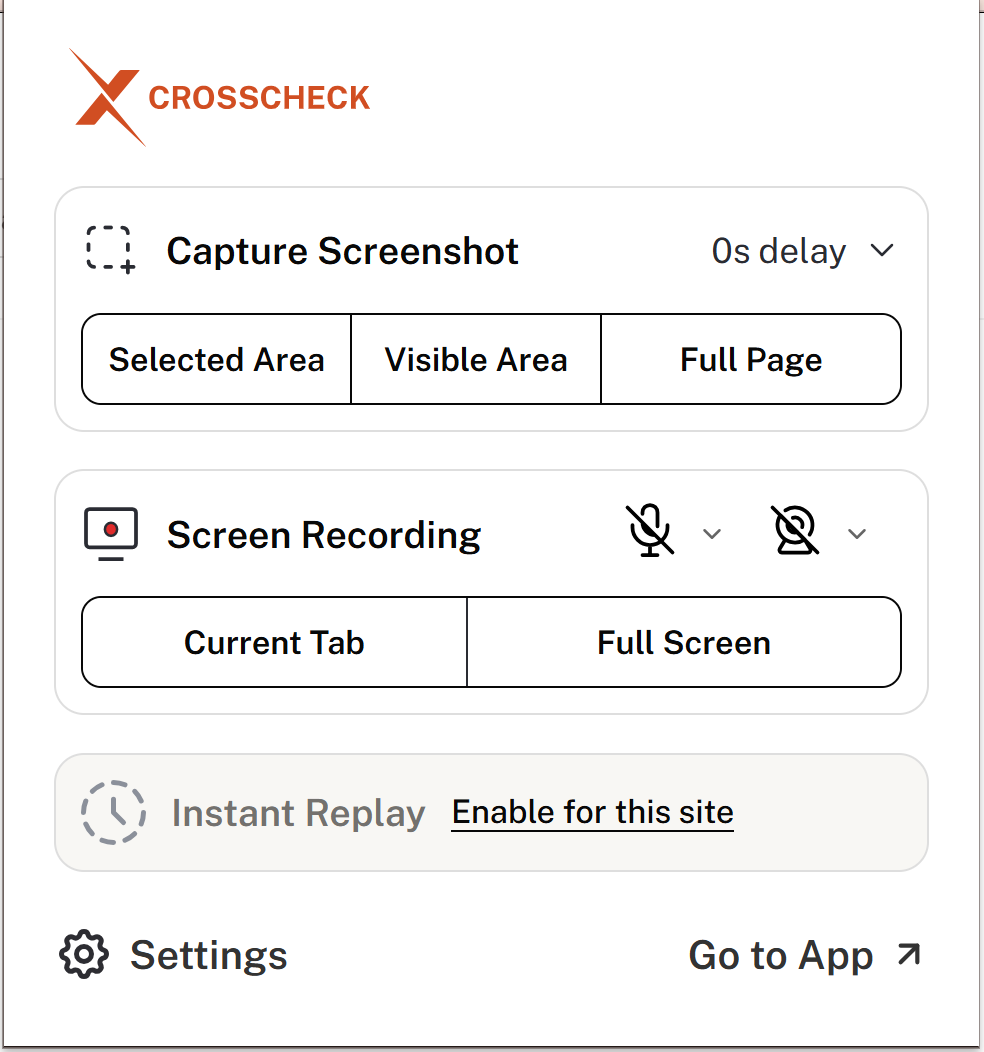
Crosscheck is a free Chrome extension for visual bug reporting. It auto-captures the data an AI bug report generator actually needs — screenshots, screen recordings, console logs, network requests, user-action sequence, browser environment — and pushes the structured report into Jira, Linear, ClickUp, GitHub, or Slack.
What makes the AI angle work is the Crosscheck MCP server. Captured bug context is exposed over the Model Context Protocol to any MCP-compatible client — Claude, Cursor, ChatGPT — so a developer can ask their assistant to analyse a specific Crosscheck report and get back a summary, suggested root cause, and a first-pass severity grounded in the actual capture rather than a written description. The drafting itself happens in the AI client. Crosscheck's job is to make sure the input data is structured and complete.
The honest framing: Crosscheck is the capture and routing layer; the LLM does the language work. That separation matters, because it means the AI is reasoning over real session data, not over a tester's prose. For more on how that capture maps to formats developers actually want, see the perfect bug report template and how to send bug reports to Jira automatically.
FAQ
What is an AI bug report generator?
An AI bug report generator is a tool that drafts a bug report — title, description, severity, suspected component — from captured context such as screenshots, console logs, and network traces. It does not replace the person reporting the bug; it removes the typing.
Can AI write reproduction steps automatically?
AI can write reproduction steps reliably when it has a recorded session to transcribe. It cannot reliably invent steps from a prose description like "the button broke." If your capture layer doesn't record user actions, the AI's steps will be guesses.
How does duplicate detection work in AI bug tracking?
Each bug report is converted into a vector representation that captures meaning rather than exact words. New reports are compared against open issues by cosine similarity. Reports that describe the same defect in different language end up close together in the vector space and can be flagged as duplicates before a new ticket is created.
Is automated bug reporting safe to use without human review?
The drafting step is safe to automate. The merging step — accepting an AI-suggested code patch, closing an AI-flagged duplicate without checking — is not. Sentry's published 53.6% fix-success rate (Sentry, 2026) is a useful baseline: high enough to be useful as a draft, not high enough to skip review.
Which AI bug reporting tools work with Jira?
Sentry Seer, Mabl Auto TFA, Jam, and Crosscheck all push into Jira. Mabl and Jam pre-fill issue summaries from AI analysis; Crosscheck pushes the structured capture and lets the developer's AI assistant work over it via MCP.
What's the difference between Sentry Seer and Crosscheck?
Sentry Seer operates on production error events captured by Sentry's SDK and proposes code-level fixes against your repository. Crosscheck operates on bug reports captured by a QA engineer or beta user in the browser and pushes the full session context into the tracker (and to MCP clients). They sit at different points in the pipeline; some teams use both.
Start filing AI-ready bug reports
The single biggest unlock for AI in bug tracking is making sure the data that reaches the model is complete. A captured session with console, network, and user actions gives an LLM enough to draft, classify, deduplicate, and route. A screenshot with prose underneath does not.
Crosscheck is free, takes thirty seconds to install, and every bug report it creates is structured for an AI assistant to read. If your team is still pasting screenshots into Jira and writing repro steps from memory, the gap is worth closing.
 Add to Chrome