Asana vs ClickUp vs Monday for QA Teams: A 2026 Comparison
For QA teams choosing a project management tool in 2026, ClickUp offers the deepest QA-native workflow (custom statuses, sprint boards, strong automation, $7/user/month entry), Monday.com wins on visual dashboards and stakeholder reporting at $9–$19/seat/month with bucket-based seat minimums, and Asana wins on platform stability and clean task hygiene but charges a premium ($10.99–$24.99/user/month) and lacks native sprint mechanics. None of the three are test-management systems — they are PM tools that QA teams bend toward bug triage, sprint tracking, and release reporting.
TL;DR — what changes the decision:
- Custom fields for severity, environment, build ID: available on all three, but only configurable at scale on paid tiers.
- Automation for bug routing and retest hand-off: ClickUp gives the highest ceiling per dollar; Monday caps lower-tier plans at 250 runs/month; Asana unlocks meaningful flows at the Advanced tier.
- Jira and Linear integrations: Asana has the broadest native ecosystem; ClickUp and Monday rely more on Zapier-style middleware for Linear.
- Test-cycle reporting: none of them ship as a TMS — pair with TestRail, Zephyr, Xray, or Qase if your team runs formal pass/fail cycles.
- Bug-capture itself: all three start the workflow after a ticket exists. The capture moment is where reproduction steps go missing, and that is a separate tooling problem.
Why generic PM tools struggle with QA workflows
Most PM platforms are built around delivery teams: features ship, tasks close, velocity gets tracked on a burndown chart. QA sits at a different angle. Bugs don't always map cleanly to a single sprint. Test cases need versioning. Reproduction steps demand rich formatting. Environment metadata — browser, OS, build number, feature flag state — has to be captured consistently for triage to be fast.
A PM tool can't fix bug reproduction time on its own, but it can quietly make it worse — depending on how it handles custom fields, automation, and the handoff to engineering tools. When teams compare Asana vs Monday or ClickUp vs Asana for QA work, the right question isn't "which has more features." It is: which one bends far enough toward the bug lifecycle without breaking everything else the company needs the platform to do.
Asana for QA: clean, restrained, integration-heavy
Asana's defining trait is its restraint. The product is opinionated about what a task is and how status moves — and that opinion produces an interface QA leads can hand to a new tester without a half-day onboarding.
Where Asana fits QA
Reliability is hard to overstate. Teams running QA operations in Asana for years routinely report only a handful of platform bugs of their own to file against the tool — a level of stability ClickUp, in particular, has not consistently matched.
The native integration ecosystem is the broadest of the three. Asana integrates directly with Jira (two-way sync), GitHub, Slack, Microsoft Teams, Salesforce, Power BI, and Tableau. For QA teams whose engineering side runs on Jira and whose product side runs on Asana, that bridge is a real workflow saver.
Custom fields cover the basics QA needs — severity, environment, browser, build version, root-cause category — and forms can be wired to a public URL so external stakeholders can file bug reports that land in a triage view. The Workflow Builder, available on Starter and above, routes incoming bugs by severity automatically.
Where Asana falls short for QA
Asana does not have native sprint boards, native test-cycle tracking, or a built-in time tracker on lower tiers. Sprint management can be improvised with sections and the Timeline view, but it is improvisation — engineering-heavy QA teams that already work in two-week sprints will feel the gap. Native time tracking only appears at the Advanced tier.
Pricing is the other friction. The Starter tier ($10.99/user/month annually) unlocks unlimited automations and custom fields, but the workflow tooling most QA teams will actually want — Goals, portfolios, branching forms, approvals, native time tracking, Tableau/Power BI integration — lives on Advanced at $24.99/user/month annually. Reseller estimates put Enterprise around $35/user/month and Enterprise+ around $45/user/month.
Asana pricing (2026, verified)
| Plan | Annual (per user/mo) | Monthly (per user/mo) |
|---|---|---|
| Personal | Free (up to 2 users) | Free |
| Starter | $10.99 | $13.49 |
| Advanced | $24.99 | $30.49 |
| Enterprise | Custom (~$35) | Custom |
| Enterprise+ | Custom (~$45) | Custom |
Best for QA teams that: value a clean, stable interface, run simple bug-triage workflows rather than formal test cycles, work alongside non-technical stakeholders, and already use a dedicated TMS like TestRail or Zephyr for test case management.
Monday.com for QA: visual dashboards, bucket pricing
Monday.com's mental model is the customizable visual board — every project is a grid of items with typed columns, and those columns can be almost anything: status, person, date, number, formula, dependency, dropdown for severity, file attachment for screenshots.
Where Monday fits QA
Dashboards are arguably Monday's strongest QA capability. A single dashboard can pull from multiple boards — bugs by severity across squads, regression cycle pass/fail rates, open-versus-closed ratios over the release window — and stakeholders who don't live inside the tool still get a glanceable view of release health. For larger orgs where QA reports to engineering directors who don't open the bug tracker daily, that translates to fewer "what's the current state" Slack threads.
Column flexibility maps well to a bug template. A bug item can carry severity, priority, environment, build, reporter, owner, expected vs actual, and reproduction steps in a single row. Forms let testers — or external beta users — submit bugs that land in a triage board with all required fields enforced.
Integration coverage is broad: Slack, Microsoft Teams, GitHub, GitLab, Jira (two-way), Zoom, Google Drive, Microsoft Excel. Linear integration is available but commonly routed through Zapier or Make rather than a deep native sync.
Where Monday falls short for QA
The pricing model is the friction. Monday uses bucket-based seat pricing — paid plans require a minimum of 3 seats and then scale in groups of 5. A 7-person QA team has to buy a 10-seat bucket on Standard, paying for 3 unused licenses. That inflates cost-per-user by roughly 43% at that team size.
Automation is the second friction point. The Standard plan ($12/seat/month annually) caps automations at 250 runs per month. For QA workflows — auto-route P1 bugs to on-call engineers, auto-notify when a fix moves to retest, auto-update Jira when status flips — 250 runs is consumed quickly on any active product. Meaningful automation volume lives on Pro at $19/seat/month, with 100,000 actions per month.
The Basic tier ($9/seat/month) is misleading for QA evaluation: it includes neither automations nor third-party integrations, so any team using Slack, Jira, or Linear effectively needs Standard at minimum.
Like Asana, Monday has no native test case management. The flexible boards can simulate one — with columns for test ID, expected result, actual result, last-run-by — but it is simulation, not a real TMS.
Monday.com pricing (2026, verified)
| Plan | Annual (per seat/mo) | Minimum monthly cost |
|---|---|---|
| Free | $0 (2 seats) | $0 |
| Basic | $9 | $27 (3-seat min) |
| Standard | $12 | $36 (3-seat min) |
| Pro | $19 | $57 (3-seat min) |
| Enterprise | Custom | Negotiated |
Monthly billing adds roughly 18–33% across tiers. AI credits are now bundled into paid plans at $0.01 per credit on annual billing.
Best for QA teams that: work closely with product, design, and stakeholders outside engineering, prioritize visual reporting over deep workflow logic, and can absorb both the bucket-pricing markup and the cost of Pro-tier automation volume.
ClickUp for QA: the most QA-native of the three
ClickUp is the platform most obviously built for QA-adjacent work. Out of the box on the Unlimited plan ($7/user/month), it ships with custom statuses, sprint points and sprint folders, task dependencies, native time tracking, docs, whiteboards, goals, and unlimited custom fields — a feature set that on Asana or Monday would require upgrading two tiers or stitching in third-party tools.
Where ClickUp fits QA
Custom statuses are the unlock. A bug in ClickUp can carry a status flow tailored to the team's actual lifecycle — Reported → Triaged → In Progress → Ready for Fix → Code Review → Ready to Retest → Verified → Closed → Reopened — rather than being shoehorned into a generic Open/In Progress/Done. Each transition can fire an automation: notify the assignee on Ready to Retest, post a Slack message on Reopened, auto-assign on Reported.
Custom fields are unlimited from the Unlimited tier upward, so severity, priority, environment, browser, OS, build number, feature-flag state, and root-cause category can all live on a bug card. Sprint mechanics are native: sprint folders, points, automatic sprint creation, velocity charts, and burndowns ship inside the product.
Integration coverage is solid on Jira (native two-way sync), GitHub, GitLab, Bitbucket, Slack, Microsoft Teams, Figma, and Zoom. Linear integration exists, primarily via Zapier-style middleware rather than a first-party sync — worth noting if Linear is the team's engineering source of truth.
For automation, ClickUp ships hundreds of pre-built recipes plus a no-code builder. The Business tier ($12/user/month) lifts most caps that matter to a working QA team, and Business Plus ($19/user/month) adds granular role permissions useful when external QA agencies sit alongside internal staff.
ClickUp Brain — the AI layer — can summarize long bug threads, generate test case skeletons from a requirement doc, surface recurring bug patterns across releases, and draft a triage note from a raw report. It is an add-on at $9/user/month on top of the workspace plan; the higher Everything AI tier at $28/user/month adds image generation, ambient answers, and an AI notetaker.
Where ClickUp falls short for QA
Power and complexity travel together. ClickUp's surface area is larger than Asana's or Monday's, and that breadth hits onboarding cost. New testers, contractors, and non-technical stakeholders take longer to become productive in ClickUp than in Asana. QA leads who inherit a ClickUp workspace from a previous administrator commonly find inconsistent custom-field naming across spaces and folders — a debt that accumulates fast.
Stability has historically been the second concern. ClickUp's release cadence is aggressive — the upside is feature velocity, the downside is occasional regressions that Asana, with its slower shipping cycle, simply does not experience.
The AI add-on is a budget surprise for teams calculating total cost of ownership. A 20-person QA team on Business with Brain AI runs $240 + $180 = $420/month, not $240. Everything AI more than doubles the per-seat cost again.
Finally, ClickUp's recent reclassification of guest users as limited members — billed at full rates — caught some organizations with large external-contractor populations off-guard. If your QA setup relies on dozens of external testers, verify the seat-counting model before signing.
ClickUp pricing (2026, verified)
| Plan | Annual (per user/mo) | Notes |
|---|---|---|
| Free Forever | $0 | 100 MB storage, unlimited members |
| Unlimited | $7 | Unlimited integrations and storage |
| Business | $12 | Sprint reporting, advanced dashboards |
| Business Plus | $19 | Custom role permissions, subteams |
| Enterprise | Custom (~$25–$40 est.) | White-labeling, SSO, HIPAA option |
| Brain AI add-on | +$9/user/mo | Layer on top of any paid workspace |
| Everything AI add-on | +$28/user/mo | Adds image gen, AI notetaker, ambient answers |
Best for QA teams that: want native sprint mechanics, custom bug-status lifecycles, strong automation without jumping to a top tier, and a single workspace covering bugs, docs, sprint planning, and retros — provided the team has the patience for the learning curve.
Head-to-head: the QA workflow scorecard
| Capability | Asana | Monday.com | ClickUp |
|---|---|---|---|
| Native bug status lifecycle | Limited (basic statuses) | Flexible (column-based) | Strongest (fully custom per list) |
| Custom fields for severity / env / build | Yes (Starter+) | Yes (Standard+) | Yes (Unlimited+, no caps) |
| Test case management | None native | None native | None native (templates available) |
| Native sprint mechanics | None | Manual via boards | Yes (sprint folders, points, burndowns) |
| Automation depth at entry tier | Modest | 250 runs/mo cap | Strongest per dollar |
| Native Jira sync | Two-way | Two-way | Two-way |
| Native Linear sync | Limited | Limited (via middleware) | Limited (via middleware) |
| Dashboards / release-health reporting | Good | Best | Good |
| Stakeholder-friendly UX | Highest | High | Moderate |
| Platform stability | Highest | High | Moderate |
| Entry price (annual, per seat) | $10.99 | $9 | $7 |
| AI included or add-on | AI Studio with rate limits | AI credits bundled | Add-on ($9 or $28) |
| Seat minimum / bucket | None | 3 seats, scales in 5s | None |
The dimension none of them solve: the moment a bug is found
Asana, Monday, and ClickUp all start their value clock the moment a ticket exists. The 60 seconds before that — when a tester sees the bug and has to capture evidence — sits outside their scope. That is where reproduction steps go missing, console errors get omitted, and the developer ends up replying "I can't reproduce this" three days later.
The typical pre-ticket sequence runs like this: the tester sees the bug, switches tabs to a screenshot tool, annotates it, opens DevTools to copy console errors (if they remember), screenshots the failing network request (if they think to), notes browser/OS/build/URL, opens the PM tool, then pastes it all in and sets severity. Five to ten minutes per bug — and it is exactly where evidence gets dropped.
Where Crosscheck fits — regardless of which PM tool you pick
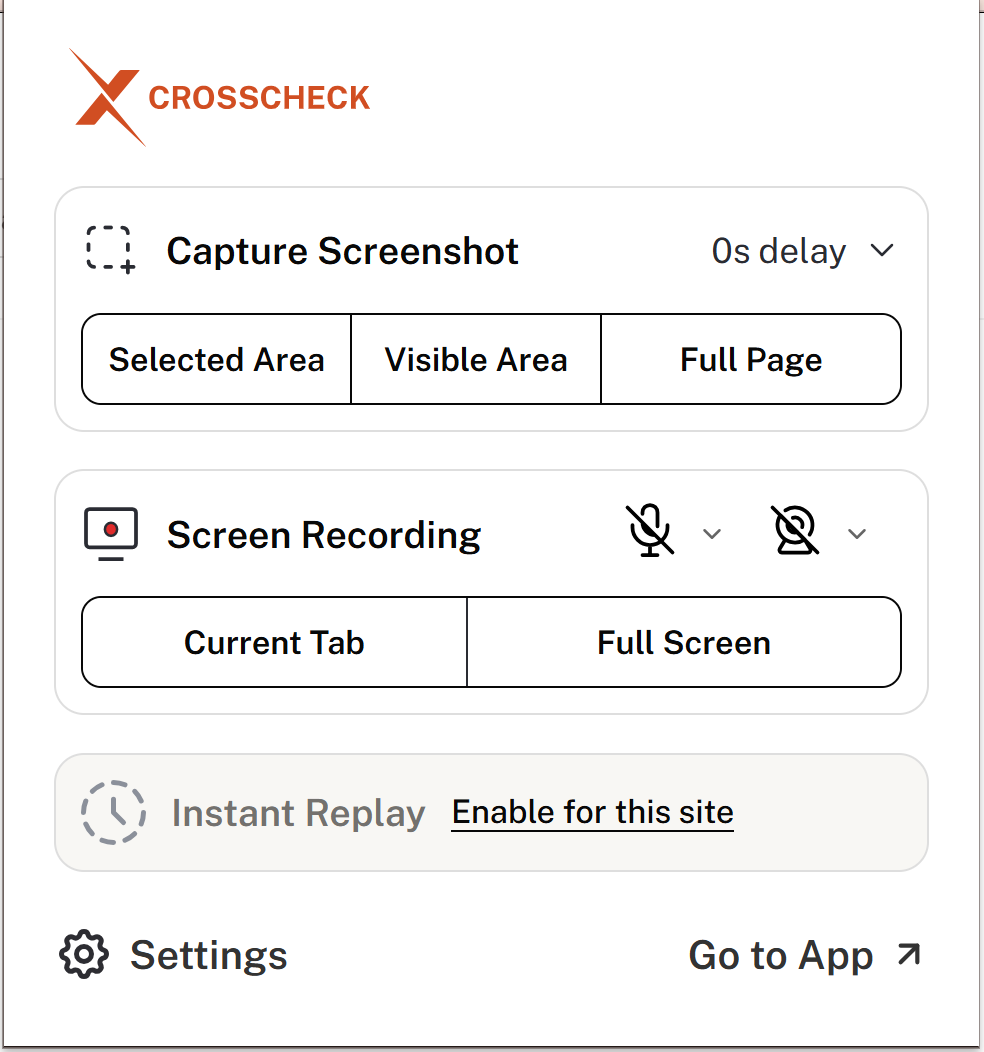
Crosscheck is a free Chrome extension for visual bug reporting. When a tester catches a bug, Crosscheck captures the screenshot or screen recording, the console logs, the network requests, and the browser, OS, and viewport metadata automatically — in the background. The tester annotates, adds a title, picks the destination (Jira, Linear, ClickUp, Asana, GitHub, Slack), and sends.
Crosscheck is not a PM tool. It is the capture layer that feeds whichever PM tool the team has chosen. A team on ClickUp keeps using ClickUp. A team on Monday keeps using Monday. The seven-step pre-ticket dance collapses into one. No paid tiers, no per-user limits.
If you are mid-evaluation of bug-reporting tools more broadly, the deeper guide covers the trade-offs between Crosscheck, Jam, BugHerd, Marker.io, and the others.
Which tool should you actually pick
Pick Asana if QA sits inside a cross-functional team that values a calm, stable interface; if your bug workflow is straightforward and test cycles live in a TMS like TestRail, Zephyr, Xray, or Qase; and if the budget supports Advanced-tier pricing.
Pick Monday.com if your most important audience is non-technical — product managers, designers, executives — and dashboards drive your release-readiness reviews; if you can absorb bucket-pricing markup; and if your team size makes the seat math work.
Pick ClickUp if you want native sprint boards, fully custom bug-status flows, and strong automation without paying for a top tier; if your team has the bandwidth for the learning curve; and if you can budget the $9/user/month Brain add-on separately when AI is part of the plan.
For a parallel framing on the testing-tool side, see Selenium vs Playwright vs Cypress 2026 and Best AI Testing Tools 2026.
FAQ
Is Asana better than ClickUp for QA teams?
Asana is better if platform stability, a clean interface, and broad native integrations matter more than sprint mechanics — and if your test cycles already live in a dedicated TMS. ClickUp is better if you want custom bug-status lifecycles, native sprints, and stronger automation per dollar. The team's tolerance for ClickUp's complexity and feature breadth is the deciding factor.
Does Monday.com have a free plan for QA work?
Yes, but only for 2 seats, with 3 boards and no automations or integrations. That is enough for a solo QA evaluation, not for a working team. Any meaningful QA workflow on Monday starts at the Standard tier ($12/seat/month annually) with a 3-seat minimum.
Can ClickUp replace a dedicated test case management tool?
Not really. ClickUp has bug-report and issue-tracking templates and can simulate test cases with custom fields, but it does not provide the formal test-cycle pass/fail tracking, traceability matrices, or test-run history that TestRail, Zephyr, Xray, or Qase ship as native concepts. Most QA teams running formal cycles pair ClickUp (for project work and bugs) with a TMS (for cycles).
Do any of these tools integrate with Linear?
All three have Linear integrations, but they are typically thinner than the Jira integrations. Two-way Jira sync is native on Asana, Monday, and ClickUp. Linear-side syncing more often runs through Zapier, Make, or n8n. For Linear-anchored teams, Crosscheck's Linear integration sits at the bug-capture layer and avoids the middleware step entirely.
What about Jira itself — should QA teams just use Jira?
Jira remains the dominant ticketing system on the engineering side. Many QA teams effectively work in a hybrid — Jira for engineering tickets, Asana/Monday/ClickUp for QA project work, and a TMS for formal cycles. The right question for a QA lead isn't "should we use Jira?" but "which PM tool do we use alongside Jira to keep QA work visible to the rest of the company?"
Start capturing bugs with full context — on whichever PM tool you pick
The PM tool decision matters less than the discipline you put around it. A team can ship great work on any of Asana, Monday, or ClickUp — and a team can also accumulate triage debt on any of them if the bug-capture habit isn't tight.
Crosscheck handles the capture step. Every bug arrives with the screenshot, console errors, network logs, browser, OS, and build context already attached — to whichever tool the team has standardized on. The tester spends seconds on the report instead of minutes, and the developer opens a ticket they can act on immediately.
 Add to Chrome