Visual bug reporting: the 2026 standard for filing issues developers can actually fix
Visual bug reporting is the practice of attaching an annotated screenshot or screen recording — together with automatically captured console errors, network requests, DOM state, browser details, and a timeline of user actions — to every bug, instead of relying on a written description alone. The premise is that a developer should see the bug exactly as the reporter saw it, with all the surrounding technical context, and start debugging without a single follow-up message. In 2026, that premise has become the default operating assumption inside most QA teams, agency UAT workflows, and customer-support-to-engineering pipelines.
The shift has not happened because anyone fell in love with screenshots. It has happened because the bug-reporting bottleneck — not test speed, not deployment speed — is now where engineering teams lose the most time per shipped feature.
Key takeaways
- Visual bug reporting pairs visual evidence (screenshots, video, or replay) with automatic technical metadata so issues are reproducible on first read.
- The four pillars in 2026: annotation, screen recording, retroactive DOM replay, and auto-captured console + network logs.
- Text-only reports still dominate Slack channels and Jira queues, and they are the single largest reproducible source of wasted developer hours.
- Tool selection breaks down by reporter persona — clients on staging, internal QA, customer-support agents, designers, end users in production.
- Crosscheck, Jam, Marker.io, BugHerd, and Userback each solve a different slice of the problem; the comparison table below lays out what each actually does today.
What is visual bug reporting, exactly?
A visual bug report is a structured artifact, not a single screenshot. It contains four layers, ideally captured in one motion by a single tool:
- Visual evidence — a screenshot, screen recording, or DOM replay. What the reporter saw.
- Annotation — arrows, callouts, highlights, blur masks, and short text labels directing attention to the broken element or moment.
- Automatic context — browser, OS, viewport, URL, console output, network requests with payloads and status codes, and a timeline of user actions.
- Routing metadata — title, description, severity, reporter identity, and a destination ticket in Jira, Linear, ClickUp, GitHub, or Slack.
When any one layer is missing, the report degrades quickly. A pristine screenshot with no console log leaves the developer guessing whether the failure was rendering or data. A perfect console dump with no screenshot forces the developer to reproduce the visual state by hand. A long recording with no annotation puts the burden of finding the relevant moment on the engineer who has to fix it.
The reason visual reporting has become a category, rather than a feature inside Jira, is that doing all four layers manually is too much work for a non-engineer to repeat every time. Tooling has had to absorb the burden.
Why text-only bug reports cost teams so much time
A report that reads "the button doesn't work on checkout sometimes" is not a bug report. It is a request for someone else to investigate a possible bug. The cost shows up in three places.
Reproduction overhead. Without a recording or the precise URL, viewport, and user state, the developer rebuilds the scenario from scratch. If the bug only fires under a specific session — a logged-in user with a saved discount code on Safari at 1280px width — the chance of accidentally reproducing it is low.
Back-and-forth latency. Each clarifying message forces a context switch back to the bug an hour later, when the reporter answers. A bug needing three rounds of clarification can sit in the queue for two or three working days even when the actual fix is fifteen minutes. The Stack Overflow Developer Survey has consistently flagged unclear requirements and missing context as a top developer frustration, and bug tickets are where this hurts most.
Wrong-fix risk. When a developer reproduces the wrong bug — something visually similar but rooted in a different cause — they ship a fix that doesn't address the original complaint. The reporter re-files. The team spends a second sprint cycle on the same issue.
A visual report with auto-captured metadata collapses all three costs. The developer sees the exact UI state, watches the action that triggered the bug, reads the console error inline, and confirms the failing network call without leaving the ticket.
The four capture types — and when each one is the right tool
Different bugs need different evidence. The mature 2026 toolset breaks into four distinct capture modes, and a team that understands which to reach for files better reports.
Annotated screenshots
The workhorse. A screenshot is the right capture mode for any bug that exists in a single visible state — broken layout, wrong copy, misaligned component, incorrect price, missing element, accessibility issue.
The annotation matters more than the screenshot. A raw image forces the reader to scan for the problem. Add a red arrow on the specific element, a yellow highlight on the expected position, and a short label — "price should be $49, showing $0.00 with code SUMMER20" — and the same image becomes a directed brief. Modern annotation toolkits include a blur or pixelation tool for redacting PII before the screenshot leaves the reporter's device; this should be the default on anything customer-facing.
Visual regression testing operates in an adjacent space — catching the same class of issue automatically, before the bug is filed. Visual bug reporting is the human-in-the-loop counterpart.
Screen recordings
A recording is right whenever the bug exists across time rather than at a single moment. Examples: a dropdown that closes the instant it is clicked, a form that submits but then fails to persist, a layout that renders correctly on first load but breaks on navigation back.
Two recording behaviours matter in 2026: trimming (cutting the recording down to the relevant 5–30 seconds before sharing) and tab-versus-desktop scope (recording only the browser tab, not the entire screen, unless the bug is OS-level). A 7-minute unedited recording where the bug appears at the end is almost as bad as no recording at all.
Retroactive DOM replay (instant replay)
The capture mode that has changed the most in the last two years, and the single biggest reason visual bug reporting has become viable for end users and support agents who do not know a bug is coming.
A retroactive replay tool runs in the background — a browser extension or embedded SDK — and continuously buffers the last 60 to 180 seconds of DOM mutations, network requests, console output, and user input as structured data, not as a video file. When the reporter notices something is wrong, one button preserves that buffer as a replayable session. The developer can scrub through it, inspect the DOM at any frame, view the console state at any timestamp, and watch the exact sequence of clicks that produced the bug.
The structural advantage over screen recording is that replay data is inspectable, not just watchable. A developer can pause on a specific frame, open a virtual DevTools, and read the actual state of the component rendered at that moment. That is what makes replay tools so much more useful than video for diagnosing intermittent or production-only bugs.
Jam.dev was an early popularizer under the name Instant Replay. Crosscheck implements a similar pattern. Userback offers it as part of its Business plan under Session Replay. Implementations differ in detail — buffer length, what's recorded by default, storage location — but the user-visible behaviour is consistent.
Automatic context capture
Not a separate capture type so much as a layer accompanying all three above. Console errors and warnings. Outbound network requests with status codes, headers, bodies. Browser, OS, viewport, network speed. URL and timestamp. A timeline of user actions over the captured window.
The shift from manually filling out an environment-info form to automatic capture is the single biggest contributor to bug-report quality across the category. Asking a non-technical reporter to find their Chrome version in chrome://settings/help is asking too much. A tool that captures it silently behind the screenshot does the same job at zero friction.
Visual bug reporting vs. traditional text-based reporting
The comparison below is what most teams actually experience when they migrate from a text-template Jira workflow to a visual-first tool.
| Dimension | Text-only bug report | Visual bug report |
|---|---|---|
| Reporter time per bug | 5–10 minutes filling fields | 20–60 seconds capturing + annotating |
| Developer reproduction time | High variance — minutes to hours | Often single-digit minutes |
| Clarification round-trips | 1–3 typical, sometimes more | Usually zero |
| Console + network context | Manually copied if at all | Captured automatically |
| Browser / OS / viewport | Manually filled, often missing | Auto-attached |
| Reproducibility for intermittent bugs | Low — relies on reporter memory | High — replay or recording preserves the exact session |
| Suitability for non-technical reporters | Poor — requires DevTools knowledge | Strong — single button captures everything |
| Routing into Jira / Linear / ClickUp | Manual ticket creation | Automatic, with metadata pre-populated |
| PII risk | Low — text only | Real — requires blur/mask discipline |
| Storage cost | Negligible | Moderate (video) to low (replay) |
The asymmetry is what makes the case. Text-only reporting saves seconds at the reporting step and loses hours at the resolution step. Visual reporting inverts the trade — slightly more sophisticated tooling up front, dramatically lower friction downstream.
Who actually uses visual bug reporting, and how the workflow differs
The category looks different depending on which side of the product the reporter sits.
Agencies collecting client feedback on a staging site
The classic visual feedback use case. An agency hands a staging URL to a client, the client clicks through and pins a comment to a specific element on the page. The PM triages comments into a Kanban board, the developer fixes the marked-up issues, and the screenshot stays attached as proof of the original complaint.
BugHerd and Marker.io are the historical leaders. Both render an overlay on the live page, capture the precise CSS selector of the targeted element, and auto-attach browser metadata. BugHerd uses an in-tool Kanban board; Marker.io routes natively into Jira, Linear, ClickUp, and similar — which matters when the agency's developers never want to log into a feedback platform.
Internal QA inside a product team
A QA engineer testing a release candidate produces dozens of reports a day across multiple browsers. The bottleneck is not getting reporters to file — they will — but getting reports to contain enough context that a developer can fix them without sitting next to the QA engineer.
For this persona, automatic console and network capture is the differentiator. Browser-extension tools — Crosscheck, Jam, BetterBugs — fit naturally because the QA engineer is already in Chrome and a one-click capture covers all four context layers. Reports flow directly into Jira or Linear.
Developer-to-developer handoff
Bugs found by one developer and assigned to another. The friction here is less about capability than about consistency — a developer-only team will sometimes drop visual evidence entirely and rely on a code snippet and a console paste, which works until the bug is a layout or interaction issue that text cannot describe. A screenshot in the PR or Linear ticket, paired with the relevant logs, is usually enough; heavy session-replay tooling is overkill.
Product manager and designer feedback
PMs and designers report real bugs — a misaligned component, copy in the wrong place, a state that doesn't match the spec — but often file them in ways developers find hard to action. Visual reporting helps here primarily through annotation: a screenshot with a clearly marked "this should look like X" removes the ambiguity text alone introduces.
Customer-support-to-engineering escalation
The use case that has grown fastest in the last 18 months. A customer reports a bug to a support agent who needs to escalate to engineering with enough context that engineering can act. Without tooling, the agent ends up in a 20-minute Zoom with the customer trying to recreate the bug.
Jam released Jam for Customer Support targeting exactly this flow — a one-click capture inside the support chat that ships console logs and a screen recording to engineering without the customer installing anything. The same pattern works with most replay-based tools by giving the support agent (not the customer) the recording extension.
How the leading visual bug reporting tools compare in 2026
The market has matured to roughly five distinct categories of tool. Below is what each currently does, verified against the vendor's own 2026 documentation.
| Tool | Primary persona | Annotation | Screen recording | Retroactive replay | Auto console + network | Native ticket routing | Pricing model |
|---|---|---|---|---|---|---|---|
| Crosscheck | Internal QA, dev teams, agencies | Yes (arrows, shapes, blur) | Yes (tab or desktop, trimming) | Yes (instant replay buffer) | Yes (logs, requests, user actions) | Jira, Linear, ClickUp, GitHub, Slack | Free Chrome extension |
| Jam | Internal QA, customer support | Yes (basic) | Yes | Yes (up to 2 min DOM session) | Yes (incl. JamGPT debugger) | Jira, Linear, GitHub, Notion, Slack | Free tier + paid plans |
| Marker.io | Agencies, UAT, client review | Yes (rich, on live page) | Yes | Yes (session replay) | Yes (browser, OS, network logs) | Jira, Linear, Trello, ClickUp, Asana | Paid, ~$39/mo entry |
| BugHerd | Agency client feedback | Yes (pin-to-element) | Yes (with audio) | No | Browser, OS, CSS selector, console | Jira, ClickUp, Asana, Monday, Trello | Paid, $42/mo entry |
| Userback | Product teams + user research | Yes | Yes | Yes (session replay) | Yes (logs, network, events) | Jira, GitHub, Slack, Asana | Free tier + paid plans |
Feature parity in this category is closer than the category itself markets — every tool listed captures some console output and some metadata, and the differences are increasingly about defaults, polish, ticket-routing depth, and pricing rather than raw capability.
Crosscheck is the only tool in the comparison that is free with no paid tier — a deliberate positioning choice from the Crosscheck team. The trade-off: no in-app SDK widget like BugHerd, Marker.io, or Userback embed for end-user feedback. Crosscheck is a Chrome extension used by the reporter, not a widget the engineering team installs.
Jam competes most directly on the QA-and-support workflow. Its JamGPT debugger and MCP integration are the most developed AI layer in the category, useful when the team wants AI to summarise the bug and propose a fix rather than just attach a recording.
Marker.io is the strongest fit for agency-to-client UAT when the destination is Jira or Linear. The two-way Jira sync (status changes flow both ways) is genuinely useful and not trivial to replicate.
BugHerd owns pin-to-element feedback collection. If the reporters are clients leaving comments on a marketing site or web app, BugHerd's overlay is still the cleanest UX. It does not currently offer retroactive replay.
Userback is the broadest platform — bundling bug reporting, in-app surveys, feature request boards, and session replay. The breadth is the pitch; for a team that wants only the bug reporting piece, it can feel heavy.
For a wider list including issue trackers and mobile-first tools, see the best bug reporting tools roundup for 2026.
Building a visual bug reporting workflow your team will actually follow
A few rules consistently separate teams that get value from teams that buy a license and then keep filing text-only bugs anyway.
Make visual evidence a quality gate, not a request. Any bug submitted without a screenshot, recording, or replay should be returned to the reporter with a single sentence asking for visual evidence. This is not about being strict — it protects the developer's reproduction time. Teams that enforce this rule consistently see ticket lifetime drop within two sprints.
Standardise annotation conventions. Decide as a team what each annotation means. Common pattern: red arrow on the broken element, yellow highlight on the expected state, blue text describing expected behaviour, blur for anything sensitive. The exact convention matters less than the fact everyone uses the same one.
Capture context automatically, never manually. If reporters are filling out a "browser version" field on a ticket template, switch tools. Metadata that gets filled by hand gets skipped under deadline pressure.
Route directly into the destination tracker. The moment a visual report requires a developer to leave their workflow — open a separate tab, download an attachment, log into another tool — friction starts accumulating. Reports should land in the same Jira board, Linear cycle, or ClickUp list the developer is already in.
Treat replay storage as an asset. There is always a temptation to set a 7-day retention policy to save space. Don't. The bugs that get re-opened months later are the ones where the original replay would have made the second debugging session trivial. Most replay tools store DOM-snapshot data efficiently enough that 30–90 days is affordable.
Be ruthless about PII. Production screenshots contain customer names, emails, internal URLs, and occasionally access tokens. Every team using visual reporting needs a blur-or-mask norm enforced by tooling defaults rather than reporter discipline. For an applied template, see the perfect bug report template Crosscheck publishes alongside the extension.
Common visual bug reporting mistakes
Capturing the symptom instead of the cause. A screenshot of an error toast is useful. The same screenshot, captured alongside the failing network call and the console error that fired, is what actually closes the ticket. Most of the value sits in the non-visual context the tool captures behind the screenshot.
Skipping annotation because the bug "is obvious". It is obvious to the reporter. The 10 seconds spent adding an arrow and a sentence saves the developer five minutes scanning the image trying to find what's wrong.
Recording everything, trimming nothing. A 4-minute recording where the bug appears at 3:40 will be skipped. Either trim before sharing, or use a replay tool that lets the developer scrub instead of watching linearly.
Treating visuals as a substitute for description. A visual report still needs a one-line title, expected-versus-actual behaviour, and severity. The screenshot shows what happened; the text explains why it matters. Teams that drop the text end up with Kanban boards of unlabelled screenshots no triage process can sort.
Buying the tool and not enforcing it. Half the team files visual reports, the other half stays on text, and the workflow becomes a mix. Without a single rule — every bug needs visual evidence — the value never compounds.
FAQ
How is visual bug reporting different from session replay?
Session replay is one capture mode inside the broader practice. A replay is a structured recording of DOM mutations, network requests, and user input, played back as a video-like reconstruction. Visual bug reporting also includes annotated screenshots, screen recordings, and the auto-captured technical metadata that surrounds any of those captures. A tool can do visual reporting without doing replay (BugHerd); a tool that only does replay (LogRocket, FullStory in their core configurations) covers part of the workflow and is usually paired with a separate annotation step.
Does visual bug reporting work for production bugs, or only QA?
Both, but the capture mechanism differs. For QA and staging, a Chrome extension on the reporter's machine handles every layer. For production bugs reported by end users, the workflow either embeds a feedback widget in the product (Marker.io, BugHerd, Userback) or hands the user a recording link they fire without installing anything (Jam). For customer-support escalation, the support agent — not the customer — runs the capture tool against the customer's shared screen.
Will visual bug reports capture sensitive customer data?
Yes, unless the team configures masking. Customer names, emails, support ticket contents, internal URLs, and occasionally access tokens all show up in real screenshots. Every serious tool in the category supports element-level blur or mask rules. For workflows touching regulated data (healthcare, financial, EU users under GDPR), masking should be enforced at the tool level rather than left to reporter discipline.
Is visual bug reporting the same as visual regression testing?
No. Visual regression testing is automated — Percy, Applitools, or Chromatic compares rendered screenshots between builds and fails the build when the diff exceeds a threshold. Visual bug reporting is human-driven — a reporter notices something is wrong and files an annotated report. The two are complementary: regression catches bugs before humans see them; visual reporting captures bugs humans saw before automation could.
How long should a bug report screen recording be?
Short. Most useful recordings are 15 to 60 seconds, including the moment just before the bug fires and the moment the bug becomes visible. Long unedited recordings are skipped — either trim before sharing, or switch to a replay-based capture where the developer can scrub to the relevant frame.
Start filing visual bug reports with Crosscheck
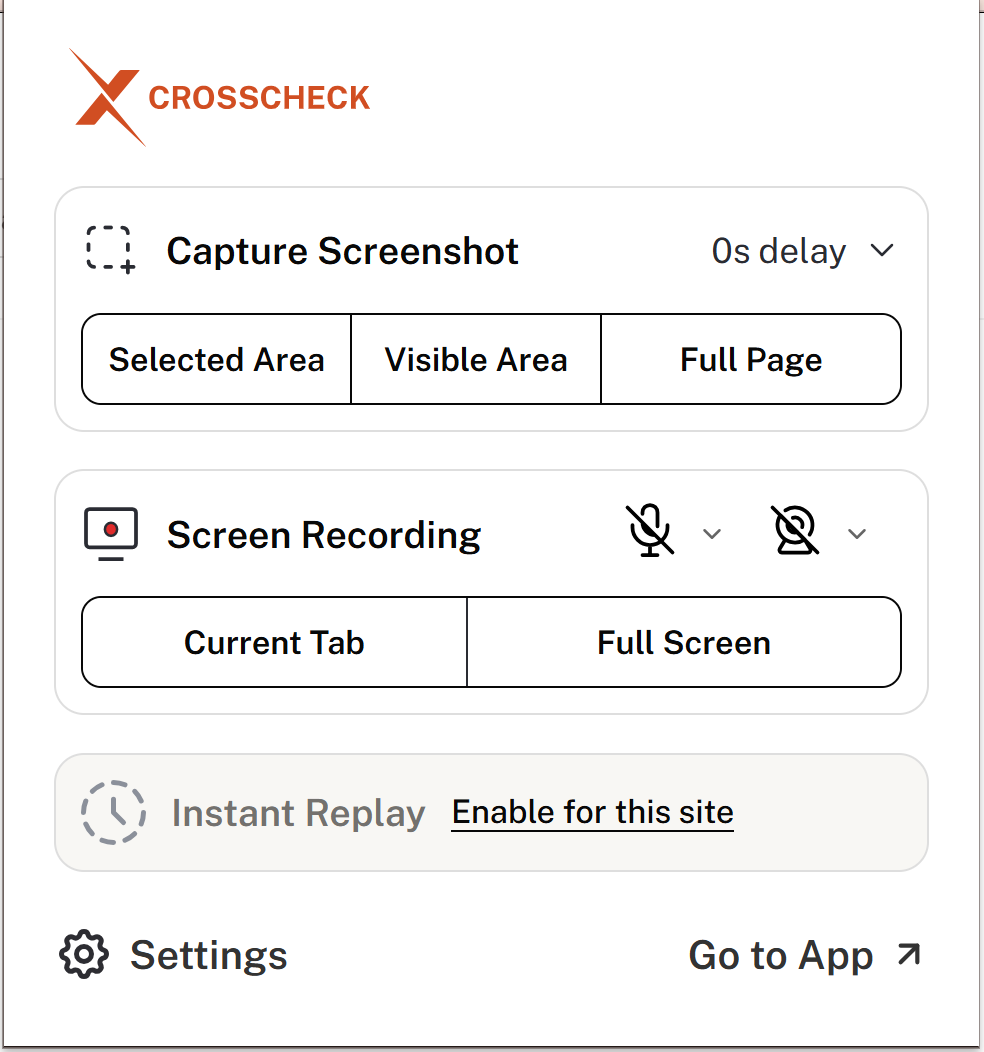
If the team is still attaching screenshots by hand to text-template Jira tickets, the closest tool to "the whole stack in one capture" is the one the Crosscheck team builds. Crosscheck is a free Chrome extension that captures annotated screenshots, trimmed screen recordings, and retroactive instant-replay sessions — with all four context layers attached automatically. Reports push into Jira, Linear, ClickUp, GitHub, or Slack without leaving the browser.
No paid tier, no per-seat pricing, no usage limits. The Crosscheck team built the extension around the observation that bug-reporting friction is a tooling problem, not a discipline problem — and removing it should not require a sales call.

 Add to Chrome