Cross-Browser Testing in 2026: A Practical Guide to Browser Compatibility
Cross-browser testing is the discipline of validating that a web application behaves correctly across the rendering engines, JavaScript runtimes, and device profiles your real users carry — primarily Chromium (Chrome, Edge, Brave, Opera), WebKit (Safari on macOS and every browser on iOS), and Gecko (Firefox). In 2026, that means a tiered matrix: one fast loop locally during development, a broader sweep in CI on every pull request, and a deep release-gate run against real devices before shipping. The tools have consolidated around Playwright for open-source coverage and BrowserStack, Sauce Labs, and TestMu AI (formerly LambdaTest) for cloud device clouds.
Key takeaways:
- Chrome still dominates globally at roughly 65% all-device share — but Safari controls 23% of mobile worldwide and 32% in the US, and every iOS browser uses WebKit regardless of branding.
- A three-tier matrix (dev, CI, release) keeps engineering velocity intact without sacrificing coverage. Most teams over-test in CI and under-test at the release gate.
- Playwright is the open-source default in 2026 because it ships first-party Chromium, Firefox, and WebKit drivers. Cypress still has only experimental WebKit support — a hard limitation for any team with iOS traffic.
- Real-device testing matters most for iOS Safari, where simulators miss touch behavior, performance, and Apple-specific Web API quirks.
- AI-native orchestration (TestMu AI's KaneAI, BrowserStack's test-gen agents) is reducing authoring time, but neither product replaces the human judgment behind the matrix itself.
What cross-browser testing actually covers in 2026
The phrase "cross-browser testing" hides three different problems, and conflating them is why so many teams over-spend on cloud platforms while still shipping bugs.
The first problem is rendering-engine divergence — the same CSS or layout API behaves differently in Blink (Chromium), WebKit (Safari), and Gecko (Firefox). Flexbox gap support, :has() selector edge cases, font metrics, scroll snap, and date inputs are all common offenders. The second is JavaScript engine and Web API divergence — V8, JavaScriptCore, and SpiderMonkey implement specs at slightly different paces, and Safari historically lags on features like Web Push, Service Workers' background fetch, or newer ES proposals. The third is device and OS context — iOS Safari on a real iPhone behaves differently from desktop Safari, which behaves differently from Chrome-on-iOS (which is still WebKit under the hood, by Apple policy).
A useful test matrix splits coverage by which of those three risks each browser exposes. Testing Brave and Opera adds almost nothing to Chrome coverage because they share Blink. Testing Safari on iOS and macOS catches different bugs because the device context differs even when the engine matches.
Which browsers matter in 2026 — and which don't
Browser market share has stratified by device class. The picture below pulls from StatCounter's all-device global view as of early 2026, cross-referenced with the StatCounter US figures and Cloudflare Radar where the two sources diverged.
| Browser | Global all-device | Desktop | Mobile | US share | Engine |
|---|---|---|---|---|---|
| Chrome | ~65% | ~65% | ~65% | ~49% | Blink (Chromium) |
| Safari | ~18% | ~9% | ~23% | ~32% | WebKit |
| Edge | ~5% | ~14% | <1% | ~7% | Blink (Chromium) |
| Firefox | ~2.5% | ~7% | <1% | ~3% | Gecko |
| Samsung Internet | ~2% | n/a | ~4% (Android) | <1% | Blink (Chromium) |
| Opera + Brave | ~2% combined | ~2% | ~1% | <1% | Blink (Chromium) |
A few things stand out. Chrome's global dominance can lull a team into Chrome-only testing — but one in three US users browses on Safari, and on mobile the figure climbs higher. Any product whose revenue concentrates in North America must treat Safari as a first-class target.
Edge has grown past 5% all-device share in 2026, driven by Windows default placement and enterprise managed-device policies. For B2B SaaS, Edge is often the second-most-important target — not Firefox. Firefox sits around 2.5% globally but matters disproportionately to developer-facing products and to compliance with the open-web ethos: it is the only major browser not built on Chromium, so testing it is the cheapest way to catch standards-non-compliance in your own code.
The browsers worth deprioritising in 2026: Internet Explorer (Microsoft ended support in June 2022), Opera Mini (compresses HTML on a proxy so you cannot meaningfully test it client-side), and the long tail of obscure browsers that show up in analytics with a fraction of a percent. If a browser is under 1% of your actual traffic and shares an engine with something you already test, drop it.
The three-tier cross-browser testing matrix
The most common mistake teams make is treating cross-browser testing as one job — "run the suite against everything." That is slow, expensive, and trains engineers to ignore the noise. The matrix that scales is tiered.
Tier 1 — Developer loop (every save, every commit)
What runs: Chromium only, headless, via Playwright or Vitest's browser mode. Smoke tests of the page or component the developer is changing. Sub-second feedback.
The goal at this tier is fast-failing on regressions in the engine that 65% of users actually browse on. Anything slower trains engineers to skip the tests. Chromium-only is acceptable here because the next tier catches the rest.
Tier 2 — CI on every pull request
What runs: Chromium, Firefox, WebKit — all three Playwright engines, in parallel, on a Linux runner. The full functional regression suite or the change-affected subset (via test impact analysis). Wall-clock target: under 10 minutes for the critical path.
This is where Playwright's three first-party engines pay for themselves. A Linux runner with all three browsers is the cheapest possible WebKit coverage — not perfect (it's WebKit-on-Linux, not Safari-on-macOS), but it catches roughly 80% of WebKit-specific layout and JavaScript bugs before code merges.
Tier 3 — Release gate (pre-deploy)
What runs: real-device coverage on a cloud platform — BrowserStack, Sauce Labs, or TestMu AI — across the matrix your analytics actually justifies. Safari on a real iPhone. Chrome on a real Pixel. Edge on Windows 11. Plus visual regression diffing against the previous release.
This tier is slow (15–45 minutes) and expensive per minute. The discipline is to run it gated on the merge-to-main commit, not on every PR. Most teams that complain about cloud testing costs are running tier 3 at tier 2 frequency.
How the leading cross-browser testing tools compare
Playwright
Playwright is the open-source default for cross-browser testing in 2026. Microsoft maintains first-party drivers for Chromium, Firefox, and WebKit, and the same API runs against all three. Version 1.60 (May 2026) added Chrome for Testing builds for the Chromium channel, finer-grained network interception, and stable Ubuntu 24.04 support for WebKit.
The case for Playwright is straightforward — three engines, one API, zero cloud vendor lock-in. It runs on Linux, which makes CI cheap, and Playwright contexts are lightweight enough that a single runner can execute hundreds of parallel browser sessions without thrashing. The case against it is that WebKit-on-Linux is not Safari-on-iOS, and for products with significant mobile revenue, Playwright alone is insufficient at tier 3.
Best for: any team building a 2026 test suite from scratch, and any team running Cypress that needs Safari coverage.
Cypress
Cypress supports Chrome, Edge, and Firefox out of the box. WebKit support exists but is still flagged as experimental — teams describe it as "useful for catching gross failures, not for production confidence." For applications with iOS users, this is a hard limitation, and the canonical workaround in 2026 is to keep Cypress for Chromium-family tests while adding Playwright's WebKit project to CI alongside.
Cypress's strengths — time-travel debugging, automatic retries, an opinionated DX — remain genuine. It just is not a viable single-framework answer to cross-browser coverage in 2026.
Best for: teams already invested in Cypress with negligible iOS traffic, or as a complement to Playwright for WebKit.
BrowserStack
BrowserStack is the largest real-device cloud, with 2,000+ iOS devices, 2,500+ Android devices, and broad legacy-browser coverage (older Safari, older Edge, even older Internet Explorer for products under regulatory contract). Pricing is published — Live testing starts at $29/month, Automate at $129/month per parallel session. Percy (acquired by BrowserStack) handles visual regression diffing inside the same workflow.
The platform integrates natively with Playwright, Selenium, Cypress, and Appium, so existing test code runs against the cloud with a configuration change rather than a rewrite. AI features are early — test-case generation and accessibility detection — but not yet at the level of TestMu AI's KaneAI for plain-English authoring.
Best for: teams that need real-device coverage at scale, especially for iOS, and teams that want one vendor for functional and visual testing.
Sauce Labs
Sauce Labs counters BrowserStack with deeper analytics (Sauce Insights surfaces test-level flakiness scores, failure clustering, and infrastructure-versus-regression triage), stronger Appium support for native mobile, and EU data residency for GDPR-sensitive workloads. Pricing runs higher at scale — at 100 parallel sessions, Sauce Labs typically lands at $80,000–$120,000/year versus BrowserStack's $50,000–$75,000 for comparable capacity.
The pitch is that Sauce sells quality intelligence, not just runners. For an org running weekly QA retros on flakiness and root-cause patterns, that's a real advantage.
Best for: large engineering organisations with compliance requirements, deep mobile automation, and analytics-driven QA leadership.
TestMu AI (formerly LambdaTest)
LambdaTest rebranded to TestMu AI in January 2026, repositioning around two AI-native products: KaneAI, an agent that authors tests from plain-English descriptions, and HyperExecute, an orchestration layer that the company benchmarks at up to 70% faster than legacy parallel execution. The cross-browser cloud underneath — 3,000+ browser/OS combinations, real-device support, Playwright/Cypress/Selenium/Appium integration — is unchanged from the LambdaTest era.
Pricing is modular across six products with a free tier on each. KaneAI is priced per agent (each agent covers 500 authoring sessions plus 300 HyperExecute minutes per month), which is a different unit economic than the per-parallel pricing of BrowserStack and Sauce Labs. For teams running AI-assisted authoring, that model is cheaper; for teams that already have authored suites, it's not.
Best for: teams adopting AI-assisted test authoring, startups that want a free tier to grow into, cost-sensitive mid-market QA orgs.
How real devices change the calculation for mobile
Simulators and emulators are good enough for Tier 2. They are not good enough for the release gate when iOS traffic matters.
The reasons are specific. iOS Safari's WebKit on a real device behaves differently from the WebKit build shipped with Playwright — Apple-specific extensions (smart app banners, Apple Pay JS, Safari Reader heuristics, the way the address bar consumes viewport height during scroll) only manifest on real iOS. Touch events on a real device have pressure, multi-touch, and the iOS rubber-band scroll inertia that simulators approximate poorly. Performance characteristics — JavaScript throttling on background tabs, memory pressure on lower-end devices, ProMotion variable refresh rate on newer iPhones — are not reproducible in a simulator.
For Android, the calculation is gentler. Chrome on a modern Android emulator behaves close enough to a real Pixel that most regressions surface. The exception is Samsung Internet on older Galaxy hardware, which can interpret CSS just differently enough to break layouts that pass on stock Chrome. If your analytics show meaningful Samsung traffic, real-device testing matters more.
A pragmatic 2026 mobile coverage rule: test the latest two iOS versions on a real iPhone at the release gate, and let emulators handle the broader Android long tail except for Samsung Internet, which earns its own real-device slot when traffic justifies it.
AI-assisted cross-browser testing — what's actually working in 2026
Three AI use-cases have moved from demo to production this year, and one has not.
Working: self-healing locators. Playwright's auto-waiting and TestMu AI's auto-healing both reduce the most common form of brittleness — a selector that breaks when a frontend team renames a class. Healing is conservative (the test still fails if the underlying flow changes), but it absorbs cosmetic refactors without engineer intervention.
Working: AI-assisted authoring. KaneAI and the experimental Playwright + Copilot integrations can turn a paragraph of plain-English steps into a runnable test. For teams onboarding manual QA into automation, this collapses the learning curve. For senior SDETs, it's a faster scaffolding tool — they still review and refactor the generated code.
Working: visual regression diffing with AI baselines. Percy, Applitools, and Chromatic now use AI to ignore irrelevant pixel differences (anti-aliasing, font rendering between browsers) while flagging meaningful regressions. This dramatically reduces false positives, which historically killed visual regression adoption.
Not working yet: agentic end-to-end QA. The pitch — an agent that takes "test the checkout flow" as input and runs it across all browsers — produces demos that look good and production runs that are slow, expensive, and harder to debug than scripted tests. The 2026 reality is that agents are useful for exploratory testing of new features, not for the regression suite.
A working cross-browser test matrix you can copy
Here is a matrix that a 12-person engineering team at a B2B SaaS product shipping daily can realistically maintain. Adjust the device list to your analytics.
| Tier | When it runs | Where | Browsers | Suite |
|---|---|---|---|---|
| Dev loop | Pre-commit, watch mode | Local | Chromium only | Smoke + changed-file tests |
| CI (PR) | Every pull request | GitHub Actions / GitLab CI | Chromium, Firefox, WebKit (Playwright) | Full critical-path regression |
| Release gate | Merge to main, pre-deploy | BrowserStack / Sauce Labs / TestMu AI | Safari iOS (latest 2), Chrome Android (Pixel + Samsung), Edge Win11, Firefox latest | Full regression + visual diff |
| Production | Continuous | Synthetic monitors | Chrome, Safari (mobile) | Critical user journeys only |
The numbers that matter: tier 1 must run in under 10 seconds, tier 2 in under 10 minutes, tier 3 in under 45 minutes. If any tier exceeds its budget, the discipline that holds the matrix together starts to crack — engineers skip tier 1, PRs queue waiting for tier 2, and release gates get bypassed because they "just take too long."
Capturing browser-specific bugs with full context
Even the best matrix surfaces bugs that don't reproduce on the developer's machine. The most expensive minutes in QA in 2026 are not the test-execution minutes — they are the back-and-forth between a tester who saw something break in Safari and a developer who can't reproduce it without knowing the exact browser version, console errors, network calls, and user steps.
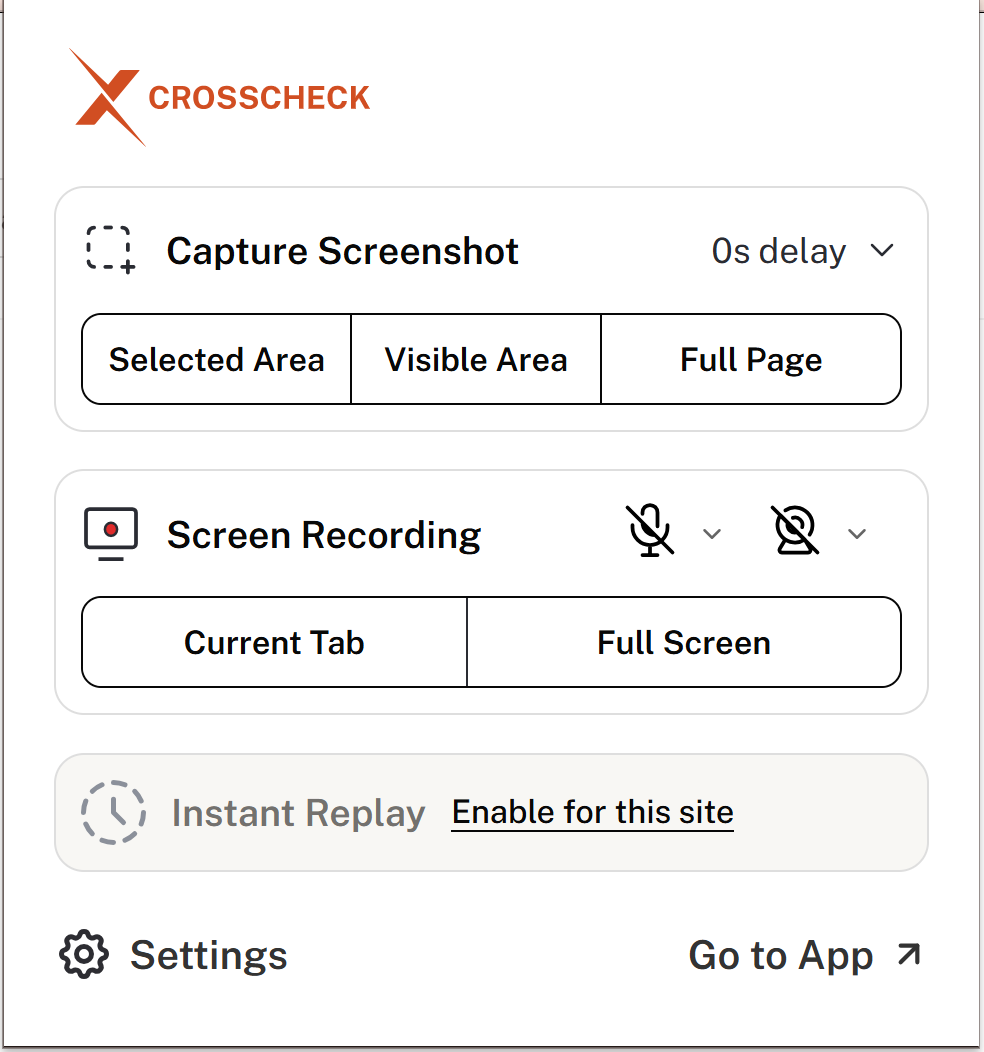
Crosscheck is the Chrome extension the Crosscheck team built for exactly this problem. When a tester files a bug from any Chromium-based browser, the report ships with the full console log, the network waterfall, a click-by-click user-action replay, and the complete environment fingerprint (browser, version, OS, viewport, extensions). It lands directly in Jira, Linear, ClickUp, GitHub, or Slack with everything attached — no screenshots, no "can you check your console?", no second meeting to repro.
For cross-browser bugs specifically, that context is the difference between a one-day fix and a week of triage. The extension is free, with no paid tiers and no usage limits.
For deeper reading on related testing topics, see the Crosscheck guide to the best bug reporting tools in 2026, the Selenium vs Playwright vs Cypress comparison, and the best AI testing tools roundup.
FAQ
What is cross-browser testing?
Cross-browser testing is the practice of verifying that a web application renders and behaves correctly across the major browser engines — Chromium (Chrome, Edge), WebKit (Safari, every iOS browser), and Gecko (Firefox) — and across the device and OS profiles that match your users. It catches engine-specific bugs that a single-browser dev environment will miss.
Which browsers should I test in 2026?
At minimum: latest Chrome on Windows and macOS, latest Safari on macOS and iOS, latest Edge on Windows, latest Firefox, and Chrome on Android. Weight beyond the minimum by your own analytics — a US-heavy product needs more Safari coverage, a B2B SaaS needs more Edge coverage, and a developer-facing product needs more Firefox.
Is Playwright better than Cypress for cross-browser testing?
For cross-browser coverage specifically, yes. Playwright ships first-party Chromium, Firefox, and WebKit drivers; Cypress's WebKit support remains experimental in 2026. Cypress still has a strong developer experience for Chromium-family tests, and many teams pair the two — Cypress for primary suites, Playwright's WebKit project for Safari coverage.
Do I need a cloud testing platform like BrowserStack?
Not for tier 1 or tier 2. Playwright on a Linux CI runner covers Chromium, Firefox, and WebKit for free. Cloud platforms earn their cost at the release gate, where real-device coverage for iOS Safari and physical Android devices catches bugs that emulators miss.
How often should I run cross-browser tests?
In tiers. Chromium-only smoke tests on every save during development, full three-engine regression on every pull request in CI, and real-device coverage on every release candidate. Running everything everywhere is the most common reason teams give up on cross-browser testing.
What about mobile cross-browser testing?
iOS browsers all use WebKit by Apple policy, so "cross-browser on iOS" really means "Safari on a real iPhone." Android has more variety — stock Chrome covers most users, but Samsung Internet on Galaxy devices is worth a real-device slot if analytics show meaningful Samsung traffic.
Ship cross-browser bugs with the context developers need
The Crosscheck team built the extension because every browser-specific bug eventually becomes a Jira ticket — and the difference between a ticket that gets fixed today and one that lingers for a sprint is whether it arrived with the console log, the network trace, and the user-action replay attached. Cross-browser testing surfaces the issues; Crosscheck makes sure they don't get lost in translation when they reach engineering.
 Add to Chrome