Regression Testing in 2026: A Practical Guide for Engineering Teams
Regression testing is the practice of re-running existing tests after a code change to confirm that previously working functionality still works. In 2026 it is no longer a phase at the end of a release — it is a continuous, layered system that runs on every pull request, gates every merge, and keeps watch in production. The discipline most teams actually have is thinner than the one they think they have: Capgemini's World Quality Report 2024-25 pegged average test automation at 44% of total testing effort, and the 2025-26 edition focuses on the obstacles still blocking maturity — 60% of organizations struggle with scalable test data and 58% cite difficulty adopting AI-powered tools. This guide explains what regression testing is, the types and strategies that matter now, when to run each, and the tools that anchor a modern regression stack.
Key takeaways
- Regression testing is a system, not a phase. Per-PR smoke, pre-merge selective, pre-release full, and post-deploy synthetic suites each catch different failure modes.
- The four classical types — corrective, retest-all, selective, progressive — still describe most regression decisions teams make, but the modern strategy layer (test-impact analysis, risk-based prioritization, AI-driven selection) is what makes them affordable at PR cadence.
- Playwright now leads the framework race. TestGuild's AG2026 survey of 40,000+ testers puts Playwright adoption at roughly 45.1%, Selenium at 22.1%, and Cypress at 14.4%, with a 94% retention rate for Playwright.
- Shift-left and shift-right both apply. Contract tests catch integration regressions before merge; production synthetic checks and feature flags catch the ones the suite missed.
- Manual coverage still matters. When a tester finds a regression by hand, the bug report's quality determines how fast it gets fixed. Capturing console, network, and reproduction context up front is the difference between a same-day fix and a week of back-and-forth.
What is regression testing?
Regression testing is the systematic re-execution of existing test cases after a code change, with the goal of catching defects in functionality that was previously working. The word "regression" describes the failure mode: a feature regresses from working to broken as a side effect of an unrelated change — a refactor, a dependency bump, a config tweak, a new feature shipped two squads over.
It is distinct from testing the change itself. Functional testing asks "does the new code do what it is supposed to do?" Regression testing asks the harder question — "did anything else stop working?" That question only scales when answered by automation, repeated on a tight cadence, and weighted toward the parts of the application where regressions hurt most.
Mature engineering organizations now deploy multiple times per day, and microservice architectures mean a change in one service can cascade into five others. Regression testing is the mechanism that lets a team ship at that pace without burning trust with users.
The four classical types of regression testing
The taxonomy below — corrective, retest-all, selective, progressive — comes from the academic literature on regression testing and still maps cleanly to the decisions modern teams make. Most discussions of "types of regression testing" are variants of these four.
Corrective regression testing
Corrective regression testing re-runs the existing suite without any modification to the tests themselves. It assumes the application's specifications have not changed — only the implementation has. This is the default mode for verifying a bug fix or a refactor: the contract is the same, the tests are the same, and you are confirming the old behaviour still holds.
Use it for: localized bug fixes, refactors that preserve external behaviour, dependency upgrades where the contract should be unchanged.
Retest-all regression testing
Retest-all is exactly what it sounds like — every test in the suite runs after the change. It produces the highest confidence and the highest cost. For a mature application, a full regression run can take hours even with parallelism, which is why retest-all is reserved for moments where the cost of an undetected defect is greater than the cost of running everything.
Use it for: major version releases, large-scale architectural refactors, database migrations, authentication overhauls, the night before a public launch.
Selective regression testing
Selective regression testing analyses the code change and runs only the subset of tests that could plausibly be affected. It is the formal answer to the question modern teams ask on every PR: "what is the minimum set of tests I need to run to be confident this change is safe?" The selection is driven by change-impact analysis — tracing which functions, modules, or files were modified and mapping those back to tests that exercise them.
Done well, selective regression keeps PR feedback loops under ten minutes while still covering the actual risk surface of the change. Done poorly, it misses non-obvious dependencies and lets regressions through. Modern test-impact analysis tools (see below) automate the mapping that used to require a senior QA engineer's intuition.
Use it for: every PR in a fast-moving codebase. The base case.
Progressive regression testing
Progressive regression testing extends the suite as the application grows — adding new test cases for new features rather than treating the suite as a fixed asset. This sounds obvious until you look at suites in the wild, where coverage was strong at launch and has drifted out of sync with the application year over year. Progressive regression is the discipline of treating suite expansion as part of the definition of done, not a separate maintenance project that never gets prioritized.
Use it for: every growing product, full stop. A suite that does not expand is a suite slowly losing relevance.
Other terms in the literature — unit regression, partial regression, complete regression — are mostly subsets or restatements of the four above. Unit regression is corrective regression at the unit-test layer; partial regression is a looser selective; complete regression is retest-all.
Modern regression strategies: how to run less and catch more
The interesting work in regression testing in 2026 is not in the type taxonomy — it is in the strategy layer that decides which tests to run, when, and in what order. Running every test on every commit is wasteful; running too few lets regressions through. The strategies below are how mature teams thread that needle.
Test-impact analysis (TIA)
Test-impact analysis links source files to the tests that exercise them, then uses git diffs to determine which tests are relevant to a given change. Microsoft popularized this internally for the Windows codebase; today it is built into Azure DevOps, available as standalone tooling from Parasoft and SeaLights, and increasingly baked into language-specific runners.
TIA tools instrument the code to capture coverage, store the test-to-file mapping, and consult that mapping when a change lands. A commit touching payment-gateway.ts triggers the tests that have ever executed code in that file, plus a buffer for transitive dependencies. Teams running TIA in CI commonly report cutting regression execution time by 50% to 80% versus retest-all configurations, with negligible miss rates when the mapping is kept fresh.
The trap is staleness. If new tests are not instrumented, files get renamed, or the dependency graph drifts, TIA silently degrades. Production TIA needs the same discipline as any other infrastructure: monitoring, regular regeneration of the mapping, and a full nightly fallback run as a safety net.
Risk-based test prioritization
Prioritization orders the suite so that the highest-value tests run first — typically tests that have historically caught the most defects, tests covering the most-recently-changed code, or tests on revenue-critical user paths. The point is not to skip tests, but to find regressions sooner. A 45-minute suite that surfaces the eight most-likely-to-fail tests in the first three minutes pays for itself in developer attention every time CI goes red.
Risk weighting is straightforward to add to most CI pipelines. The inputs that matter most: historical failure rate per test, code-churn-weighted file mapping, and business-risk tags on tests covering checkout, auth, and core data flows.
AI-driven test selection
The 2026 evolution of TIA is selection driven by machine-learning models that combine git diffs, historical failure patterns, code-ownership signals, and runtime telemetry. There is a real risk that AI test generation — copilots writing tests from natural-language specs — is creating regression bloat faster than infrastructure can run it, which is precisely the case AI-driven selection exists to solve. Vendors in the space (SeaLights, Parasoft, Avo, ContextQA) report regression execution reductions from 50% up to 98% against a brute-force baseline, depending on suite shape and instrumentation maturity.
The honest framing: AI selection is TIA with better inputs and a probabilistic backstop. It does not replace deterministic coverage mapping; it complements it. Treat it the same way you would treat any model output — useful, fallible, and best deployed with a full-suite nightly run as the safety net. The dominant pattern in production is "gate the risk-weighted subset per PR, gate the full suite nightly" — and that pattern is widely recommended by tooling vendors and practitioners alike. For a deeper look at the model layer, see the best AI testing tools 2026 breakdown.
Contract testing as regression scaffolding
In distributed systems, the regressions that hurt most are the ones that cross service boundaries. A change to the /orders API breaks the consumer service three teams over, and the failure surfaces in a manual test session two days after the deploy. Consumer-driven contract testing — Pact being the canonical implementation — closes that gap by making each service responsible for verifying the contract its consumers depend on.
Contract tests are fast, run per-service, and catch a category of regression that end-to-end UI tests catch slowly and unreliably. They belong in the regression strategy for any team running more than three or four services in production.
Visual regression testing
UI changes are the hardest regressions to catch with assertion-based tests. A button shifts four pixels, a layout breaks at a specific breakpoint, a brand colour gets overridden by a CSS specificity bug — these defects pass functional tests and fail user trust. Visual regression tools (Percy, Applitools, Chromatic, Playwright's built-in snapshot APIs) take pixel-accurate baselines and flag visual diffs on every PR.
The current generation uses AI-assisted diffing to suppress false positives from anti-aliasing, font rendering, and animation — Applitools' Visual AI and Chromatic's TurboSnap are representative. For teams shipping marketing sites, design-system components, or pixel-sensitive UI, visual regression is no longer optional. See the best visual regression testing tools 2026 breakdown for the full landscape.
When to run regression tests across the SDLC
A modern regression strategy distributes the work across the pipeline rather than concentrating it before release. The right test runs at the right stage, with a clear answer to what it is catching.
| Stage | What runs | What it catches | Typical duration |
|---|---|---|---|
| Local / pre-commit | Unit tests for touched files, lint | Type errors, broken contracts at the unit level | Seconds |
| Per-PR (CI) | Selective regression via TIA + unit + contract | Most behavioural regressions in changed code paths | 5–15 minutes |
| Pre-merge gate | Risk-weighted subset + visual diff | UI regressions, cross-service contract violations | 10–20 minutes |
| Nightly / pre-release | Full regression suite, full visual baseline | Anything the selective layer missed, drift in untouched code | 1–4 hours |
| Post-deploy (shift-right) | Synthetic checks, canary monitors, feature-flag rollback triggers | Regressions only visible against production data and traffic | Continuous |
Two patterns are worth calling out.
Shift-left is the move to catch regressions earlier — unit tests in the IDE, contract tests before merge, accessibility checks in the linter. The economic argument is unchanged: a defect caught at the developer's desk is roughly an order of magnitude cheaper to fix than one caught in QA, and another order of magnitude cheaper than one caught in production.
Shift-right is the complement, and it has matured fast. Synthetic monitoring runs the equivalent of a regression test against production every few minutes — a real login, a real checkout, a real API call — and pages the on-call when it fails. Feature flags let teams release incrementally and roll back without a deploy. Observability stacks tie production errors back to recent changes, so a regression that escapes the suite still gets caught within minutes, not days.
The teams that ship most reliably do both. Shift-left compresses the cost of catching regressions; shift-right is the safety net for the ones that slip past.
Regression testing tools in 2026
The browser-automation race has reshuffled. TestGuild's AG2026 survey of 40,000+ testers found Playwright usage now exceeds Selenium for the first time, with Playwright at roughly 45.1% adoption, Selenium at 22.1%, and Cypress at 14.4% among QA professionals. The State of JS 2025 survey (released January 2026) recorded Playwright developer satisfaction at 91% versus Cypress at 72% — the widest gap to date. Playwright also posted a 94% retention rate, an unusually sticky number in a market where tool fatigue is common.
For a head-to-head breakdown, see the Selenium vs Playwright vs Cypress 2026 comparison. The summary below is what each tool earns in a regression context.
Playwright
Playwright is the default recommendation for new regression suites in 2026. It communicates with browsers via the Chrome DevTools Protocol rather than WebDriver, which makes it faster and more reliable for the auto-waiting, network-interception, and trace-capture features that matter most for regression debugging. Native support for Chromium, Firefox, and WebKit gives it the only genuine Safari-class coverage among the three frameworks, and the built-in trace viewer cuts post-failure investigation time materially — every failure ships with DOM snapshots, network logs, and an execution timeline.
Use it for: new web regression suites, cross-browser coverage including Safari, teams that want UI and API tests in one framework.
Cypress
Cypress runs test code inside the browser alongside the application, which produces a developer experience that no other framework matches for fast local iteration — time-travel debugging, automatic waiting, a live test runner that shows DOM state at every step. Its limits are well-documented: single-tab execution, weaker cross-origin support, and slower CI execution per equivalent suite. For frontend-heavy teams already invested in the ecosystem, Cypress remains a strong regression tool. For new suites, the calculus has shifted toward Playwright.
Use it for: SPA regression on JavaScript-first teams, developer-led test authoring, mature Cypress investments worth preserving.
Selenium
Selenium 4 brought native CDP support and improved W3C WebDriver compliance, and the framework's language breadth — Java, Python, C#, Ruby, JavaScript — keeps it the default in enterprise environments and polyglot teams. New project adoption has declined, but the installed base is enormous and Selenium remains the right tool when language requirements, compliance, or grid infrastructure make migration impractical.
Use it for: enterprise regression suites, polyglot codebases, legacy environments where migration cost outweighs framework gains.
Below the UI layer
The browser frameworks above are only part of a healthy regression stack. Most teams pair them with:
- Unit-test runners — Jest or Vitest in JavaScript/TypeScript, pytest in Python, JUnit in Java. Fastest feedback, narrowest scope.
- Contract testing — Pact for consumer-driven contracts between services, Spring Cloud Contract in the Java ecosystem, Postman/Newman for API regression at the request level.
- Visual regression — Percy, Applitools Visual AI, Chromatic, or Playwright's own snapshot APIs for pixel-level UI regression.
- Accessibility regression — Axe-core, Pa11y, and Lighthouse CI as failing-build gates. The European Accessibility Act took effect June 28, 2025, with member-state enforcement now live and penalties ranging from €30,000 to €600,000 per violation in some jurisdictions. Accessibility-as-CI is no longer a nice-to-have. See the best accessibility testing tools for the current stack.
A useful frame: end-to-end browser tests should be a small fraction of the suite, not the bulk. The testing pyramid still holds — most regressions should be caught by unit and contract tests, with UI tests reserved for the user flows that genuinely require a browser. For the broader landscape of frameworks across this stack, the best test automation frameworks 2026 roundup is the companion read.
Building a regression suite that stays useful
A regression suite is only as valuable as the discipline behind it. Suites in the wild tend to follow a predictable decay curve — strong at launch, increasingly noisy, eventually ignored. The principles below are how teams keep that from happening.
Start with revenue-critical user flows. Login, sign-up, checkout, and the core integration paths produce most of the application's economic value. These are the regressions that hurt most when missed, and the right place to invest the first wave of automation effort.
Layer the suite intentionally. Most assertions belong at the unit or contract layer. UI tests are expensive, slower, and more flaky — reserve them for behaviour that can only be verified end-to-end. A suite that is 80% UI tests takes too long to run and breaks for the wrong reasons.
Treat flakiness as a defect. A test that passes 95% of the time is not 95% useful — it is training the team to ignore failures. Fix it or quarantine it, do not add a retry. Modern CI tooling (CircleCI's flaky-test detection, GitHub Actions test summaries, Datadog's CI Visibility, Trunk's analytics) makes flakiness visible — use it.
Keep PR feedback loops under fifteen minutes. Beyond that threshold, developers start context-switching and the cost of CI compounds. Parallelism, sharding, and selective regression are the levers. Playwright's native parallelism, for example, comfortably runs 20–30 concurrent tests on an 8-core machine — a 45-minute serial suite shards to under 15.
Prune relentlessly, and make regression coverage part of the definition of done. A regression suite is not append-only. Tests for sunset features belong out of the suite, not commented out. Features that ship without regression coverage compound debt sprint over sprint — the right time to write the test is when the feature is being built, not three sprints later when someone is paid to backfill.
Where manual testing still earns its place
Automation handles volume, not judgment. Even in mature engineering organizations, automation typically covers under half of total testing effort, which means the majority of test execution is still human. Exploratory testing, UX validation, edge cases that resist scripting, accessibility checks that require human perception — these are the work the suite does not do, and they consistently find a meaningful share of regressions.
When a manual tester finds a regression, the value of that finding is bottlenecked by the quality of the bug report. A screenshot with "this is broken" takes a developer hours to reproduce. A report that captures the console errors that fired, the network requests that failed, the precise sequence of actions taken, and the application state at the moment of failure takes minutes to triage and fix.
This is the bug-reporting bottleneck the industry has been quietly accumulating. AI-assisted developers ship code faster; automated suites run faster; production observability surfaces issues faster. The single step that has not gotten faster is the manual handoff between "tester finds a regression" and "developer has enough context to fix it." Closing that gap is where Crosscheck fits in the regression workflow. The perfect bug report template is a good starting point for what a developer-ready regression report should contain.
FAQ
Is regression testing the same as retesting?
No. Retesting verifies that a specific bug has been fixed — it re-runs the test that originally found the defect. Regression testing verifies that the fix did not break anything else. Both happen after a code change, but they answer different questions.
How often should regression tests run?
The selective suite runs on every pull request. The risk-weighted subset runs on every pre-merge gate. The full suite runs at least nightly, ideally on every release candidate. Production synthetic checks run continuously. The exact cadence depends on release velocity, but every commit should hit some layer of regression coverage.
What is the difference between regression testing and smoke testing?
Smoke testing is a narrow, fast subset that verifies the application is functional at a basic level — a build is not catastrophically broken. Regression testing is broader and verifies that previously working functionality still works after a change. Smoke is a precondition for further testing; regression is the broader safety net. See the smoke vs sanity vs regression breakdown for more.
Do I still need manual regression testing if I have automation?
Yes, in most teams. Automation covers the predictable, scriptable cases. Exploratory testing, UX validation, and judgment-driven scenarios remain human work, and they consistently find regressions the suite missed. The right model is layered — automation for volume, manual for judgment, and tooling that makes manual findings as fast to triage as automated ones.
How do I choose between Playwright, Cypress, and Selenium for a new regression suite?
For most new suites in 2026, Playwright is the default — faster execution, better cross-browser coverage, stronger trace tooling. Cypress remains compelling for JavaScript-first teams that prioritize developer experience for local iteration. Selenium is the right choice when language requirements (Java, C#, Ruby) or compliance constraints rule out the alternatives, or when migration cost from an existing Selenium suite outweighs the framework gains.
What is AI-driven test selection, and is it worth adopting?
AI-driven test selection uses machine-learning models to pick which tests to run for a given code change, combining git diffs, historical failure data, code ownership, and runtime telemetry. Vendors report regression execution reductions from 50% up to 98% against a brute-force baseline. It is worth adopting alongside — not in place of — deterministic test-impact analysis, with a full nightly suite as the safety net.
Make every manual regression report developer-ready
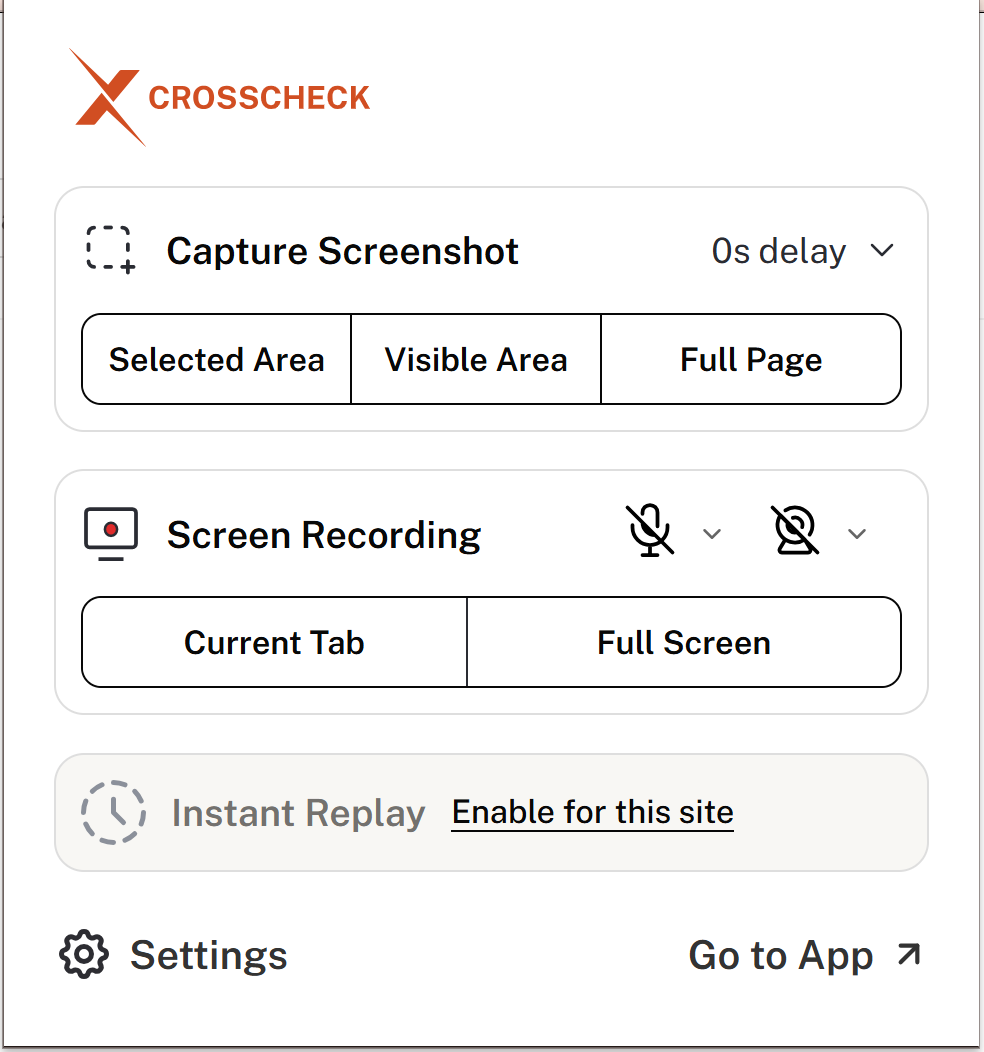
Crosscheck is the free Chrome extension that closes the manual-to-developer handoff inside the regression workflow. It captures screenshots, screen recordings, console logs, and network requests automatically during a manual testing session, then sends a complete bug report straight to Jira, Linear, ClickUp, GitHub, or Slack in one click — no setup, no usage limits.
When a tester finds a regression that the automated suite missed, the report your developer opens has the console error that fired, the failed network request, the exact reproduction path, and the application state at the moment of failure. Same-day fixes replace week-long back-and-forth. The automated suite handles volume. Crosscheck handles the rest.
 Add to Chrome